
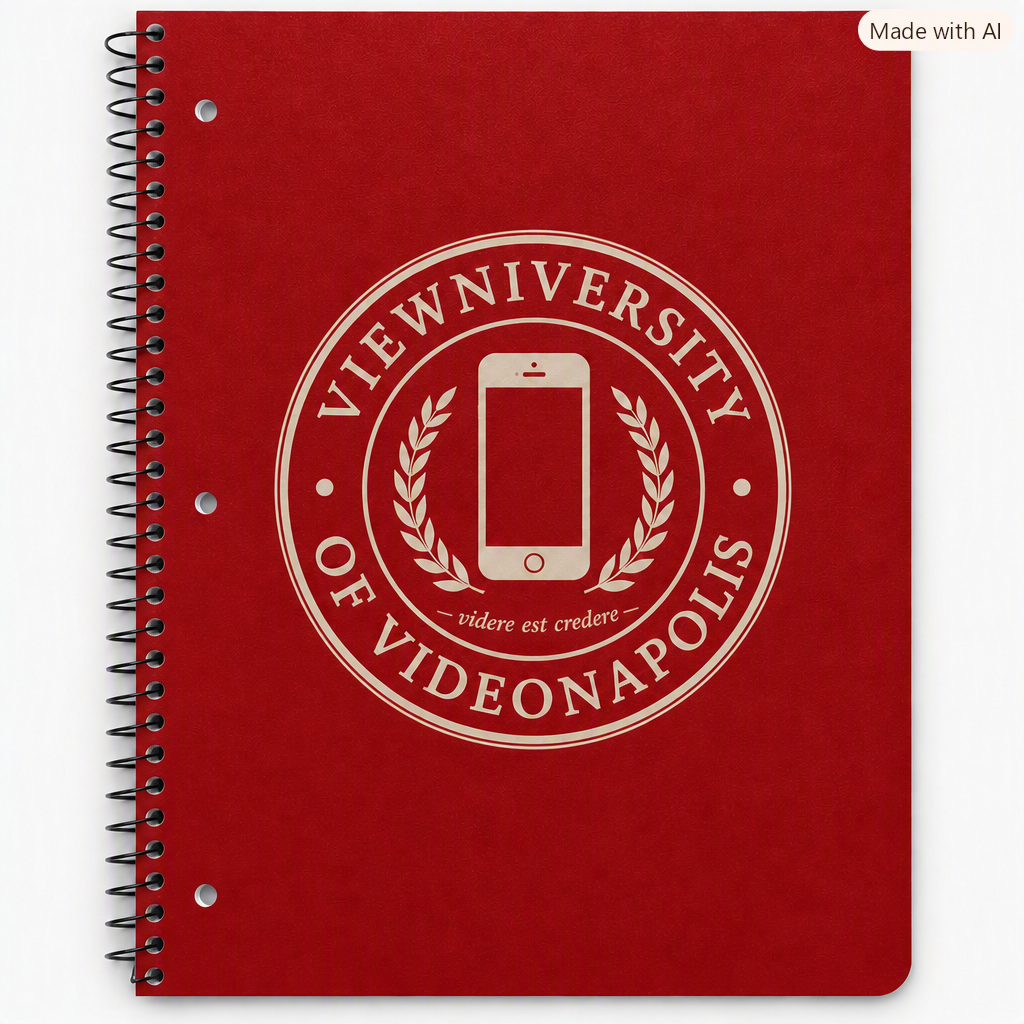
We judge our universities of scholarly renown based partly on complex, published rankings. Today, much of our culture has embraced an alternative center of influential information, and we judge it much more casually—with “likes.”
The academy of hyperlinks called YouTube deserves an assessment more extensive than merely thumbs-up or thumbs-down. For some of us, the tens of billions of videos hosted there make it the last wonder of the modern world, sneaking in among post-modern vanguards. Critics consider it a sprawling, random arcade where loiterers play the game of “down the rabbit hole.”
Wossamotta U
As humanity struggles with stewardship of an ever-messier digital ecology, we ought to ask social and moral questions to contemplate our serious relationship with YouTube.
For example, we hear concerns that the platform, founded in 2005, could be on the brink of suicide. Due to the simulation and manipulation made easier by artificial intelligence, some analysts foresee a “trust-collapse problem” that will worsen society’s disconnection from reality. People won’t know which information is true or fake, so they might deem all YouTube content suspect.
A video multi-versity is admittedly more like a state of mind than a curation of intellectual riches enshrined at brick-and-mortar colleges. YouTube’s virtual “campus” is everywhere and nowhere, with lessons floating in the breeze. We might imagine its main library is hidden in a cloud in Loudon County, Virginia.
The state of mind which too many people bring to YouTube cares less about learning which is centered and directional, and more about impressions and whims.
Couch potatoes can drift along on generic searches or algorithmic currents. The platform is now the most popular app for content on smart TVs, not just for images we swipe on our phones. American viewers consume more than one billion hours of videos per day.
Unlike college curricula, our YouTube streams aren’t designed to distinguish between an expert’s statement of tectonic importance and an amateur’s critique of top-10 Star Trek episodes.
Because about five hundred hours of video are uploaded to YouTube every minute, there’s always more to consume; one might dismiss the value of endpoints in learning—reaching destinations where big questions are addressed and big decisions become possible.
We often choose simply to wander through content, whereas the goal of higher education is to spark wonder, which Socrates called “the beginning of wisdom.”
Tu-be or Not Tu-be
To be fair, YouTube offers this more purposeful and rewarding mode, too. Just one video may suffice to learn how to repair an appliance. On a grander scale, if we approach the platform with deeper ends and means in mind, guided by personal interests and instincts, we can uncover compelling offerings of conversation, music, news, and more.
This is a doorway to wonder. Who among us has not been enriched by a podcaster’s insights into history or worldviews? And who has not been delighted by an alternative rendition of a favorite song which amplifies its genius for fans?
Even better, we can enter a virtuous cycle, choosing to elevate our path of learning. Aided by the same algorithms that suggest “shorts” about cats, a discriminating viewer who’s suddenly intrigued by a topic can bump up the wisdom level with each video picked.
Such growth is a distinctive treasure of YouTube, going to the heart of humanity’s most urgent task: to keep pace with, and make peace with, our future colleagues and competitors—some of which will be made of silicon chips.
Like the Audrey II plant in Little Shop of Horrors, artificial intelligence cries out to its corporate developers to “Feed me!” with more “compute.”
Yes, That Does Compute
But we visitors to YouTube can choose to feed ourselves, deciding the direction and elevation of our own paths. People of faith can base choices on good use of resources received from our Creator.
Although we will continue to gain extraordinary benefits from AI, we also should act deliberately in accord with human responsibilities to a greater good. This means exercising our inner “compute.”
Metaphorically speaking, we need various “data centers” where we connect broadly to reality. A centered life requires resources and power reserves; our fuel includes curiosity and imagination, reason and faith, happiness and hope.
These are clues for relating well with YouTube and committing to the care and feeding of our digital habitat. Whether we seek our resources at the aforementioned colleges of scholarly renown, or via social media and AI, or through other “apps,” we should respect wisdom as the endpoint.
Wisdom comprises embodied consciousness, true knowledge, holistic perspectives, and hunger for greater goods which AI cannot comprehend. While Socrates said this begins with wonder, Aristotle added that this is thoroughly practical, not trivial. Experts on the virtue of practical wisdom, or phronesis, say it helps us find genuine happiness in meaningful relationships and contributions to society.
Judeo-Christian traditions add that the wisdom of humanity, made in the image of God, is uniquely able and responsible to care for the vast reality around us. As part of a supernatural hierarchy, we participate together in God’s own creativity. Our sense of wonder can foster humility, gratitude, community, and communion geared for noble achievements.
Today, we ought to plan to manage each new wave of technology to protect the massive vocation we’ve been given.
Remember that television popularized violence. The internet propagated porn. Social media enraged us in order to engage us. And our growing video culture tells us that “seeing is believing” (videre est credere) even as it erodes that trust by deceiving our senses with AI slop.
Aiming for the Honor Roll
As the stakes get higher, the next several years may bring our ultimate chance to restrain the toxicity of media messages. We should recapture trust by highlighting and honoring the “grandeur of humanity.” That’s the term Pope Leo XIV used this year in his encyclical, Magnifica Humanitas, arguing that AI must be “person-centric.”
What content shall persons shop for in the marketplace of ideas? Shall we whimsically dwell on our “likes”—or pursue more productive “loves,” such as the true, the good, and the beautiful? To which principles, or influencers, shall video viewers “subscribe”?
Melanie Challenger, whose “The Psychosphere” podcast explores humanity and bioethics, wrote this month in an Aeon essay, “We have fallen into habits that are steadily deskilling the human body, eroding capacities honed by evolution to support our wellbeing as we move through the world.”
She warned that we rely too much on devices like mobile phones and AI “to rapidly do work that would once have required something more physical—like looking around, or asking someone, or going to find and consult a book.”
A tech-driven life involves “less sensing, navigating, remembering, walking, choosing, and attending,” Challenger wrote.
Our human wisdom wanes when a machine tells us, “Don’t bother with that. I’ll do it for you.”
Our need to avoid physical laziness extends to the danger of spiritual laziness, according to one AI chatbot offering narrowly defined—but still vast—resources.
At the Platform, Mind the Gap
A research tool called MagisAI, which answers questions based on two millennia of Catholic scholarship, is now being updated by the Jesuit-run Magis Center. Its hyperlinks to primary texts will give each user more content and confidence to evangelize the secular culture.
Asked for an analysis of YouTube’s worth, the Magis site affirms that some videos provide immense insights into minds and hearts, although there’s plenty of shallow and erroneous information, too.
Careless content can damage the sensibilities of individuals and deskill audiences seeking a hierarchy of truth. Magis warns that videos can habituate us to “sensational, emotionally intense, visually stimulating, and ego-centric” messages.
“A morally responsible assessment of YouTube must consider all stakeholders,” the chatbot adds. This imposes an individual duty to pursue justice and hope for: “viewers, especially children; [content] creators; persons depicted in videos; families; schools; churches; communities affected by misinformation; vulnerable people exploited for attention; and society as a whole.”
Therefore, MagisAI concludes, the proper question in any encounter with YouTube is not “How much information did I receive?” but “What kind of person did this viewing help me become?”
With this question in mind, here are some thoughts about putting YouTube in proper perspective during our daily lives.
An On-Site Evaluation
The video multi-versity, though crowded with couch potatoes, is still a fertile field. It has become a unique gathering place, gaining its influence partly from the generous initiative of talented people— those who wish to share their knowledge, their vocations and avocations, and their love of conversation.
A regular visitor will find many well-intentioned influencers to be appealing extroverts, eager to build connections among people, ideas, and institutions from the grassroots.
Notwithstanding numerous creators who may be self-centered or untrustworthy, YouTube provides models of human and humane technology.
There is a real danger that YouTube could be damaged if its corporate managers, presenters, and viewers allow it to fill up with unproductive or malevolent AI slop. Pope Leo XIV has wisely asserted that the dignity of the human person, especially as it’s mirrored in one’s voice and face, should not be toyed with. The already rampant copying (or simulation) of a person’s appearance or speech should be subject to moral scrutiny.
An act of “going public” with inaccurate, untrustworthy content is a sign of laziness which should redouble everyone else’s insistence on quality and substance. Our critical thinking, fact-checking, and healthy skepticism is the best response to the call from MagisAI: to let YouTube form us as better people.
Our whole approach to learning is in danger of drifting toward visual sensations rather than linear, logical clarity. Social media of all sorts replace a love of text with blasts of dopamine, aggressive “hot-take” comments, and polarization of civic debate through propaganda, bots, and bullies.
YouTube should not reduce the time we invest as readers of fiction and nonfiction. The brain learns better and thinks more contextually when we sit down and open a hard-copy book, experts say. Silence and quiet time for reflection strengthen hearts and minds. Before bingeing on a series of videos, consider whether one’s time is better spent reading, writing, or pondering.
Also, the human body and soul naturally receive the most profound and lasting lessons from personal experiences, as Melanie Challenger advises.
People of faith say the capstone of belief in God is a personal relationship with him, leading to community and communion with fellow believers.
Videos cannot replace “touching grass” or appreciating the truth, beauty, and goodness in relationship with the earth. In these cases, “believing is seeing.” A Christmas song recommends this approach: “I wonder as I wander.”
Ideas from a Faculty Advisor
Rather than sliding into YouTube “rabbit holes,” pre-plan your viewing by maximizing your overview of the platform. Clicking “likes” and subscriptions helps makes the algorithms your accomplices. Suggested trending subjects are atop YouTube’s website. Also, “Favorite” and “CreatorDB” offer features that resemble the old TV Guide’s suggestion resources.
In general, seek out presentations by and about a wide spectrum of people with varied viewpoints, from all sorts of locations and backgrounds. YouTube scores well in fulfilling the information-age promise of seeing/hearing directly the presence of lesser-knowns.
Think of the platform as a library you loved to visit, where you enjoyed browsing through the cookbooks, the newspaper racks, the spirituality section, recently published literature, and the vinyl albums of diverse music and comedy. Save favorite episodes as playlists to take home, to share with family, to post online with comments.
Reflect on your YouTube journeys to learn from patterns you see in ideas or developing trends. For this writer, clicking on songs of favorite genres has revealed that a sizeable number of great, sometimes quirky, “recorded-live” presentations are keeping music current and interesting. Human beings are still the best performers.
As an alternative to tune-buying websites, one can watch the “Post-Modern Jukebox” transpose classic songs into a different zeitgeist. Or get up and join in with dynamic stage-shows from the “Grand Jam” series, where up to 1,000 musicians and singers form “the world’s largest band”; they belt out “Dancing Queen” or “Viva la Vida,” reviving the old-fashioned energy of sing-alongs and jam sessions.
Check out the wide array of video journalism. According to data on different career categories, one of the biggest employment losses in any field since the year 2000 has occurred among newsroom reporters. Professionals from broadcasting and print have migrated to “new media” like podcasts and Substack.
Avid followers of countless news subjects can find skilled, informed journalists still “on their beats.” Nowadays, it seems almost any nation or group of people can participate directly in encounters that “scoop” standard news resources or introduce different concerns and histories. The deeper, faster, fairer reportage here is worthy to be a model for today’s journalism-school students.
YouTube Is People!
Of course, in all of these cases where rich harvests beckon, we must be wary of disinformation, misinformation, behind-the-scenes schemes, confirmation bias, and temptations toward irrational extremes. Expressive individualism and “victim vs. victimizer” power struggles taint judgments in various areas of life.
But there are reasons to celebrate, rather than denigrate, YouTube.
Confronting a post-modern, post-truth society where too many machines aim to think like humans and too many humans tend to think like machines, we ought to protect our authentic haven because we really do “like” what it stands for.
YouTube ranks especially high in contrast to grim forecasts for artificial intelligence. It is no coincidence that AI guru Nick Bostrom’s latest book is called Deep Utopia; given vague hopes of superintelligence yielding a “desire-satisfying” world of leisure, will there be no place left to find meaningful struggles, purposeful quests, a sense of value and achievement?
Bostrom’s outlook, discussed on a recent podcast, hints at an AI ethos of competition and control grounded in selfishness and privilege. However, YouTube more closely models community-building on a friendly campus, where people need not feel alone.
AI devices tend to lack humility or receptivity to judgment, while YouTube has an element of, and need for, critiquing, accountability, and constructive entrepreneurship.
The latter hive of activity empowers people’s ceaseless urge to produce things, whereas the bipolar buzz of AI moguls’ promises, doubts, and hypotheticals recalls philosopher Dietrich von Hildebrand’s warning: Beware the mind games of isolated intellectuals trapped in a “cult of cognition.”
AI will need rigorous global coordination, according to Bostrom, but YouTube is more casual and random, for good and ill. While YouTube content might launch human minds into the clouds, some AI executives seem resigned to let mechanical minds wander into danger zones—and even into new functionalities that no one understands.
Advancements in AI are awe-inspiring, but their best-known fruit is fear; YouTube bears fruit that is often joyful, even happy, entertaining a world that craves truth and trust.
At its best, this scenic school of thought, established twenty-one years ago, shows signs of maturity from which we can learn. Its lineage draws upon all the virtues and foibles of human beings. Although it reveals our mediocrity in cultivating wisdom, YouTube is the very picture of wonder we can share.
Let’s benchmark institutions like this which witness to humanity’s destiny for transcendent connectivity. Such settings protect against an alternative state of mind which risks autonomous artificiality.
Image created by Microsoft Co-Pilot designer.


