
After twenty-five years of remembrances spanning many aspects of the 9/11 terror attack at the World Trade Center, the legacy of that day is likely to become less visceral and more virtual. As intense personal emotions fade over time, Americans still will need to buttress our collective response as a society.
We should promise to “never forget” even though, as they say, the spirit is willing and the flesh is weak. Indeed, both the spirit and the flesh are under assault.
The nation has memorial venues and ceremonies (at the Pentagon and Shanksville, PA, as well as New York) which will deter our forgetfulness. We still feel moved to show respect for the victims, the heroes, and the country we lifted up to God during the tragedy in 2001. Our key mission now is to help younger generations grasp enduring duties of security, solidarity, and civic wisdom which won’t go away.
We ought not allow our 9/11 storytelling to be numbed in the way that memories fail on the Fourth of July and Memorial Day. Not only should we go beyond mere vacationing and spectating on such days, but we must rise together to the “big picture” challenges we’ve ushered in with the 21st century.
This means embracing our individual roles as moral agents who utilize all of humanity’s unique gifts, some as basic as the five senses, to energize each other. Persons are called to pursue transcendent truth and to “keep things real” for everyone to share. This passion must override mundane thoughtlessness, not to mention lazy imaginations and artificial intelligence.
The Two Towers
The story of my own experiences twenty-five years ago, a few blocks away from Ground Zero, is one of immersion in reality. It begins with my seeing and hearing the first tower’s explosion, and it extends into the grim, anxious march of thousands toward oases like midtown Manhattan. We downtown refugees walked through a “nuclear winter” scene shrouded in skyscraper ashes.
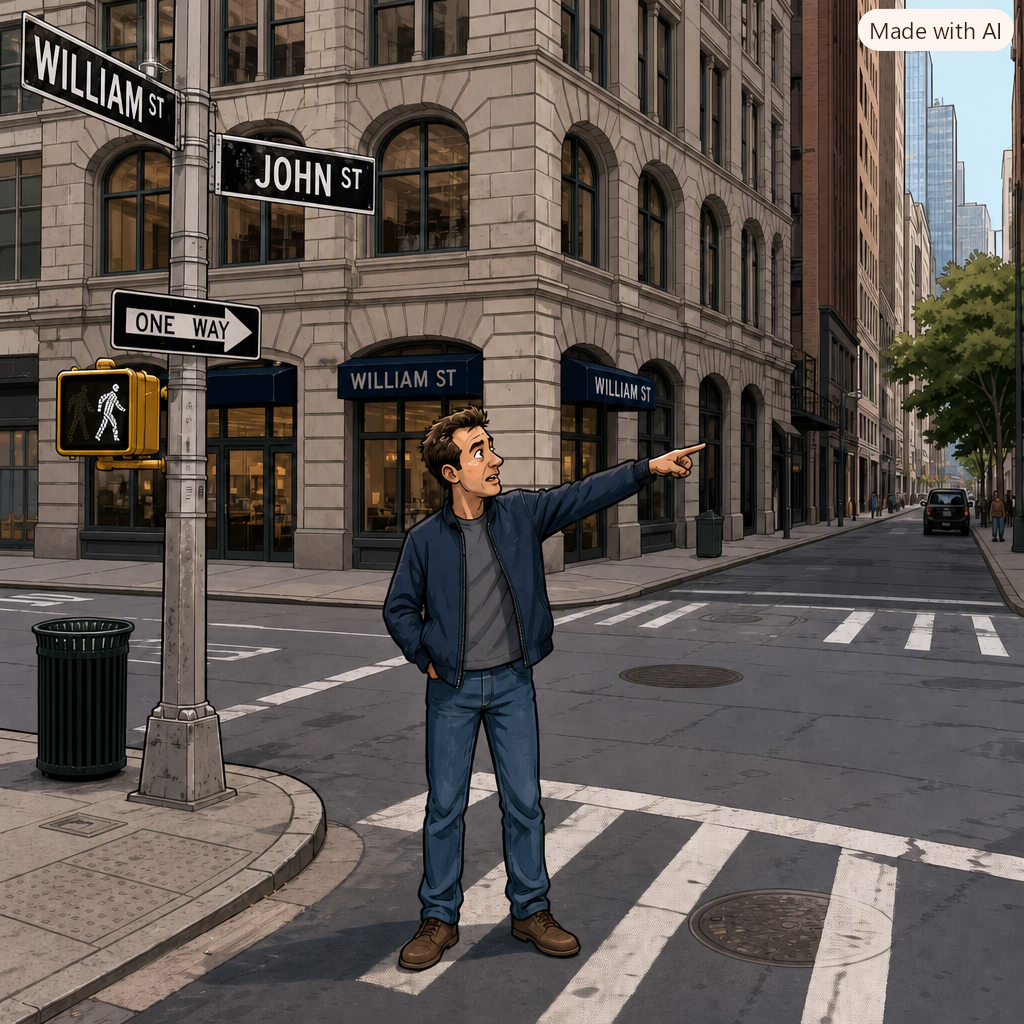
My recollections also span multiple months which followed as I commuted to, and meandered around, my office building at the corner of William and John Streets.
I seldom retell the tales without noting one particularly vivid sensation: The whole downtown area stank to high heaven.
An olfactory demon hovered over the area, haunting workplaces and streets. It penetrated into subway stations to stalk crowds on their errands.
The stench besieged heroic responders and crews perpetually digging into WTC debris, seeing and inhaling the worst horrors up-close. Fetid air also surrounded local residents, plus suburbanites who returned to the vicinity after the “all-clear” was sounded—by official or unofficial consensus—via TV and e-mails.
I don’t recall making a major effort to analyze the smell, nor did daily conversations with my fellow wanderers broach the subject. This reflected a New York-style stoicism based on the adage, “It is what it is.”
When I asked an AI chatbot recently to find old recollections from eyewitnesses at the scene, I learned that the New York Fire Department deputy chief had cited “the smell of burnt flesh.”
In an oral history entry from the Library of Congress, an NYPD officer spoke of “encountering a pervasive, unforgettable odor” that “stays with her to this day.”
The bot, which was admirably up to date, pointed me toward more than 1,700 historical documents the city had released on Sept. 8, 2026, revealing tallies of air quality measured over time. Official files reportedly discussed “the persistent toxic smell … an odor of asbestos, pulverized concrete, chemicals, and burning materials that lingered for months.”
When I watched a video of the press conference announcing this new download of data—an announcement long-delayed by legal battles during four mayoral administrations—I heard no one stressing the urgency embodied in the smells of 9/11. Instead, lawyers and government leaders focused on quantitative, not qualitative, findings.
Reporters wanted to tell this story through the lens of documentary evidence and blame-game victories regarding human health impacts. This was important, objective information, but it was an online sampler of statistics, not the stuff of storytelling. Little work went into “humanizing” the history.
A Nose for News?
The lapse in scent-awareness at the September 8 event was nothing new, according to Google’s AI. When I asked why individuals’ impressions of the air went relatively unreported during the 2001 crisis itself, the computer gave several reasons. For one thing, even the best reporting teams couldn’t capture every detail of that crazy day.
The news understandably was dominated by awesome impacts of sight and sound—from plane crashes to the screams and sirens accompanying those harmed and those helping. Broadcasters zeroed in on these sensations.
Google’s resources prompted me to consider the indispensable stories, including great literature, which grab us by interweaving such details as smell, touch, and taste, as well as those senses preferred by today’s media. I realized that, without focusing unduly on the visible world, serious learning should take note of everything that is “in our faces,” imparting meaning to human beings.
My AI tool reported “there was pressure to reassure New Yorkers that downtown air was safe,” leading environmental experts to downplay “chemical danger and governmental failure.” Officials wanted to portray American resilience at the hubs of financial and military power.
Whether Google’s assessment of the 9/11 messaging is right or wrong, it need not trigger entirely new debates about timing or tactics. It’s mostly a reminder for us to pay attention to a full spectrum of observations, public or private. Each of us ought to be a detective, taking nothing for granted, wanting to “see for myself” what is happening and why, allowing follow-up discussions for the common good.
One important takeaway lesson from the past twenty-five years is the need for human beings to transcend easily computed summations of history, pooled assumptions about values, and gray spreadsheets of statistics. As human storytellers, we must be nudged to use our superpowers of consciousness, feeding body and soul. We ought to prowl for “primary sources” which crystallize existential and moral connections we can’t dismiss.
Highly Sensitive to AI
Journalist and screenwriter Walter Kirn commented in a recent video interview that people nowadays are reducing their ties to reality as we lose our zeal for intimate, expansive, humanistic inquiry. Trends in society and media pander to a shorter attention span, a mass-market taste for easy solutions and shallow knowledge.
“We are seduced into a kind of corporate version of reality that is false, artificial, lonesome—very lonely—that we think will flatter the ego,” he told interviewer Renaud Beauchard. “The ego is being led down a path, and the body is being left behind.”
Signaling a shift from profound storytelling to quick narrative bites and utilitarian factoids, Kirn warned, “The senses, the spirit, and all the other things that make us human are being sacrificed for these little treats, these little appetizers to the ego.”
This led Kirn to criticisms of artificial intelligence as the villain du jour in the drama, especially when AI itself “authors” the information we consume. “Why do we want to read literature written by a machine that has never loved … never experienced the cold or the heat?
“Once we start training our own minds on [AI], once its products become our guides to life, then we are in a perverse, and I think catastrophic, situation,” he continued. Artificial intelligence “is a machine that has never been to the places we live in or have to go … in physical reality, in spiritual and intellectual reality.”
Kirn was echoing a prescient quote from journalist Sydney L. Harris who wrote in the mid-20th century, “The real danger is not that computers will begin to think like men, but that men will begin to think like computers.”
One hopes that America’s collective or electronically mediated remembrances of 9/11 will never take on the sterile, formulaic traits of AI. But Kirn’s biggest worry is that experience will lose its immediacy if we settle for the lure of clickbait and outsourced interpretation:
“We’re going to stop telling our own stories because this thing [AI] has replaced it…. So, we will stop being creative in the traditional way. We will stop observing our own situation. We will stop inspecting our own emotions. We will stop respecting our own experience in favor of a false god.”
Note that the parables of Jesus in the Bible occurred to him and stirred his followers because his incarnation brought him directly into the details of earthly life. As God and man, his teaching was scintillating and on point.
Imagine That!
Kirn’s warning of creativity at risk in a world of routinized, atomized thought leads us to a key finding in the Final Report of the National Commission on Terrorist Attacks Upon the United States (“The 9/11 Commission Report”), published in 2004.
Its executive summary says the awful occurrences of that day resulted from “a failure of policy, management, capability, and—above all—a failure of imagination.”
That verdict can be read as a call to nurture the virtue of practical wisdom. It keeps us alert to the moral assignments clustering in everyday life. Prior to the terror incident in 2001, some defense and intelligence experts had failed to see (or report) patterns in the actions among foreign adversaries. And they were unable to foresee that new, more fearsome attack strategies might be in preparation.
Humanity must recognize the danger of “creative” minds delinked from the ultimate initiatives and intentions of the divine—God’s ability to “make things new.” He gives grace not to lone wolves, but to creatures who adopt humility and openness to true enlightenment.
Kirn’s warning about a “false god” does not apply only to artificial reality. Deceit can reign supreme when ideological or self-centered imagination opts to rely on the cognition of someone or something else.
Both the producers and consumers of this information-without-formation may trap themselves in the echo chamber of confirmation bias, where propaganda and groupthink rule; they are likely to be disinterested in such reference points as God and persons blessed with dignity and free will.
The alternative to this isolated life is the virtue of practical wisdom (Aristotle’s phronesis). It is fine-tuned to the common good and receptive to the senses and sensibilities where reality, beautiful or distressing, is ingested.
This practice can break through to discover different, surprising connections among people and conditions. This watchfulness allows life-saving reflection: Some patterns we see forming will set off alarm bells, while others will open doors to foresight and constructive cooperation.
Seeing is Believing, and Vice Versa
In good or bad times, practical wisdom can teach those grounded in truth how to stay secure. The advice might be secular or spiritually enhanced by Judeo-Christian insights. The latter case yields a perfected motto of human alertness: “If you see something, pray something.”
Are miracles possible? The near-calamity on a Flydubai flight headed to Israel on September 30—an incident promptly investigated as possible terrorism—suggested that awake, capable, and caring people can respond to crises with heroic action and transformative results. The classic story of flight United 93 above Shanksville foreshadowed this inspiring theme. These lessons deserve to be remembered.
The best news about recent remembrances of 9/11 is that Americans still strive to answer the need for more diligent, effective imagination. On September 10, 2026, the U.S. House Committee on Homeland Security issued its 25tth anniversary report, titled National Security Improvements and the Domestic Threat Landscape 25 Years After 9/11/01.
The 112-page document, following up on the aforementioned 2004 commission report, came from people determined to continue the discernment, to generate hopeful but cautionary advice we should apply.
As relayed by Microsoft Bing AI, the new assessment says: “While the U.S. has made major advances in counterterrorism, intelligence coordination, and emergency preparedness since 9/11, new threat vectors—especially domestic extremism, cyberattacks, and AI-enabled operations—now pose the most urgent risks, and several original 9/11 Commission recommendations remain only partially fulfilled.”
There is clearly much more preparedness to be achieved—a fact affirming that Americans must “keep things real” in their minds and spirits. A love of wisdom, delivered on demand, will keep us in motion.
In spite of the distractions and divisions bound to emerge from artificial technologies and manipulative fakery, young adults need to retain the instinct to turn 9/11 remembrance into ongoing responsiveness.
The task remaining for all Americans, if we remember, is to exchange authentic, timeless recollections about deeply felt fear and favor, about taking things for granted but then waking up. These microcosms of reality will make us glad we’re distinct from algorithmic machines.
AI follows patterns—and, please God, someone’s orders!—on its way to an assigned end. We must learn that, when all is said and done, we humans follow a lamp unto our feet. (Psalm 119: 105) Our orders are broader and bolder. We must follow our senses and good sense. They should always be online because only detectives armed with truth and trust will avoid missteps into empty, contrived experience.
Our civic calendars will bring back memories of 9/11; then, our memories will help us to progress from one anniversary to the next. If we are teachers and learners with a nose for what’s new, our responses to crisis will be fleshed-out, not dumbed-down. Imaginations connected to God and humanity will improve our problem-solving with every breath we take.
Image created with Microsoft Bing’s AI Co-Pilot designer.


