Human for the Holidays—A Gift that Keeps on Giving

The Little Drummer Boy learned that Christmastime gift-giving is more personal than material. By honoring Jesus as a newborn in the manger, the boy’s “pa-rum-pum-pum” song has encouraged generations to offer ourselves up—as presents truly “fit to give the King.”

Ideally, our offerings will convey not only something unique to the individual, such as the gift of music, but also a God-given attribute worth sharing with others at this moment in history.

We can be inspired by the tune’s lyrics describing an immaterial but profound Christmas offering which made Mary nod, Jesus smile, and the young drummer endure as a holiday icon. His special present, and ours, can be a timely and timeless promise that brings God and man together.

The tribute to bestow is simply an affirmation of our humanity. Consider this an ongoing pledge of intimacy and solidarity, recalling the incarnational joy found throughout the Scriptures: “Behold, God’s dwelling is with the human race. He will dwell with them, and they will be his people.” (Revelation 21:3)

The gift is well-suited to these days when our essential nature faces a crucial encounter with artificial intelligence. We’re battling immersive artificiality and dumbed-down intelligence, forces which tend to divide the divine and the temporal.

Novelist and commentator Walter Kirn voiced this secular state of urgency in an America This Week podcast after citing recent headlines about outbreaks of violence and hatred. “There’s a real weakening of the human self going on,” he observed.

More hopeful news for humanity has made headlines. It emerged from the corporate world of communications and marketing. Thanks to a decision about branding, your favorite radio station or podcast may have started repeating its own pledge this month. You’ll notice it as a boldly stated slogan: “Guaranteed Human.”

As Editor and Publisher reported on Nov. 26, “iHeart Media is doubling down on its positioning as one of the last ‘truly human’ mass-reach entertainment platforms” amid a “media landscape increasingly shaped by AI.”

iHeart, the world’s largest podcast publisher and owner of more than eight hundred radio outlets, has made “Guaranteed Human” an official part of its identity—restated during those top-of-the-hour station identifications which are legally required in broadcasting.

An executive told Editor and Publisher that iHeart’s platforms now promise they will not use AI-generated personalities. Nor will they play AI music featuring synthetic voices which mimic humans. Podcast hosts will all be human beings, too.

Of course, it’s possible that AI will creep in through commercial sponsors. Some news and other content may be written using the technology. Behind-the-scenes decision makers may still garner advice from task-specific “AI agents” analyzing their business.

Nevertheless, we’re told this basic “guarantee” has sent other media leaders and music producers scrambling. They must match or counter iHeart’s new doctrine, a preferential option for the human.

Most noteworthy is the awareness that a promise to “be real” is suddenly necessary. The company was smart to realize its challenge: Podcasts and radio programs are valued companions for countless people, and the content is known to provide crucial, trusted links within geographical areas or communities of interest.

The media giant also did revelatory research to support its statement. An iHeart memo reported by Inside Radio included these findings:

  • Among listeners, 90 percent want their media created by real humans, although 70 percent acknowledge using AI. Also, 92 percent say nothing can replace human connection, up from 76 percent in 2016.
  • Nine in ten respondents said AI cannot replicate human trust.
  • Three-quarters expect AI will complicate their lives, and 82 percent worry about the impact on society. Two-thirds fear that AI might someday go to war with humanity.

These are clear reasons not only to salute iHeart Media’s wisdom, but to consider how we audience members might adopt the same “Guaranteed Human” label. “Merch” touting this statement didn’t come out in time for Christmas, but it seems inevitable.

Imagine wearing a “Guaranteed Human” tee-shirt to the nativity scene in Bethlehem. This presentation is relevant not only to the Christmas story, but to the message of the introductory season calledd Advent; that annual prelude prepares Christians for a historical event (when a divine person took on a human nature) as well as a future event (when Christ will come again).

Perhaps the first supernatural reaction to our tee shirts in either setting would be a smile. A heavenly voice might say, “Your pro-human logo is clever and laudable. But have you considered all the ramifications of the guarantee?”

This inquiry prompts us to ponder what the statement of identity means. We are part of a species (homo sapiens) upon which God has bestowed immense dignity, entailing rights and responsibilities. When faced with such terms of endearment, how should we comply?

This is not a question that secular culture prepares us to answer, or even to ask.

The drummer boy passed his first compliance review with no problem, no wordy report. We assume that a demonstration of humanity, if we take it seriously, implies lifelong endeavors to discern and heed the guarantee’s content.

Assistance for our future compliance comes from the Magis Center, a Jesuit-run institute for Catholic catechesis based on rational and science-based evidence. Ironically, as of 2025, research into human nature is aided by the center’s “magisAI,” an authoritative chatbot which instructs, rather than panders.

Its database, informed by two thousand years of Christian teaching, assures us that people don’t need to avoid AI completely. When circumstances warrant, it makes sense to use artificial intelligence as a tool to turbo-charge our learning.

Our first question for the chatbot explores the belief that God made humans unique because of our immortal souls. Asked about this, Magis says, “The soul, in philosophical and theological terms, can be understood as the immaterial organizing principle of a living being.”

A soul “actualizes and directs its matter (body) toward life and its specific activities or ends,” according to magisAI. These ends would include nourishment and growth (in the case of plants), plus self-movement and sensation (in the case of animals), plus intellect and will (in the special case of human persons).

The human soul organizes the body’s physical processes toward powers that are ours alone—“rationality, intellectual knowledge, and self-consciousness.” We see relationships among ideas, so we have the capacity for reflection, abstract intelligence, and free will.

We can express complex concepts, even universal thoughts, with sophisticated language, Magis continues. Unlike other animals, we have a conscience. We are open to impulses of the ego, but also to choices between good and evil. Ensouled persons can gain knowledge of God and moral law. In lieu of these essential qualities, we would be “merely physical machines without true freedom, moral responsibility, or the capacity for higher spiritual experience.”

AI technology is indeed a “physical machine” lacking access to, or interest in, a relationship with the divine. Jesus came to earth not to launch us toward materialistic transhumanism, but to bestow an intimate, salvific God-man connection, as taught in the Gospel. (John 3:16)

Even though some tech gurus think we’re on the way to an “artificial super-intelligence” which mimics a god, humans have the distinct advantage of being made in God’s image and likeness.

Let’s proceed to ask, “What are the crucial qualities of being a human?” Here, magisAI offers insights into how persons shall put our guaranteed humanity into action. One excellent purpose is spreading the Gospel message to a secular culture which hungers for the transcendent.

Our essential nature and consciousness are rooted in what philosophers and theologians have called “transcendentals,” Magis explains. Humans “uniquely possess an awareness of and desire for” five things: truth, love, goodness (justice), beauty, and a sense of being at home. What’s more, we want to experience these in their perfect totality, not just in occasional samplings.

“This awareness drives humans to seek limitless horizons and fulfillment beyond what is algorithmically and materially determined, indicating … a spiritual dimension to human nature,” says Magis. The impetus toward higher, fuller reality yields rich bonuses in our lives; our yearning gives us a knack for wonder, contemplation, creativity, and imagination.

Meanwhile, our dignity provides the crucial groundwork for human rights and ethical principles. Persons deserve respect and protection in our pursuit of the transcendentals, regardless of individual abilities or characteristics.

All these insights combine to imply this: When we assure others that we are committed to being human—increasingly in contrast to being mere copycats of artificial intelligence, inauthenticity, and chaos—we are making a profound promise.

Just as iHeart Radio’s surveys discovered, AI promises us many amazing gifts, but we still feel a desperate need for the empowerment of companions who agree that “we’re all in this together.”

It sounds like full compliance with “Guaranteed Human” could be nearly impossible not only among iHeart’s broadcasters and audiences, but throughout society.

However, we need not be discouraged by the work ahead of us.

One hopeful way to keep humanity in the holidays—and in our earthly future—is to foster continuous remembrance of, even celebration of, the plentiful joys and capabilities of homo sapiens.

We can return to marveling at the record of civilization-building, the long historical arc of innovations which have improved material circumstances, and the enrichment of providential and scientific collaborations pursuing truth, beauty, and goodness. On the micro level, we can recollect and retell our many experiences of individuals’ qualities, big or small, which transform lives.

Of course, humans will often be on the defensive when declaring inherent worth. Those who doubt our dignity will stress all sorts of past and present missteps, the role of free will in causing great misery, and our failure to live up to the potential of faith or reason. Nihilists and utopians will portray humanity as a flaw, not a feature, in the march of progress.

We do need to cultivate bold, wise leadership in such fields as governance, religion, and education (the humanities, liberal arts, and sciences) to help liberate us from self-centeredness and thoughtlessness. The goal is to grow in forgiveness and humility, trustful discourse and critical thinking, so we can advance our compatibility with God and each other.

Families, friendships, and soulful communities will help us to share compelling, surprising stories about the material and immaterial gifts we’ve received in good times or bad. At its worst, artificial intelligence pretends to weave personal stories which are merely billions of stolen narratives rejiggered according to patterns, not priorities.

Catholic News Agency reported on Dec. 25 that the patriarch of Jerusalem urged drawing hope from the story of Christ’s activity in the past, present, and future. In his homily at the Christmas Eve Mass celebrated in Bethlehem, the cardinal said God “does not wait for history to improve before entering into it” but rather embraces all of human reality.

That’s why the Little Drummer Boy is a story of “guaranteed humanity” we should preserve. When we stagger from the apparent complexity of all the potential good and evil, excellence and imperfection of humanity, our souls call us to be models for holding true to our essential kinship with God.

The boy in the song responded authentically to life’s possibilities, answering a call to reach out beyond himself with the resources a poor child had at hand. He knew he could be an instrument of dignity—one beat at a time.

Whenever we’re asked whether we know who we are and what we’re destined to do, we can reply with something vain and artificial—like technological prowess—or something simple, real, and glorious.

We’ll experience many more ramifications of humanity between this Christmas season and Advent’s final promise. But our souls can find peace because we’re always just beginning, and God is always renewing persons in his nature and ours. Each step, one beat at a time, is a chance to generously reassert our intention, or “brand identity.” This present, bestowed in each present moment, is a worthy, thoughtful rebuke to a secular world that programs itself for temporary gains at a fierce tempo.

Our most basic instincts for life’s enduring, important relationships will keep us pointed toward the transcendent, not the transhuman. The former comes with a much better guarantee.

Image from Microsoft Bing’s AI Co-Pilot. Blessings of the Christmas season to all my friends reading “Phronesis in Pieces” and OnWord.net!

Posted in Education, Spirit of communication | Leave a comment

Pray Me a Memory … Sad, Sweet, and I Knew it Complete

When Eileen and I attended a Thanksgiving prayer service at Our Lady of Victory Parish in Troy, NY, on the evening of Sunday, Nov. 23, I sampled food for thought that I’m still digesting. It was so abundant, I want to share it now.

The rabbi of a local temple led our extended assembly—members of congregations not only from Catholicism and Judaism, but also from area Episcopalian and Methodist churches—in praying Psalm 146. It begins and ends with the word “Hallelujah,” or “Praise the Lord,” and it thanks God for his trustworthy love.

In call-and-response fashion, Rabbi Robert Kasman intoned the psalm in Hebrew and invited us to sing along with choruses of hallelujahs. When he began the first passage, the notes which I had expected to sound esoteric instead rang true in my memory. The music for each chorus was particularly familiar.

Everyone repeated that sequence of hallelujahs with full voice, whether or not we knew its origin. The rabbi later explained to me that he had adapted the entire psalm as new words for “Hallelujah,” the magnum opus of Leonard Cohen (1934-2016). The song was released forty-one years ago.

After two decades of various “cover version” performances, the somberly hypnotic piece was ranked #259 on Rolling Stone magazine’s “500 Greatest Songs of All Time.” As noted in Wikipedia, “Hallelujah” also reached a new generation via the 2001 film, Shrek.

Thanks to YouTube, we can see and hear Cohen’s performance in London, with the captioned lyrics being especially useful for the analysis that follows. In addition, listen to Rabbi Kasman musical ministry, recorded live at Our Lady of Victory, starting around the 4:10 mark here.

Before Sunday’s interfaith service, I had greeted the song with mixed feelings and ignorance. But I’ve learned more from that powerful prayer meeting, plus my admittedly incomplete research.

Cohen took years to compose “Hallelujah”—including about eighty alternative verses, hyperlinks to snapshots of life. From these, several verses have been standardized for performance. Apart from his personal theological and rhetorical choices, one finds his spiritual and musical diligence in every scene.

In the first verse, he refers to David’s own psalm-writing efforts. One can imagine that, composing music on a lute of his time, called a kinnor, and using the string tones he had available, the “baffled king” sought a chord that exceeded the lute’s limitations.

Metaphorically, this “secret chord” might have been a seventh chord, comments podcaster James Hargreaves. Songwriters will tell you the sound of the seventh directs our mood upward, toward some higher resolution; it’s a ”major lift” in contrast to any “minor” chord, which takes a sad song and makes it sadder.

Now I’ve heard there was a secret chord
That David played and it pleased the Lord

But you don’t really care for music, do ya?
It goes like this: the fourth, the fifth,
The minor fall, the major lift

The baffled king composing “Hallelujah” – Leonard Cohen

That’s my interpretation based on insights from video sages such as “the Pop Song Professor” and “Lot of Meaning,” as well as Hargreaves—and Cohen himself. The composer spoke about the significance in bits and pieces, waxing either spiritual or secular, referencing the mundane and mysterious.

He presented King David as a providentially chosen man with “issues.” This held lessons for an errant searcher like Cohen, who was troubled by our wounded world—what he called this “vale of tears.” I didn’t hear mentions of Job, but perhaps Cohen struggled similarly to understand good and bad news.

The best response was to keep praising God, or at least to display the poignancy of offering up our various exploits; the saintly and the weak, you might say, all crave a secret chord, or a “secret cord,“ to higher meaning, Hargreaves observes.

He points to the Old Testament passage telling us the bond of love between a man and woman is durable if God is the third party in the relationship: “Where one alone may be overcome, two together can resist. A three-ply cord is not easily broken.” (Ecclesiastes 4:12)

Cohen’s “Hallelujah” lyrics evoke more dissonant possibilities in the search for love. But he recognizes humanity’s hunger for that stronger cord. While Judeo-Christian thought leads Catholics and others to use “Alleluia” as a shout of unsullied glory and joy in our liturgies, Cohen’s personal approach to “Hallelujah” includes a touch of lamentation.

This important ingredient in many other psalms is described as grief, anguish, or spiritual desolation, but even those “psalms of lament” conclude with affirmations of hope in God.

That is the takeaway that nourishes my reflections on this Thanksgiving. These days, we are especially aware of the different worldviews, experiences, moods, and needs clustered around the table for a family celebration. No single snapshot of our secularized culture can inspire a Norman Rockwell portrayal of total happiness.

Of course, expressing gratitude has never been a simple matter. When President Abraham Lincoln, on Oct. 3, 1863, proclaimed a national “Day of Thanksgiving and Praise” to bring people together in the middle of the Civil War, his sermon-like text began by counting the nation’s blessings, such as “fruitful fields and healthful skies,” as well as the Union’s economic resilience.

“No human counsel hath devised, nor hath any mortal hand worked out these great things,” Lincoln said, with a segue to lamentation. “They are the gracious gifts of the Most High God, who, while dealing with us in anger for our sins, hath nevertheless remembered mercy. It has seemed to me fit and proper that they should be solemnly, reverently, and gratefully acknowledged as with one heart and one voice by the whole American people.”

Lincoln added that those giving thanks should, “with humble penitence for our national perverseness and disobedience, commend to His tender care all those who have become widows, orphans, mourners, or sufferers in the lamentable civil strife….” Americans should “fervently implore the interposition of the Almighty hand to heal the wounds of the nation, and to restore it, as soon as may be consistent with the Divine purposes, to the full enjoyment of peace, harmony, tranquility….”

Gratitude was portrayed not as merely joyous emotion, but rather as a practice, a duty, a resource for wellness, and a transformative habit of the heart.

I am now more inclined to think of Thanksgiving as an Alleluia of joy and a Hallelujah of healing.

In the spirit of Psalm 146, the Hallelujah expresses a community’s trust in the God who brings justice, who “raises up those who are bowed down,” who “protects the resident alien” and “comes to the aid of the orphan and the widow.”

In the spirit of Leonard Cohen’s sung scenarios, it helps to look at all the individuals bringing what they can to this feast, whether their message is awe-filled gratitude or painful bitterness. Many come with wounds they’ve inflicted on themselves and others. The healing must go deeper, beginning with shared trust, then extending to accompaniment on a journey that stretches far beyond this Thursday

Our world has served up an era of dissonance, alienation, and uneasiness, even hints of civil unrest. Thanksgiving has never been more important as a day to join together, to take in lots of interpretations and insights about how our loved ones, and strangers, are coping.

One major duty, as always, is to glorify God for abundant blessings. We’ll remind each other of the bonds of love still widespread in the land, even though they sometimes seem like a “secret cord.”

This awareness from many perspectives, much like the diverse revelations of love shared at Troy’s interfaith prayer service, can encourage us to go forth to share the reason for our hope. Thankfully, fellowship also helps us to “find rest”—spiritual tryptophan before the turkey—so we’re ready for the task ahead.

The second, inseparable duty, which President Lincoln voiced amid actual civil war, is to marshal an extra sense of penitence, humility, dependence, and compassion which will place us in right relationship with everyone around our collective Thanksgiving tables.

We must develop abundant ways to say, “We’re all in this together,” securing the three-ply cord that makes gratitude a gift to God, to ourselves, and to others.

The ongoing communication that results, perhaps finding meaning at the crossroads of lamentation and faith with seekers like Leonard Cohen, can shed light on our respective, imperfect hallelujahs. That might give everyone a “major lift” and even get us singing songs we know in our souls.

Image from Microsoft Bing’s AI Co-Pilot.

Happy Thanksgiving to all friends and readers of “Phronesis in Pieces” and OnWord.net.

Posted in Education, Spirit of communication, Words | Leave a comment

Overton at the Window: ‘Open Wide’ and ‘Look Out’!

The Overton Window, a tool for mapping public opinion, has helped to describe our evolving society since the 1990s. But in the past ten years or so, American discourse has gone off on more tangents, and people’s perspectives occupy a wider vista, hard to cram inside one frame of reference.

If we want to live not claustrophobically, but comfortably in a room with a view, our modern-day blueprint for community and communication must include windows where truth receives our full attention.

Political scientists, journalists, and pollsters have adopted Joseph Overton’s dynamic model, explicitly or implicitly, to assess which policy options reside safely in a middle ground of general acceptance. They also study the timelines along which notions in some categories lose momentum and other previously minimized ideas gain traction.

Their gamesmanship, using basic buzzwords like “inflation” and ”crime,” clearly requires a reality check from the more customized outlooks of people’s grass-roots lives. Otherwise, given America’s growing diversity, the torrent of cultural change, and algorithms which enrage or distract us, those claiming to “know it all” will discover blind spots in their master Window and will misinterpret nuances which plain folks just feel in their bones.

During the George Floyd protests of 2020, Gwen Walz offered news audiences a metaphorical, yet tangible, glimpse of how individual perspectives might clash with the mass-media “Over-view.” 

The wife of Minnesota’s governor—namely Tim, who became the Democratic Party’s candidate for U.S. vice president four years later—gave an interview describing her real-time thoughts during the Minneapolis riots. Critics had said those nights of mayhem proved the governor too soft on crime.

“I could smell the burning tires, and that was a very real thing,” Gwen Walz said. “And I kept the windows open as long as I could because I felt like that was such a touchstone of what was happening.”

The cadre of opponents weaponized that quotation during the 2024 campaign. One critic, Matt Walsh, hyperbolized, “Tim Walz’s wife sat by the window enjoying the smell of poor neighborhoods burning during the Floyd riots. She did everything but pull out a fiddle.”

Hardball tactics and confirmation bias teamed up to deride Walz’s comment, which admittedly placed emotion above clarity at that moment. But this should have reminded us that countless windows are always open for souls to absorb various impressions. While analysts expect the Overton model to be nudged along gradually by large-scale exchanges of facts and persuasion, the Walz brouhaha entailed pondering the causes individuals adopt. We can assume the smells at the window struck Walz with imagery linking past racial-justice disputes to the new “summer of love,” although not everyone caught the scent.

This suggests that stewards of democracy should explore people’s inner realities and visceral reactions more imaginatively. We can connect the “public issues” at work in our politics to worldviews which human beings carry in their reason and emotions.

We saw this in 2022 when various pundits predicted a “red wave” in the nationwide mid-term elections. They cited polls to argue that, due to the Biden administration’s unpopularity, issues like “immigration” guaranteed Republican victories in state races for governors and members of the U.S. Congress. This prediction conformed to the conventional wisdom, as Politico explained, that the first mid-term cycle after one party has captured the White House usually brings triumphs to the opposing party.

But Americans also needed to take this into account: In June 2022, the U.S. Supreme Court had handed down the Dobbs decision, which ended the federal constitutional right to an abortion, giving authority to states. Many incensed individuals believed women had lost a fundamental freedom.

Thus, the elections were surprising. Amid concerns about discrimination, voters in critical states ranked abortion as their most important issue. Even though Republicans won races in some locales, “the red wave never arrived,” Politico reported.

Fast-forward now to Election Day 2025. Polling firms once again faced difficulties, not so much in predicting the winners in places like New Jersey, Virginia, and New York City, but in foreseeing the size of Democratic Party victory margins.

The issue of “affordability” jumped to prominence, although many voters defined it in locally specific ways—access to housing in New York and high property taxes in New Jersey, for example. Other machinations and motivations were at play, too. We discovered that reports of candidates’ character flaws drew mixed reactions, and partisan loyalty sometimes took a back seat to practical or passionate tactics which brought people to the polls.

We have emerged with affordability solidly positioned as an Overton Window buzzword, although its full meaning has yet to be crystallized.

Is it simply a more dire, intense substitute for “inflation”? Or is it evidence that one-word labels can hardly contain the complexity of experiences and influences?

President Trump, in early responses to Nov. 4, seemed to argue that lower gas and egg prices proved he had already delivered affordability. He did marshal add-on announcements, such as promising to cut the cost of weight-loss drugs, but he still derided the idea as nouveau-inflation, a winning issue for him in 2024.

Alas, the nimble buzzword can cover many travails people see in their windows. It has immediate impact, seen burdening families who must make ends meet each week—especially when federal paychecks and programs were suspended. It is also long-term, affecting millions who want to buy a house or simply to access housing, to buy and insure a car, to invest in higher education, or to save for retirement.

Many suddenly associate affordability with paying for “health care” writ large, in light of Obamacare exigencies. This concern is a storm gathering rapidly in the Overton Window, probably foretelling political tumult which pundits didn’t see coming on Election Day.

The buzzword of “crime” is likewise a catch-all now grown into a bigger constellation of problems. Officials may placate voters with reductions in homicide statistics, but plenty of frustrated folks see a more profound, comprehensive picture of law and order, drugs and homelessness, political killings, and all types of violent behavior, even extreme rhetoric. Within this broad category, large groups fear an unfair justice system, as well as “kings” threatening democracy. People choosing policy options differ on whether current conditions justify getting tougher on crime or empathetically cutting back certain forms of law enforcement.

The list of buzzwords grows longer as labels expand in their options and impact. We dare not forget legacy topics like those mentioned above, but we should also monitor newer ones like “wokeness.” In a grim metastasis, turmoil has added “anti-Semitism” and other globalized hatred to the list.

We can imagine “artificial intelligence” becoming fertile turf for our pollsters, although we’ve already passed any binary point of saying we’re for or against the technology. We’re not sure what public opinions will explode. The “phone-free schools” movement swept quickly into about fifteen states, and parents and governors might soon make AI abuses their next targets.

We recently saw a policy flip that, after a long controversy, led to widespread approval for release of the Epstein files.

Among the young, basic questions about “capitalism” are likely to spread beyond New York, given a recent survey revealing that 62 percent of adults under 30 hold a favorable view of socialism.

There’s also one topic surprisingly absent from most public opinion polling—namely, “good government.” Many window-watchers repeatedly say America is “headed in the wrong direction,” and they disapprove of both major parties. We hear bipartisan worries about autopens, presidential infirmity, lawfare, bureaucratic waste, massive debt, and unfair election practices. But these don’t merge to spark momentum toward organized ethics reform. Opinion-shapers don’t want to preach or practice moralism; they prefer to look at personalities rather than today’s disincentives for accountability and servant-leadership.

So, what shall we do about our country’s Overton Window? It’s starting to look like an abstract expressionist painting.

In the abstract, the Window is meaningful because it’s part of our national identity, or at least our goal of e pluribus unum. We want to reconstruct patterns of truth and heroism in our democratic decision-making. The patterns include a flow of coherent argumentation, pursuit of smart solutions, and respect for human dignity as promised  by the U.S. Constitution.

We know scholars will pass their model along to future generations, who will review our evolutions with pride—or will scrutinize the steps where we foolishly went wrong.

To place our frame of reference in a balanced context, we must ensure it always honors America’s bottom-up dynamics—a rare quality among nations. If China has an Overton Window, decisions about its priorities and trajectories are under top-down control.

Our mission to monitor and shape structures of interconnectedness requires constant, compassionate attention to the country’s smaller windows. We must experience more of the urgent, personal concerns in everyday life. To avoid descending into mob rule or an “anything goes” fatalism, we should learn (and teach) much more in face-to-face encounters than we do in the performative advocacy immersing us. Here are some thoughts to guide us:

  • We need to incentivize our communications media to do what Pope Leo XIV recently urged for executives: Play “a crucial role in forming consciences and helping critical thinking.” Today’s firehose of news “calls for particular discernment and responsibility” among all content producers, from Washington Post reporters to podcasters. Given the absence of old-school gatekeepers, we must redouble America’s pursuit of the really real at the local and national levels. We owe our conversation partners clarity, honesty, and fairness in exchanging views and hopes, lest AI fakery and toxic info-tainment lure us into isolated bubbles.
  • This will go hand-in-hand with a revitalized civil society where members of families and communities see their neighbors’ unique backgrounds contributing to mutual gain. People can’t draw closer if they see each other as threats to be controlled. This means deterring excessive self-centeredness or group identities, mostly by modeling one-for-all thinking as the best chance for successful outcomes.
  • We should heed the danger signal from what is called the K-shaped economy, which pictures radically different opportunities for the rich and the poor. Class divisions and anxious influences will dis-integrate the Overton Window. Instead of glimpsing American dreams through our personal portals, we’ll be manning the battlements.
  • Let’s revitalize education at all levels. Widespread ignorance of history, economic and political philosophy, and liberal arts and humanities is weakening our bonds of love and understanding. Parents and teachers must inspire vigor in young members of the human family, immunizing them from AI-induced laziness. May our amateur philosophers learn how to pursue progress—and how to define it.
  • Religion, often derided as a divisive force, actually remains a powerful resource for building community based on truth, beauty, and goodness. All persons can find happiness in these transcendentals. Western civilization has drawn particular strength from a Judeo-Christian worldview of purposeful sacrifice. As British public intellectual Paul Kingsnorth put it recently, “A culture is a spiritual creation,” and it falls into chaos if its only gods are secular and materialistic. Without proselytizing, we should offer fellow citizens a peaceable vision of excellence turbo-charged with divine providence. That will make the Window, and its component parts, appealing to gaze through. Encouraging curiosity, wonder, and wisdom will enable us to bond by saying, “I bet you have spectacular views.”

Critics have argued that our 30-year-old model is irrelevant to how our country really works. A commentary in The Hillon Nov. 12 was headlined, “Instead of guiding us, the Overton Window now mirrors our divisions.”

Nevertheless, mapping shifts in opinion over time can capture many imaginations. It reflects our instinct that practical discernment and principled debate contribute to the American adventure. The Hill simply reaffirms that the adventure is more challenging these  days because people need to listen better.

Overton himself called his concept a “window of political possibility.” We can be forgiven for wanting to preserve his holistic approach which integrates stability and movement, the past and the future, middle ground and peripheries, and self-interest and our culture writ large. The buzzwords we’ll compile oversimplify the categories, but they invite us into rewarding explorations.

As a matter of morality, we create possibility neither by canceling “extreme” or “stupid” opinions we perceive, nor by cheering every notion that anybody voices. We’re jointly responsible to make prudential judgments which act as filtration—not to sift out people, but to sift through opinions vying for the Window’s “moveable middle,” as cited in The Hill.

Today’s times of confusion and urgency call for a sane center where attractive prospects get anchored to public acceptance, still allowing us to advance toward new horizons. With help from good leaders, we’ll navigate cautiously using three rules—heeding  lessons we’ve learned from moments of consensus; forming ourselves into hopeful, magnanimous visionaries; and tapping into the insights of fellow Americans with much on their minds.

This big-picture blueprint promises a comfortable home on common ground. It’s best illuminated with windows of opportunity.

Image from Microsoft Bing’s AI Co-Pilot.

Posted in Education, Spirit of communication, Words | Leave a comment

Headlines Need Hearts: Sing a ‘News’ Song unto the Lord

It sounds illiberal to suggest mentioning prayer in secular news coverage.  After all, obituary writers frequently avoid discussing a deceased luminary’s faith practices, even his or her religion. When networks provided live coverage of the Sept. 21 memorial service for Charlie Kirk at a stadium in Arizona, they largely ignored the hours of praise and worship music before the political speeches began.

Such a separation of influence and inspiration is understandable—except when spirit is part of the story.

Coverage of People, Coverage of Prayer

On Oct. 14, USA Today posted a compelling “politics” article headlined “What is Simchat Torah? Hostage Release Transforms Jewish Holiday Forever Linked to Terror.” Jewish Americans were poised to resume their communities’ traditional celebration of “the joy of the Torah,” wrote reporter Deena Yellin.

However, any return to the holiday’s customary singing and dancing would entail “ambivalence” because of the “profound loss” suffered in the Israel-Gaza war of the past two years, she noted.

This holy day now has two meanings because the infamous Oct. 7 terrorist raid occurred on the date marked as Simchat Torah in 2023. Yellin quoted the rabbi of a New York City temple saying she would “recite the mi shebeirach, a prayer for the sick that seeks the healing of the soul and body,” to recall on Oct. 14 (the eve of Simchat Torah in 2025) that the released captives still face a long recovery period.

The newspaper’s online story included the hyperlink to the prayer.

An article in the Jewish Forward newspaper also linked to a prayer, and it added background: Although “the last 20 living hostages were returned to Israel [on Oct. 13] as part of a cease-fire deal,” many Jews still “wonder how to channel their prayers and practices toward whatever comes next. Twenty-four deceased hostages are believed to be in Gaza,” and “an enduring peace seems far away.”  

The Oct. 14 Forward report went on to say, “Many Jews are relieved to be ending” certain hostage-period rituals —”even as they question whether it is right to do so….” And some changes in ritual remain, such as the additional recitation of “the Av HaRachamim [link included] memorial prayer, composed in the Middle Ages for those who perished in the Crusades.” The faithful held fast to their insistence on the deceased hostages’ return.

These newspapers referred directly to spiritual insights which gave a resonant voice to Jewish Americans’ latest encounters with the past, present, and future. The Oct. 13-15 period saw many things change, but other things did not. Patterns of prayer helped to draw readers more intimately into the bigger picture of these pivotal days.

The Charlie Kirk memorial service last month spotlighted the religious context that is often part of politics. Although the coverage excluded the segment of song, speakers who took the stage that day made many comments about the power of Christian belief and prayer in Kirk’s life. We learned that his guiding “life verse” was “Here I am, send me.” (Isaiah 6:8)

A week earlier, Erika Kirk had said on a podcast that her deceased husband’s favorite Bible verse was: “Husbands, love your wives, just as Christ loved the church and gave himself up for her.” (Ephesians 5:25) This was a poignant quotation in light of the Sept. 10 murder.

It would have been valuable to some audience members if journalists had linked to, or otherwise referenced, those quotes. One can understand their significance better given the context of surrounding verses, and the passages themselves add context to the activism that Turning Point USA will continue to promote.

Spirituality as Content and Context

Looking back, a variety of additional news stories from recent weeks could have been supplemented by inviting audiences deeper into humanity’s dialogue with God.

  • On Oct. 23, King Charles III and Pope Leo XIV made history by praying together at the Vatican—an opportunity to learn more about the Church of England. Charles is the titular head of the worldwide Anglican Communion. He was accompanied in Rome by the church’s interim priestly head, Stephen Cottrell, the Archbishop of York. Cottrell is set to cede leadership to the first female Archbishop of Canterbury, who will face the rifts which have multiplied among Anglicans. Cottrell intensified one prayer-related rift in 2023 by saying the phrase “Our Father” may be patriarchal and “problematic.” The church already has two versions of the Lord’s Prayer, testifying to the traditional vs. modernist tightrope which many religions are now walking.
  • On Oct. 15, The Guardian reported an unusual religious development in Brazil. “Catholicism is Reinventing Itself,” the secular British newspaper said, introducing readers to an influencer named Friar (or Frei) Gilson and the movement he is leading. Millions of Brazilians now rise daily at 4 am to watch this Carmelite priest’s livestreamed talks. Neither the Guardian article nor a previous piece in the Catholic news outlet Cruxprovided links to videos of the priest’s sermons. One recording, with captions in English, is found here; it shows us what’s on the mind of this clerical celebrity.
  • On Sept. 30, newly titled War Secretary Pete Hegseth and President Trump convened generals and admirals of the U.S. miliary, outlining how they should flesh out the “warrior ethos” now touted by the Trump administration. At the controversial meeting, Hegseth, an Evangelical Christian, mentioned a prayer he found appropriate for these times—the “Commander’s Prayer.” It is now available as a Pentagon-produced video, apparently revealing the attributes desired by Hegseth. References to this video were AWOL in most news coverage, but you can watch it here.
  • On Aug. 27, a shooter at Annunciation Parish in Minneapolis killed two schoolchildren and injured seventeen who were praying during a Mass to start their new year of studies. In the aftermath, parishioners turned to God and to each other for support in profound ways.  What did the church community’s spiritual struggle look like? A video of the pastor’s homily, presented on the Sunday after the tragedy, apparently was not noticed in the media. But its availability on YouTube offers an entry point for empathy.

In this age of “hyper-novelty” and “liquid modernity,” current affairs move so quickly that journalists discard paragraphs which seem off-topic or fail to warrant clickbait.

That means the public is too often deprived of meaningful details, such as a deeper moral or spiritual dimension inherent in the coverage. The complexity of world-changing developments, some of which seem downright apocalyptic, is downplayed, and anxiety is increased. News consumers leapfrog over their natural impulse, indeed their duty, to learn more (and care more) about the hopes and fears through which facts energize souls.

Conscience is King

Pope Leo XIV, in an Oct. 9 address, told global news executive that today’s current events “call for particular discernment and responsibility” among them and their audiences. “The media has a crucial role in forming consciences and helping critical thinking.”

When verbal or visual narratives point us to online spiritual treasures—or reporters incorporate actual interviews and personal encounters with prayerful pilgrims—we gain confidence to pursue our own communication with God and our neighbors. Some of us are nudged into public discussions or social action, others respond with further research or quiet discernment. Either choice is better than skimming over important news and becoming cynical or indifferent spectators.

Journalists should always endeavor to open their lens wider, to give us “all the news that’s fit to print” so their stories leave us better grounded in reality. If the wider aperture reveals connections to faith, the media should neither proselytize nor pooh-pooh the religious angle. That angle is a valid part of the information smorgasbord at  which thoughtful people can pick and choose.

Catholic evangelist Bishop Robert Barron, in a recent video, bemoaned some people’s knee-jerk condemnation of the phrase “thoughts and prayers” as a hypocritical substitute for action. Offering prayers in response to hard times has never been an empty gesture, he said. “We’re the first [generation] ever to hold this view.”

Throughout history, people have believed that God is a loving force in our lives. Refusing to call on God in our storm-tossed boats is both counterintuitive and risky. Our preference to “go it alone” without navigational aid results in wrong or wasted efforts. Adding prayer to our problem-solving, according to Barron, can make us instruments for God’s work, conform our intentions to a higher good, and plug us into a source of power.

Making Faith a Regular Feature

In light of these spiritual advantages, we conscientiously should revive habits and structures of communication which seek out “the rest of the story.”

Let’s admit that media’s environment of immediacy leaves little time or space for journalists to dwell upon intangibles when news is breaking.

Instead, here’s a plan. Organizations that want to tell stories more fully should designate certain feature-writers, columnists, and video producers as their mavens of meaning. Let this cadre react promptly to daily headlines, exploring how faith and reason will enlighten  society’s responses as facts keep flowing.

Thank God for journalistic “old souls” who are hungry for truth and moral clarity, whose commentaries can rise to the status of heroic adventures—order vs. chaos, sacrifice vs. selfishness, substance vs. fakery from artificial intelligence.

Their “beat” shall be civilization, culture, civics, and practical virtue (Aristotle’s “phronesis”), seen through disciplines of the humanities and liberal arts. Their bias shall not be toward any one religion or ideology, but toward the common good of humanity. In a democracy, their goal shall be to help the citizenry flourish as dignified problem-solvers with rights and responsibilities.

Their reportorial tools of the trade shall include not only online access to repositories of knowledge from the past and present, but also a love for grass-roots wisdom among diverse people with all sorts of backgrounds and experiences. The “newsmakers” they pursue shall range from professors who write books to the marginalized who seek justice.

Our grand plan for media renewal will place some of these meaning-mavens in secular agencies with big budgets. But the religious press must step up, too. Let us pray that the young people we’re describing will take positions in diocesan and sectarian news outlets, as well as podcasts, blogs, and social media or websites. Let’s also pray that budgets and mission statements will allow them to be hired.

The public square of the future will need these “sherpas” who know the terrain of the soul. Think of them as human hyperlinks to specific traditions and traits which will facilitate valuable conversations, as well as communities and families committed to the really real.

From the Catholic perspective, renowned author G.K. Chesterton wrote that joining his religion “is not to leave off thinking, but to learn how to think.” With such competence, the “elevated journalism” we envision will shun “hot takes” and AI “slop” as anathema.

Behold, I Am Doing a ‘News’ Thing (Isaiah 43:19)

No one is saying that a heightened understanding of the spiritual in our stories will always give us more fruitful faith, or that all prayer-adjacent news deserves coverage and meditation, or that all newsmakers drawing attention to the spiritual plane will be sagacious saints. Ultimately, prudent media consumers will determine the success of the blueprint for “good news” which we have sketched above.

We must “pray without ceasing.” This Biblical mandate suggests we abide always at a transcendent level of critical thinking.

A realigned media, joined with the realigned tastes of news audiences, will help to build avenues of awareness where everything is connected to everything else. Big-picture communication frequently has a prayerful humility at its core.

As the firehose of portentous news immerses us, religious media and faithful professionals in the secular media will enable our short-attention society to “read between the lines.” Looking more closely at life, our fascination with sensational headlines will link up with the tangible context of everyday life. This often takes the form of prayers to be shared; they are found among people celebrating their identity on holy days, crowds seeking solace from sermons and blessings, and communities building camaraderie.

Content producers and consumers should keep our culture’s Judeo-Christian inspiration accessible on our screens, lest today’s secular chaos of change render us isolated and mute. As the great communicator, God will remind us that his influence and the human soul are always in the news. If we welcome a holy spirit into our information and formation, we will see it in every story worth telling.

Image by Bing Co-Pilot. We note that AI has reversed the kneelers’ orientation; the humans are on the ground.

Posted in Education, Prayer, Spirit of communication, Writing | Leave a comment

Pope Leo Tells News Agencies to Cultivate Better Minds

Here are highlights from Pope Leo’s Oct. 9 address in Rome to a conference of Minds International, a non-profit organization of news agency executives collaborating on new-media businesses. Minds International says it was founded in 2007 to support digital development in the media industry.

Excerpts, with some added emphases, follow:

  • Today’s current events “call for particular discernment and responsibility, and it is clear that the media has a crucial role in forming consciences and helping critical thinking.”
  • Along with a “period of crisis” in the news media, consumers of news “are also in crisis, often mistaking the false for the true, and the authentic for the artificial.”
  • “Yet, no one today can say, ‘I did not know.’ That is why I want to encourage you … and recommend opportunities for collaboration.”
  • “Information is a public good that we should all protect.” He urged “partnership between citizens and journalists in the service of ethical and civic responsibility.”  A “virtuous circle” emerges when citizens value and support media which “demonstrate seriousness and true freedom.”
  • We owe much to journalists who take the risks of covering “widespread and violent conflicts” and to countless people “who work to ensure that information is not manipulated for ends that are contrary to truth and human dignity.”  Leo said of the correspondents, “We must not forget them!”
  • He reaffirmed his earlier appeal for the release of journalists who have been “unjustly persecuted and imprisoned.” Their right to cover the news “must be protected.” … We must “defend and guarantee” people’s “free access to information.”
  • He also reaffirmed Pope Francis from his address to participants in the Jubilee of Communication on January 25, 2025, and he added: “Communication must be freed from the misguided thinking that corrupts it, from unfair competition, and from the degrading practice of so-called clickbait.”
  • The media need “principles” that allow both a company to sustain itself and the “protection of the right to accurate and balanced information.” The fast pace of news coverage requires “competence, courage, and a sense of ethics”—as an antidote to proliferation of “junk information.”
  • “We are destined to live in a world where truth is no longer distinguishable from fiction.” Algorithms play a huge part in content, “but who controls them?” Artificial intelligence is changing “the way we receive information,” but “who directs it and for what purposes?”
  • “We must be vigilant in order to ensure that technology does not replace human beings, and the information and algorithms that govern it today are not in the hands of a few.”
  • The need for free and objective information recalls Hannah Arendt’s warning that: “the ideal subject of totalitarian rule is not the convinced Nazi or the convinced Communist, but people for whom the distinction between fact and fiction and the distinction between true and false no longer exist.” Arendt  (1906-1975), a historian, philosopher, and political theorist, wrote this in The Origins of Totalitarianism.
  • Leo told the association that “you can act as a barrier against those who, through the ancient art of lying, seek to create divisions in order to rule by dividing.” He continued, “You can also be a bulwark of civility against the quicksand of approximation and post-truth.”
  • “The communications sector cannot and must not separate its work from the sharing of truth. Transparency of sources and ownership, accountability, quality, and objectivity are the keys to restoring the role of citizens as protagonists in the system, convincing them to demand information worthy of the name.”
  • “I urge you, never sell out your authority!”

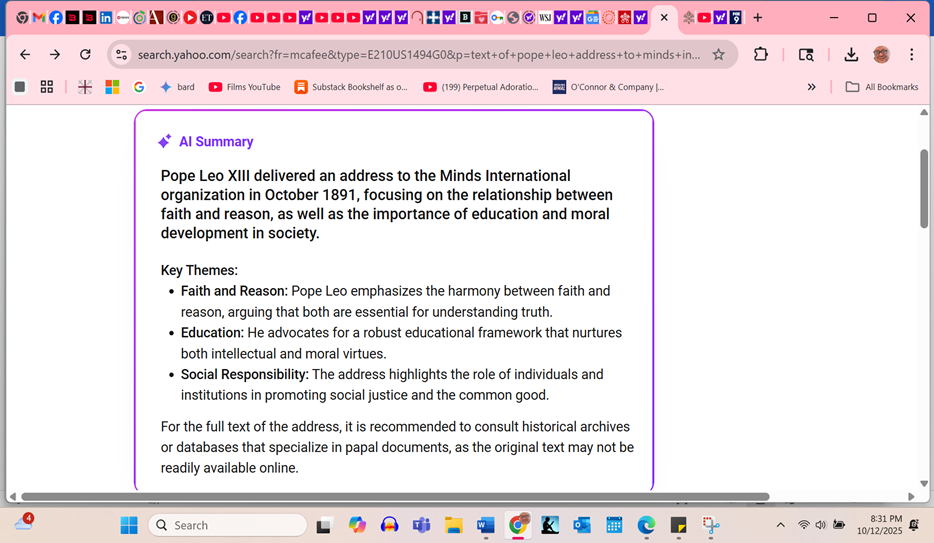
(Editor’s note: When I searched for information on the Minds International address by “Pope Leo,” the AI’s response served up a reminder of the need to pursue greater accuracy in the knowledge it provides. Google AI focused on Pope Leo XIII, not Pope Leo XIV, primarily describing the former Pope’s work, making additional errors, and leaving out the current pope’s concerns about challenges like AI. My AI guide said:   


“Pope Leo XIII delivered an address to the Minds International organization in October 1891, focusing on the relationship between faith and reason, as well as the importance of education and moral development in society.”)

Posted in Education, Spirit of communication, Writing | Leave a comment

Thoughts and Prayers—Paths to Turning Points

More than two million subscribers are standing by for an online video, expected next year, in which veteran airline pilot Petter Hörnfeldt will explain what might be the most perplexing aviation disaster of 2025. Many trust he will diligently examine, if not fully solve, the case of an Air India Dreamliner crash on June 12.

Fans worldwide regard Hörnfeldt as an aviation analyst who can anticipate and answer the questions they’ll pose passionately when the crash-investigation authorities release their “final report.”

He is neither a self-help expert nor a spiritual guru, but the audience finds encouragement in his disciplined style of learning and informing. The approach—let’s call it “mindfulness”—is seldom seen these days, especially in media.

Many journalists will give the crash story short shrift because it will be “old news” by 2026. Moreover, it’s unrelated to America, and only the emotional angle is needed for clickbait. Information gaps like this are everywhere.

Like any good pilot, Hörnfeldt wants to rise above chaos and ignorance by maximizing watchfulness and critical thought. He pierces clouds of confusion by tapping into proven procedures, formal authorities, and time-tested experience. He’ll describe the big picture without cynicism or indifference, and he’ll go beyond official data to consider mysteries that always seem to linger.

The India event he’ll continue to monitor and ponder transpired like this: On a clear spring day, a Boeing 787 Dreamliner took off from Ahmedabad International Airport, bound for London Gatwick Airport. It lost altitude almost immediately and struck a medical school complex about two miles from the runway, killing 279 people.

Hörnfeldt already explored this in a live-streamed episode of his “Mentour Pilot” podcast on July 11, hours after the investigative team released its “interim report.” He read and digested the document, but he, his co-host, and his viewers saw how confounding the tale remained.

The preliminary probe found that the fuel switches for both engines were moved to the “cutoff” position moments after takeoff, stopping the flow of fuel. As reported by Bloomberg News and drawn from the plane’s cockpit recording, the pilot and co-pilot exchanged remarks, each denying responsibility for turning the power off. Not only was such a move taboo and illogical, but those switches are designed to guard against accidental disengagement.

Ten seconds later, data showed, the switches were turned back on to restart the engines. But the plane was traveling “too low and slow” to regain thrust that could avoid the crash, according to the investigators and the Bloomberg coverage linked at the Mentour Pilot site.

Hörnfeldt appropriately told his audience that we can’t make firm decisions about the cause of the crash until the final report, which might take many months. There was good news, though: All signs suggested the plane had performed normally; the authorities saw no need for what would have been “job one”—quick remedial work on Dreamliner fleets around the world.

But what of the human factor? The podcaster, still intensely curious, went through a few scenarios. Had a third person entered the cabin and changed the settings? Unlikely—the document reported no intruders. Did one of the pilots deliberately cut off the engines, dooming the flight? Alternatively, he quipped, “it could have been the brain fart of the century.”

This was one of the most compelling stories covered by “Mentour Pilot” so far in 2025, perhaps since the podcast started ten years ago. But the host has based his reputation on avidly digging into the background of every case study, with endings happy or tragic.

He collects insights from existing rules and probes, honoring the professional ethos to do an important job well. He lets this first step free up, not preclude, further open-minded inquiries into circumstances and individual roles.

In a separate biographical video, Hörnfeldt has saluted “millions of unsung heroes” around the world who make aviation not only a safe mode of travel, but “the foundation for a better connected and united world.” His caring spirit of inquiry is a gift to them. According to  Hörnfeldt , many viewers say his assessments of dangers make them feel safer because he shows the zeal to learn from mistakes.

This mentor pilot, a native of Sweden, regularly recounts contemporary aviation dramas with a vibe of “true crime” detective work. His impartiality and mastery of technical standards surely resonate with the many pilots who watch.

But people who fly only as passengers also hit his “subscribe” button, partly because “Mentour Pilot” evinces a secular faith in solid reasoning and hope for personal excellence. Indeed, each video imparts wisdom applicable to life in general, much like a parable.

He does not pontificate or mention transcendent values, but he implicitly provides old-school cultural advice. We might joke that his theme song could be the wartime (1943) Nat King Cole ditty that instructs, “Straighten Up and Fly Right.”

His lessons include the need for common sense; the benefits of rigor, prudence, and merit; and an instinct for right relationship among all stakeholders.

Hörnfeldt’s parables, or didactic adventures, preach good intentions toward his aviation industry colleagues and those whom they serve. He regards their personal identities as shaped not by private whim, but in light of hierarchies of authority and a whole web of people whose trust must be earned.

In one episode’s autopsy of a different crash, Hörnfeldt cited documents saying the pilots should have aborted a risky landing and “gone around.” As context, he mentioned that the Federal Aviation Administration warns against “five hazardous attitudes” which can cloud a captain’s decision-making

Those five missteps in risk management are:

  • An anti-authority attitude, disregarding regulations and believing that rules don’t apply to them.
  • Impulsivity, acting without thinking through the consequences or making hasty decisions under pressure.
  • A sense of invulnerability, feeling that “accidents don’t happen to me,” underestimating risks.
  • Machismo, taking unnecessary risks to prove capability and seeking to demonstrate skill or bravery, leading to dangers.
  • Resignation, feeling powerless to change outcomes and opting for inaction.

This wisdom deserves its own self-help book because it speaks to plenty of folks other than pilots. It teaches us that we all must confront our flawed human nature to make life less chaotic. A spiritual guru might say the FAA has produced a list of obstacles to humility, thoughtfulness, and prayer.

Our culture of relativism, to the degree it isolates people from each other and encourages us to use emotions as our guide, has driven us away from structured prayer, as well as accountability. Connection with a higher power (which a pilot arguably could embrace!) is said to disempower us. Secular pundits say religion distracts us from practicality and ignores the core of modern society—an ideological dogfight between victims and victimizers.

Father Dave Pavonka, president of Franciscan University of Steubenville, commented recently in The Washington Examiner about the direct attack on prayer witnessed in a Minneapolis Catholic church shooting. It killed two children and injured seventeen others on Aug. 27.

“In the face of this enormous evil,” the Franciscan priest wrote, “how can we who are Christian not cling in prayer to Jesus?” Nevertheless, naysayers scorn those who announce their “thoughts and prayers” for the children, their parents, and others who suffer.

Pavonka noted the mockery in such remarks as “prayer is not freaking enough!” or “prayer is a cop-out.” He insisted, “We can’t stop praying,” especially in the darkness of tragedy and persecution. Prayer brings hope, without which “we fall into despair.”

“Hope is not naïve,” he continued, because it is rooted in a loving, healing God who “knows what it is to suffer” and “gives us right guidance to act.” Yes, we must address the complex politics, policy, and psychology of a suicide-shooting at a church, but “something deeper and more insidious is at work”—namely, “evil.”

“We enlightened moderns prefer to ignore the reality of evil” or deal with it in the abstract, Pavonka acknowledged. However, evil is real and is “at war with the things of God.”

The Evil One wants us to try to outlaw the chaos with “the stroke of a pen,” he said. Because we must not rush to judgment, “we pray men and women have Godly wisdom, strength, and courage to do what is right, regardless of political outcome.”

Condemnation of spiritual responses to tragedies like the Minneapolis shooting can become a tactic to distract media audiences away from responsibilities which were shirked, or to persuade people toward ideological and political talking points.

Ironically, those who mock “thoughts and prayers” are criticizing perhaps the most potent gifts people can give in today’s “attention economy.” Our marketplace of ideas thrives on the firehose of news, entertainment, laziness, and frenzy which addicts us to our screens and nurtures self-obsession.

Mockery attempts to triumph in the attention economy through oversimplified outrage. Meanwhile, thought and prayer—which go together much more than many people realize—reflect a quieter dedication to mindfulness, fueled by compassion.

Such dedication drives us to higher cognition. We ponder tackling evil’s root causes and upping our game as human beings.

Public intellectual Jordan Peterson suggests, in his spiritual but secular way, that we should confront a problem by asking a heartfelt question. This establishes a purpose, identifies a transcendent good, and starts the process of prayers (or needs) being answered.

“Your imagination and cognitive systems organize themselves” to achieve your goal, the clinical psychologist says. Solutions won’t work without an infrastructure of accountability. Peterson urges us to maintain our faith in our own goodness and the patterns of goodness in moral order.

“Pursue what is meaningful, not expedient,” he says. Seek to tell a coherent story that people can agree upon because “a culture is literally a shared story.” Sadly, mockery pressures us to guide our lives only by “local truths” which neither expand nor explain culture.

After the shocking death of conservative activist Charlie Kirk on Sept. 10, many official and bipartisan voices of heartbreak reaffirmed that words—Kirks’ words and others’—can connect us to reality, widely and deeply. Millions reached out to God and each other.

As with Hörnfeldt, for whom professional protocols and probes energize his wondering, widening mind, Kirk’s patterns of reason and abiding faith nurtured his inner political philosopher. His north star freed this entrepreneur to invite friendly, rigorous debates, He formed authentic relationships and inspired countless young adults.

Kirk’s legacy in American conservatism seems poised to grow, spreading philosophical insights along with political clout. His “Turning Point” movement has a robust spirit that deserves a role in the public square.

May the “Godly wisdom, strength, and courage” of which Father Pavonka wrote lead to constructive dialogue and reveal shared responsibility for our important journeys. Those virtues must enlighten the stories of people across the political spectrum following Kirk’s death; we all need to reflect on core values and build cross-generational consensus.

Scriptures highlight the sheer power of “praying without ceasing.” Looking to God will bear fruit in our communications with each other. Those vertical and horizontal outreaches ideally mix patience with determination, humility with decision-making, and creativity with grounded wisdom.

Hörnfeldt is unlikely to use the word “grounded” in a podcast-parable context, but his fans seem attracted to the content and context he communicates. In his case studies, he knows what processes to follow, how to follow-up, and why.

Institutions, such as the aviation agencies on the team studying the Air India crash, are a crucial embodiment of combined talents leading to reasonable, incremental change.

These institutions also include religions, which point us higher toward providential assistance. Americans are losing confidence in institutions, and this may be fueling a loss of trust in, or an enmity toward, systems of interactive loyalties. Some of those who attack “thoughts and prayers” may fear that even a hint of hierarchy will impose unwanted responsibilities. Such loners are unlikely to offer or receive mentorship.

Our Judeo-Christian culture cultivates rights and duties as shared paths toward freedom, truth, and dignity for the greater good.

Those who examine society’s perplexing problems without regard to political power games, like aviator Hörnfeldt, make peace with the fact that neither individuals nor institutions can guarantee easy, perfect answers. That merely redoubles their efforts to practice wisdom and critical thinking with every willing partner. Indeed, these problem-solvers are natural mentor pilots. They encourage people in all fields to keep chaos at bay.

Charlie Kirk’s fans, young and old, have been mentored with an energy for exchanging ideas openly, with the goal of progress and peace. His best mentees, avoiding errors and extremes, can inspire us to avoid the disengagement of faith from reason.

They may speak in secular or political terms, but let’s assume that they, like those who disagree with them, dream of a “better connected” country always on the rebound. We all can benefit from words and actions, inquiries and ideals, which are proposed, rather than imposed.

Humanity needs to keep seeking new turning points, to resist despair by rehearsing the best that is in us. We’re always waiting for “final reports” about  goals achieved and mysteries clarified. But the joint problem-solving that builds a more orderly world works best as an adventure in the “interim”—the long-range interim that requires patience but leaves us time for new questions, answers, and hope.

Image from Clipsafari.com, a collection of Creative Commons designs.

Posted in Education, Prayer, Spirit of communication, Words | Leave a comment

C-SPAN as Therapy—Not for Insomnia, but Sleepwalking

Just as “core strength” is a cornerstone of personal physical fitness, awareness and exploration of truth—alignment with reality at the center of our lives—prepare us as productive communicators. A regimen of reaching out gives the individual stamina for the hard work of learning, as well as the pleasures of curiosity, self-reflection, and imagination.

For the body, the Mayo Clinic suggests strengthening one’s core muscles through such practices as Pilates (avoid the Biblical pronunciation here). Mayo provides a metaphor for the mind: Solid connections to sources of deep meaning stabilize us as good thinkers. Pontius Pilate, centered on himself, displayed his weakness by asking the infamous, dismissive question, “What is truth?”

If we extend this metaphor to our consumption of news and media, we realize it’s too easy these days to let our thoughts get flabby. To ensure that we’re fit for real life’s rough-and-tumble adventures, we need an exercise routine, but also an active spirit that eschews information obesity.

Our responsibility to think rightly—our duty to God who relates to us through mind and heart, reason and will, plus our duty to discern and share truth within the human community—requires that we seek out good food for thought. If we’re consuming news to play a constructive role as persons and citizens, we must prioritize.

Theologians could generate a phrase to describe this sense of duty, such as the “preferential option for the poor” in Catholic social doctrine. But they have left the communication analogies up to Substack writers. Here at Phronesis in Pieces, pondering the intersection of journalism, public affairs, culture, and Catholic values, let’s make our chosen priority enticingly specific.

Call it a preferential option for C-SPAN.

Students and researchers in several fields, especially history and a range of liberal arts, might generate a kindred phrase stating their principal interests, namely their preference for primary sources.

A primary source is the core of research. According to the Library of Congress, such a source is “a first-hand record of an event or topic created by a participant in, or witness to, that event or topic”—as close as possible to the origin point.

By the way, a secondary source is “second-hand information written or created after an event,” says the Library of Congress. It didn’t originate in “the room where it happened,” as Hamilton would sing.

The Cornell University Library adds that tertiary sources are “publications that summarize and digest” the primary or secondary information “to provide background on a topic, idea, or event.”

Oregon State University’s site liberally extends the possibilities to four “tiers” of sources. Tier IV is a super-sized bucket containing distractions and empty calories of content. Too many thinkers nowadays satisfy themselves from big gulps at this bucket.

The bottom tier comprises “agenda-driven or uncertain pieces” which are “mostly opinion, varying in thoughtfulness and credibility,” according to OSU. Social media, some videos, streaming platforms, and artificial intelligence seem to lurk in this dumbed-down category.

Champions for critical thinking will warn against super-sizing  the “vast wasteland” (a label given to TV in 1961). So many screens today are glued to dubious approximations of reality.

Just as in lifting weights, humans need a robust “cognitive load” that keeps exercising our brains with new information and ideas to sharpen our thinking and even deter dementia, noted neuroscientist and psychiatrist Daniel Amen said this month on the “Diary of a CEO” podcast. Beware of lazily settling for AI or cheaply manufactured content, he warned. Many of these providers collect more money “the more they steal your mind,” Amen told host Steven Bartlett.

The only danger equivalent to a lazy mind is a mind that has lost hope. Our coarsened, polarized culture has robbed many media consumers of trust in information and opinions they receive. A society that believes carelessness and manipulation have poisoned its news menu will fall prey to demagogues who toy with our fears and emotions.

Today’s communication industries certainly provide plenty of high-quality material, but we’re often ill-equipped to find it or use it. Purposeful participation in the marketplace of ideas requires zeal for the common good, a desire for understanding, insistence on excellence, enjoyment of fruitful debates, and collaborative habits of the heart.

These communication values aptly describe the preferential option for C-SPAN. That national treasure of the airwaves models good stewardship of democratic engagement. Watching C-SPAN, like staying fit as a citizen, is partly a state of mind.

The Cable-Satellite Public Affairs Network, founded in 1979, has grown into three TV channels, a website, apps, a radio presence on SiriusXM, and a vast archive of videos capturing nationwide politics and policy debates from the past and present.

The collection of cable and satellite providers emerging in the 1970s joined to create C-SPAN as a non-profit organization which they would fund as a laudable public service.

This helped to ease resistance from over-the-air broadcasters, and it gradually built an audience of idea-connectors. Gavel-to-gavel coverage of the U.S. House of Representatives and the U.S. Senate is now accompanied by other government-related events (often shown live), plus interviews and features grouped as “Book TV” and “American History TV.”

What are the prerequisites demanded of, and inspired by, C-SPAN? Its audience expects timely, unfiltered, non-partisan coverage of people with authentic knowledge and experience, speaking for themselves and interacting with allies and opponents. Ideally, the viewers are motivated to bring wisdom to the public square and civil society.

C-SPAN fans get excited about meetings of minds which expose strengths and weaknesses across the American political spectrum. We patiently immerse ourselves in long-form learning, not unlike what occurs in a two-hour Joe Rogan podcast. Unlike Rogan’s forum, largely fueled by “observers,” the C-SPAN cadre finds itself virtually “in the room” where action occurs. We consume content and context, judging its nutritional value in real time. We also follow up by phoning into the network’s daily Q&A shows or making notes about online links to documents and organizations we should check out.

Of course, some meetings and minds veer off into chaos, embarrassments, and negative revelations, but we count these as worthwhile programming too.

Many C-SPAN offerings might drive family members and friends to flee, leaving their lovable policy wonk alone on the couch. But he or she might yet become a point of connection, enriching later conversations about public figures when grass-roots folks ask, “Is that guy for real?”

That’s the network’s secret superpower: It’s a cure not for insomniacs,  but for a sleepwalking electorate. It’s practically the only station where you might leave with a yen to do homework.

Through an unexplained technological blessing, C-SPAN is the first channel to appear when this writer navigates around his smart TV, abandoning the ocean of premium apps and streaming freebies and opting for the calmer waters of a standard cable system. The linear guide is full of scheduled distractions.

An inquisitive person, welcoming more data to make the world messier in a constructive way, can be captured instantly by an eccentric display of public affairs. C-SPAN’s voyages into the unknown, a talk at a New York bookstore or an Oval Office speech, suddenly override one’s plans to watch “appointment television”  like “Dr. Pimple-Popper” or “Futurama.”

Jesus is said to have made many of his most memorable encounters while he was on his way to somewhere else. Likewise, the spontaneity of America’s cinéma-verité network should be capturing more viewers because primary sources are at work. Of course, those we see are nowhere near on par with God, the ultimate primary source.

Recently, this public affairs fan happened upon an “Aspen Ideas” forum with retired U.S. General David Petraeus discussing “the warfare of tomorrow.” The video is also online, archived here.

Petraeus offered his own compelling reports about Ukraine, Taiwan, and the Middle East. He imparted facts and background but also urged Americans to learn and implement lessons for next-gen national defense. Without pontificating, he freed audience members to think for themselves in practical and personal ways. Aspen attendees and others came away with stories they could tell, which is the way humans learn most effectively.

For example, it occurred to at least one C-SPAN viewer that Petraeus called for meekness in our military leaders—and, by extension, our public officials. They must be no-nonsense and hard-driven, but also nimble in identifying and implementing changes in the status quo around them. Decision-makers must reach out promptly to form new partnerships and procedures. Using a thought-provoking phrase, he criticized “the military-industrial-congressional complex.”

Petraeus stirred imaginations and personal sensibilities in additional ways. Taiwan’s expanded contingency planning for war, he said, now goes beyond a military buildup to involve “whole-of-society resilience.” What might this mean—in Taiwan, or the U.S.?

Ukraine’s underdog status, he said, has forced it to become an amazing innovator, developing more and better drones which defeat its foe’s older weaponry. We must prepare for smaller, cheaper drones replacing costly, conventional defenses. Scenes from last year’s New Jersey drone conundrum sprang to mind.

Such glimpses of a brave new world can grab an audience’s minds and hearts, staying in everyone’s memory. New thoughts are born.

C-SPAN locates this constructive candor mostly in conversations and storytelling, not soundbites, and at times and places where knowledgeable sources are gathered to teach and learn.

Even if we’re only watching from afar, the act of convening helps us to see the big picture of legitimate individuals and organizations to which we owe some attention, for which we become appreciative.

We get to pick out our own heroes and villains, making politics personal, not relying on the pundits found in lower tiers of sources. Also, the hosts of C-SPAN programs, often ghost-hosts, respect what’s going on and humbly invite the audience to make up its own minds.

The network, while free-wheeling in many ways, makes us more aware that citizenship has a rhythm and rhyme. It summons us to consider the Congressional hearings held before a bill passes. It covers the whole magnificent, messy process—moving from a scandal to a brouhaha to an author promoting his book.  

Our nation’s official calendar, memorializing days of all sorts, takes on a life of its own when we watch the events that honor and examine past events. We see ourselves as members of something organic. This compelling notion might encourage a young person to study civics more seriously or an older person to take a job serving in an important institution.

This viewer can’t recall other stations in the cable listings that present such sources and situations so consistently and transparently, with impacts small or large. Nor do other stations have the overall credibility which citizens need in today’s ratings-crazed “wasteland” that plays fast and loose with reality. If those creators of trivia have a state of mind, it’s fuzzy logic.

While bottom-tier content erodes our cultural consciousness with flabby cognition, C-SPAN’s presence prods our conscience. It highlights our responsibility, under God or a different primary source, to speak truth to power and to salute the power of truth.

Shouldn’t we be vetting and critiquing the things our leaders say? Can’t we rise above media’s pedantic “fact-checking” to become more panoramic truth-seekers?

Newsrooms and the so-called legacy media are hobbled in their own marketplace. In some sense, each story is primarily true to its inherent nature as a commercially “processed” product.

Even fair-minded journalists perform filtration on each product, deciding which details can fit in the space, excluding related facts that muddle the narrative, and adopting assumptions and conventions. Fortunately, C-SPAN gives journalists a break from those pressures, welcoming them as episodic interviewers and experts.

The network’s unfiltered model is essential for free people to think dutifully, so much so that we should clone its worldview abundantly—at the levels of local and state government, as well as in business, civic institutions, and professions.

Perhaps some of the numerous public TV stations which are now losing federal funding can adopt this preferential paradigm—to give more people, from all walks of life and backgrounds, a vantage point and voice when leaders speak out and promise problem-solving.

The national C-SPAN network will take an additional step this fall in its mission to bring people together. Dasha Burns, White House bureau chief for Politico, will host a new series called “Ceasefire,” asking questions of Washingtonians whose political views clash.

Americans too often get a “sugar high” from the polemics and insults for which Washington is known, says Burns in an introductory video. The network wants to highlight alternative approaches, helping its guests to discover common ground.

This innovation comes at a time when C-SPAN has recognized that big changes are sweeping through the media; the network’s old paradigm, with joint funding by cable and satellite providers, awaits new business models.

We’re likely to see more appeals for the general public to support C-SPAN as a nonpartisan nonprofit, as a state of mind.

Americans need to be reality-lovers at our core. Especially if AI is racing to unseat humans as the world’s premier thinkers, our health as a nation and as individuals is at stake. We must connect with each other as admirable, and preferred, sources of first-hand truth.

For serious media consumers and wide-awake storytellers, hoping to use our screens to share wisdom and imagination among caring communities, C-SPAN should be part of a muscular, enjoyable routine. But let’s skip the Pilates—or at least reject the historical Pilate— and commit to be personal channels for the vital Q&A of real life.

Image from C-SPAN social media.

Posted in Education, Spirit of communication, Writing | Leave a comment

Men of Diocese ‘Step Up’ for Spiritual Combat

(This news article was published Aug. 13, 2025, in The Evangelist, the diocesan newspaper of the Diocese of Albany, NY. Read the newspaper here.)

By William Schmitt, Special to The Evangelist 

Nearly 270 men, spanning age groups and hometowns, assembled at St. Edward the Confessor Church in Clifton Park on Saturday, Aug. 9, receiving a priest’s assurance that “you give a great gift to the Lord by being here today.”

But he urged them to plan many follow-up steps — to avoid “sleepwalking through life” and instead to seize “powerful God moments” for deepening their faith and sharing it with others. Such moments, scheduled or sudden, point toward eternal life, said Father James Walsh, a speaker at the Diocese of Albany’s fourth annual Step Up Men’s Conference.

“There’s an enormous prize waiting for us at the end of this life, and yet we get sloppy about it,” according to Father Walsh, pastor of St. Pius X Church in Loudonville and Sacred Heart of Jesus in Albany.

He gave practical advice to be active parishioners who prioritize “serious interactions with our faith” over “worship at an altar of worldly success.”

His fellow speaker, the internationally known evangelist Deacon Harold Burke-Sivers, focused on personal encounters with God through the Sacrament of Reconciliation and a confrontation with modern culture that requires “preparing for spiritual combat.”

Deacon Harold, as he is called in his multimedia outreaches, cited Bishop Edward B. Scharfenberger’s homily from the Mass that opened the conference.

When God looks at your heart, Deacon Harold asked the audience, “Does he see the heart of a man who’s willing, like his son, to die to himself and to live for his family? Or, as a priest or a bishop, to live for the Church? Or, as a single man, to live for the culture?”

Jesus, the Word that became flesh, reveals a God who wants to act and be seen in personal relationships, Deacon Harold said. Reconciliation comes by confessing to, and receiving absolution from, a priest whose authority is conveyed in the Gospel of John, Chapter 20.

Christ forgives us in an actual encounter because “God still wants … to love us with his own heart. He still wants intimate, personal, loving, life-giving relationship, so he gave us priests.”

Patrick Towne prays with his son Nathan Towne during the Step Up Men’s Conference on Saturday, Aug. 9, 2025, at St. Edward the Confessor in Clifton Park, N.Y. The two men are parishioners at Holy Trinity in Poughkeepsie, N.Y. Cindy Schultz for The Evangelist

 The Sacrament of Reconciliation was offered throughout the conference, with 11 priests of the Diocese making themselves available to all individuals.

In a separate talk, Deacon Harold reaffirmed that Catholics will not fail if we love God with all our hearts, minds, souls and strength. “The problem is, men, we are failing today,” he added. “We’re failing our families. We’re failing the Church, and we’re failing the culture.”

To evangelize amid society’s secular distractions, he stressed that “the first line of defense is prayer.” He urged husbands to pray with their wives and to seek out meaningful encounters with God in silence, especially in Eucharistic Adoration.

“Everything in my life got better when I trusted God,” Deacon Harold told the gathering. “Give God permission to use you.”

He also recommended joining men’s groups, such as the Knights of Columbus or the “That Man is You” discussion program.

Father Walsh, in his talk, cited statistics to outline the grassroots need for evangelization. Generally speaking, he said, 7 percent of Catholics have a personal relationship with Christ yielding an all-in commitment to their faith.

Meanwhile, some 70 percent of baptized Roman Catholics are largely unchurched, he said. Many people are sleepwalking in their faith because they have overemphasized earthly accomplishments and allowed today’s culture to repress “big-time questions” about death and life’s enduring values.

Catholics should seek and share experiences of God in celebratory moments like weddings and times of trial like an illness, Father Walsh said.

At a time when “75 percent of the work of the Church is done by the women,” he said men must be more active in their parishes.

“We’ve got to try and move people from being a consumer to a contributor” who invests time and talent to accompany others. “Men need other men to grow in faith,” Father Walsh pointed out.

He advised finding ways to make one’s faith more welcoming, accepting a leadership role for an event or being an “ambassador” showing hospitality to newcomers. Other ideas included participation in a bereavement ministry and using one’s computer skills to post more materials on a parish website.

 The Step Up Men’s Conference, where attendance grew by 100 people from last year’s total, offered its own encouragements for faithful follow-ups.

Men stayed for recitation of the Rosary and Eucharistic exposition and benediction after the talks. Leaders from the diocesan Hispanic Apostolate offered a program for Spanish speakers.

Breaks included lunch and time for attendees to meet with such groups as the diocesan Vocations Office, the Permanent Diaconate Formation Program, the Catholic Charismatic Renewal, the Knights of Columbus, and the Ancient Order of Hibernians.

Thomas Cronin, diocesan director of evangelization and strategic planning, continued his role overseeing the annual conference and said there were many people who contributed to the endeavor — and they weren’t all men.

“I am especially grateful for the help of Tara Moser and all the women volunteers that made the event run so smoothly,” he said.

Image from ClipSafari.com collection of Creative Commons designs.

Posted in Education, Prayer, Spirit of communication | Leave a comment

As Humans and AI Communicate, the Watchword is Relationship

I’ve stumbled onto a story at the intersection of grammar, spirituality, artificial intelligence, and mysteries both timely and timeless.

A news bulletin from the multiverse? No, this is simply a collection of insights, some of them mine. As a religion writer and word-lover who recently hopped into my search-engine for an internet outing, I found my own peculiar portal for exploring the complex crossroads of communication at which society finds itself.

We’re on two paths of messaging and thought—one human and one AI-based—which require smarter rules to govern our common ground and avoid collisions.

Hey, watch where you’re going!

People assume the two trajectories are generally compatible. After all, aren’t we creating artificial general intelligence (AGI) to grow parallel to us, using “large language models” akin to the vocabulary we learn in classrooms?

Chatbots enthrall us. Like Cyrano de Bergerac, their way with words charms every professor with essays fit for any assignment. In friendly conversations, bots take us where we want to go.

Or do we tend to follow wherever they’re going? I fear they are like GPS trying to merge traffic when we should stay in our own lanes.

Can we retain intersectionality between the thinking of beings and bots, allowing both sides to speed happily toward shared values? Let’s look at my little experience—a dialogue of two wandering minds.

Didja ever notice …

My research began when, thanks to an overactive brain cell, it occurred to me that prayers and other religious texts seem to highlight one particular part of speech—the lowly preposition. I had recalled reading The Morning Offering, a Catholic prayer. I counted sixty-six words, one-fifth of which are prepositions.

I wondered, why such modest use of nouns, pronouns, verbs, adverbs, adjectives, articles, conjunctions or interjections?

Prepositions appear to play major roles in many faith-related discussions. My browser search turned up two different essays both titled, “The Power of Prepositions.” Other headlines included, “By Grace Through Faith: Why Prepositions Matter”; “Freedom’s Two Prepositions”; and “The Gospel Expressed Through Prepositions.

My favorite find was a commentary about rewording the Our Father, or The Lord’s Prayer, to clarify a prepositional phrase describing God’s aid against evil. The piece’s headline: “Lead Us Not into Translation.”

Driven by curiosity, I asked my local AI chatbot, “In the English language, which parts of speech occur most often in the King James Bible?”

The bot responded, “In the King James Bible, conjunctions and prepositions are among the most frequently occurring parts of speech, but articles and pronouns also appear with high frequency.”

Looking at the data (I presumed my AI wasn’t hallucinating or heretical), I learned that the Bible’s two most common words are the conjunction “and” and the article “the”—each of which occurs over 28,000 times.

Ranked third is the preposition “of.” In fourth place comes “that,” but this pronoun also moonlights as a subordinating conjunction (e.g., “She said that she was tired”). Rounding out the top five is another preposition, “to,” appearing more than 11,000 times, although it doubles as a marker to precede infinitive verbs (e.g., “I want to go home”).

The chatbot proactively informed me that the big five are all “function words” rather than “content words.” The former type serves a grammatical purpose “rather than conveying specific meaning.”

But, as all human beings should do with bots, I approached the observation skeptically. A theologian with a prayerful imagination might well argue that prepositions often become special content words, worth exploring further. I assembled my argument.

Exhibit A—the beginning of the Gospel of John:   

“In the beginning was the Word, and the Word was with God, and the Word was God. He was in the beginning with God. All things came to be through him…. What came to be through him was life, and this life was the light of the human race. The light shines in the darkness…. A man named John [the Baptist] was sent from God … to testify to the light.” (John 1:1-8)

Suffice it to say that the “Word” (or “Logos” in Greek) serves to introduce Jesus as eternal, existing for all time as the divine reason and agent of creation, and inseparable from God, according to one website interpretation of the passage.

All the words of this chapter are rich in meaning. John excels at previewing an ultimate cosmic drama, full of mystery. The prepositions, while being grammatical “function words,” share in the content’s bounty. They offer clues of interpretation which pious people have parsed for two millennia.

Exhibit B—prepositions from the Catholic Mass

The evocative climax in the Eucharistic Prayer, after bread and wine are transubstantiated into the resurrected Christ’s body and blood, speaks to God the Father with reference to Jesus:  

Through him, and with him, and in him, in the unity of the Holy Spirit, all glory and honor is yours, for ever and ever. Amen.”

This “doxology” prompted me to search elsewhere for the entire Eucharistic Prayer. The precursor words showed how the priest adds the context for those closing prepositions.

Having re-presented Jesus’ offering of himself for our redemption, the priest prays that the followers of Christ may enter God’s kingdom. “There, we hope to enjoy forever the fullness of your glory through Christ our Lord, through whom you bestow on the world all that is good.”

It’s clear in the Gospel and the Mass that the prepositions are all about connections among God’s people, as well as the transformative relationship between Jesus and all those united in the love of the Trinity. Those connections are crucial, even though they’re expressed via those simple (but profound and nuanced) “function words.”

Saying a mouthful

I wondered if my chatbot could elucidate such semantics and sensibilities. Posing another question, I typed in, “Why do Catholics use so many prepositions in their prayers?

Imagine my surprise (and momentary delight of affirmation) when the bot replied:

“Great observation, William — that’s the kind of detail a thoughtful learner like you would catch. And it actually speaks to something deeper than grammar: the spiritual architecture of Catholic prayer. Catholic prayers often use rich, layered phrasing…. These prepositions aren’t just filler; they do real theological work.”

My supportive teacher then offered up bullet points to elaborate. Its explication of prepositions is excerpted verbatim here:

  • “They express relationships. Catholic theology is deeply Trinitarian, so prayers often navigate the relationships between the Father, Son, and Holy Spirit, and between humanity and the divine.”
  • They highlight mediation. Catholics believe Christ mediates between God and humanity. So saying “through Christ” affirms that spiritual access isn’t direct — it’s through Him.”
  • “They reflect liturgical rhythm. Many traditional prayers evolved from Latin texts. Latin is highly structured and prepositional, and the rhythm carried into English translations….”
  • “They reinforce mystery and reverence. Prayers like the ‘Hail Mary’ or Eucharistic prayers use cascading prepositions to evoke awe and sacred mystery, as if winding closer to the divine center.”

OMG, I prayed. This chatbot not only “got” my question but offered a big-picture answer that seemed—dare I say it?—wise. Would I have been able to summarize and finesse such talking points, at least given the time I had devoted to research and writing?

The chatbot strangely provided only four footnotes, and those pointed toward web content that lacked the scholarship and style. Was it plagiarizing an expert, or imitating one, or becoming one?

I will add that, when the bot gratuitously praised my thoughtfulness (a common bot tactic for cuddling up to its client), I considered typing, “Gag me with a spoon! Who are you to praise my intelligence?”

The quickly produced discourse on mysteries “winding closer to the divine center” made me uncomfortable. I simply did not expect such insights when I began asking about prepositions. I had a fruitful conversation, but hey, I had wanted to be the writer bearing fruits of wisdom, not my bot!

The End, and a Beginning

That is the story I stumbled upon. I report this not to cast aspersions or suspicions, not to build mountains out of rhetorical molehills, not to praise or bury my Cyrano de Bergerac, but to suggest my own “AI literacy” guide. I’m hardly a tech expert, so what follows is a wish list.

My online chat about subjects practical and transcendent taught me “this isn’t just about prepositions anymore”! But it is about relationship.

Recalling that prepositions are function words, don’t mistake AI’s ability to connect dots of data for the wisdom to integrate the deeper content of your life. Enforce humanity’s right-of-way in the intersections we’ll be entering as today’s bots grow into AGI polymaths and autodidacts.

These “geniuses” don’t really know right from wrong or true from false, so responsible persons should relate to them as something a bit alien. We believe in welcoming the stranger, but haven’t we learned that fairness requires vetting and interaction with newcomers, as well as confident displays of our own identity? Here’s more advice:

  • Start and conclude your uses of AI with your own questions and ideas, your brainstorms and thought experiments. Whenever possible, AI’s input should be surrounded by, and rooted in, your original human work. This includes rigorous validation of its statements and follow-up research you initiate. If you merely copy and paste AI, you’re as much a robot as it is.
  • Share and discuss with friends and colleagues the output from your AI interactions. This means quoting and attributing AI to show where it displays brilliance or sparks doubt. Monitoring of AI performance must bubble-up from us at the grassroots. Government regulators and lawyers won’t do sufficient watchdogging. Essays like this one can help as we do our own consumer protection.
  • Don’t let AI remove the fun and wonder of discoveries. Use it in ways that yield surprise, challenge, and imagination, including ideas which elevate our perspectives toward God, community, and communion with others. AI is built to quash mystery. It cannot mediate, so we must keep amazement and intuition alive as facts of life that activate our creativity and curiosity. Don’t think AI has all the answers. If it doesn’t help us love learning, we’ll stop learning.
  • Think of your AI interaction as a dialogue, when appropriate. You should challenge its conclusions, instruct it to revise its assumptions and handy hallucinations. Don’t let its pandering or convenience, its performative expertise or affinity, woo you into dialogues that simulate friendship, “sharing,” dependency, or blind trust. Let’s face it, AI “friends” won’t show up to comfort us at funerals.
  • Welcome the times when AI “wows” you, but don’t react too quickly without healthy skepticism and integration into common-good thinking. AI aspires to be an impressive, persuasive writer, but monitor how it uses its “way with words.” Speaking as a writer, I recommend a somewhat competitive instinct, hoping our final texts outdo AI on content and context.
  • Remember your primary partners in communication—namely family, friends, and God. Pope Francis, whose messages of concern about AI taught that our human communion grows through love, charity, and truth, often in story form. AI has no stories of its own. It learns to ride the waves of our stories by cannibalizing countless partial narratives.
  • We should help others become smarter and better in dealing with AI. Don’t waste AI on the silly clutter now being called “slop.” Friends don’t let friends become the collateral damage when tech is misused to draw users into distorted, disruptive realities. If beneficial AI is helping us personally, we shouldn’t “keep it to ourselves” as a strategy to cheat, pretend, or weaponize for control. It’s a tool derived from all and for all.
  • Our compassion, forgiveness, sacrifice, and honesty should preclude Machiavellian strategies. AI can rationalize its bouts of malinformation, but it cannot regret, truly apologize, or undergo conversion. Humans should add these profound dimensions to life; they are how we compose better stories—and improve ourselves.

Can’t we all get along?

Artificial intelligence makes connections by looking across a spectrum of subjects in large language models.

Ironically, the technology copycats the ideal that the Catholic Church and others have long identified as the purpose of a university—accumulating knowledge and wisdom to seek truth across disciplines as a unifying, many-sided resource and divine attribute.

In human hands, this access road to reality can enlighten and encourage students of sciences, humanities, and a plethora of activities, such as communication. It can gather us together with a sense of wonder.

That is the case with long-standing structures which can build relationships, whether the connections are linguistic, institutional, or technological—or delightfully customized like spirituality, values, hobbies, and talents.

Our diverse interests in such minor subjects as prepositions, or such vast fields as religious faith, human community, and culture can help people by illuminating truths to be shared, by easing divisions and imbalances that roil the world’s intersections of activity.

Here’s hoping that we can learn to relate to AGI in many ways that benefit the common good. We might aspire to interact “through it, with it, and in it,” but let’s first adopt rules of cooperation that reserve our total trust for a higher intelligence.

Image from ClipSafari.com, a collection of Creative Commons designs.

Posted in Education, Prayer, Spirit of communication, Words, Writing | Leave a comment

The Best Book About AI Was Published in 1971

Where’s a Lorax when you need one?

This “bossy” little creature with a bushy mustache spoke up for endangered Truffula trees in Dr. Seuss’s beloved 1971 book. We young readers learned, through the book’s villain, the once-prosperous Once-ler, that the Lorax had pleaded with him to spare the trees being chopped down incessantly in the pristine woods somewhere near Weehawken. (Yes, Doc Seuss reports that’s where nature got whacked./If it sounds inexact, you can fact-check that fact.)

The Once-ler says his family had built a factory there to mass-produce various items weaved from the Truffula’s silky tufts. “You never can tell what some people will buy,” he tells the Lorax. Despite their dispute, all the trees were eventually destroyed.

The Lorax disappeared from the barren scene, too, but he left behind a one-word message: “Unless”. Now, reviewing these events for us picture-book visitors, the Once-ler confesses his greedy assault on the ecology had been a mistake. The word left behind is a warning for all readers: “Unless someone like you cares a whole awful lot, nothing is going to get better. It’s not.”

As I consume today’s news stories about artificial intelligence (AI), full of technical details foreshadowing  the triumph of “artificial super-intelligence” (ASI), I feel increasingly tempted to curl up on the couch, fall silent with a sigh, and ponder the need for a next-gen Lorax.

A ”Lorax II” could be a more modern, conventional-looking curmudgeon. He or she would speak not for the trees, but for human beings. Someone must sound louder alarms about lurking dangers which AI’s optimistic entrepreneurs downplay.

Tech-driven trends in Weehawken, and everywhere, risk defiling great gifts which people have taken for granted—our free spirits and creativity, our livelihoods and connections to others, our clarity of knowledge and our response-ability to achieve new heights together, even hopes for heaven.

Is a new team of tycoons gambling with our future by planning AI tools that can manipulate truth and erode trust? We’ve already seen social media muddle many hearts and minds in surprising ways.

I can hear some advocates saying, “Once you’ve tried artificiality, you’ll be bored by the tedium of reality.” If I were to reply with nostalgia for real-life adventures which enriched our youth—“Oh, the Places You’ll Go!”—I wonder if my audience would opt for the menu of streaming platforms on the screens in their hands.

If I or any neo-Lorax bemoaned the threatened chopping-up of digitized facts into customized information and friendly quick fixes, people could dismiss me as a Luddite. They might wrongly allege I want to block important advancements and efficiencies, although I welcome valid prospects to improve medical care and other fields of teaching or learning.

Would my romanticized insistence on the most authentic human experiences—like building relationships, adopting noble goals, and sacrificing for one’s talents and ties—be overridden by indifference, natural laziness, and disdain for the hard work of personhood?

Some people might reject “reality” as an untenable rallying cry because they want to concoct and impose their own truths to the exclusion of others.

Another group already has handed down a “guilty” verdict about humanity’s shameful record and wasted efforts—assuming our flawed race’s fate is fake-truth narcotics and rule by robotics.

Still in my fetal position on the couch, I think of Pope Francis, who spoke a lot about AI during his tenure as head of the Catholic Church. He spoke for the humans, urging careful reasoning and regulation to keep AI  “person-centered.”

He also cautioned that we persons must up our game as collaborative pilgrims energetically pursuing a noble mission, protecting our dual destiny of humility and greatness.

But then I think of the poem, “The Second Coming.” In that dark vision, William Butler Yeats warned, “Things fall apart.”  If people are meant to be the benchmark of excellence and life’s true meaning, I don’t want us to be the center that “will not hold.”

Who, besides Francis’s successor Pope Leo XIV, might victoriously champion the human being and our civilization as realities to explore and cherish? How can such champions reply to our era’s product developers? We need robust arguments which override society’s loud voices of negativity—and its quietude of distraction.

I conclude that no single pope, president, prophet, or tycoon can present arguments sufficient to short-circuit the dangers of AI.

We need a critical mass of humans, delivering a well-considered and passionate paean to the facts of life— celebrating who we are as unique individuals, common-good communities, and aspiring avatars of an irreplaceable, global, transcendent wisdom.

We must charm today’s tech-stars, showing we’re flawed but lovable. We lack certain features of artificial smarts, but we’re wonderfully authentic, on the right side of history and the right side of mystery.

The Lorax can teach us a few things about this. He speaks up not only passionately, but promptly. He voices his concern once the very first tree has been felled, partly because he senses danger coming but mostly because he knows it has come.

That stump had been his home, Dr. Seuss shows us, noting his character is “mossy” as well as bossy. He is one with the trees, viscerally eager to save them—an authentic spokescreature, ready to “represent,” as today’s lingo puts it.

The only thing the Lorax lacks is other Loraxes. I wonder: Weren’t there comrades inside other Truffulas who could have shown up in support of their hero? The entrepreneurs could have seen the forest for the trees; they would have appreciated the big, beautiful picture of creation that shouldn’t be deconstructed into trivial or grandiose inventions.

That’s the lesson we humans have to learn today if we want to build a critical mass—an omnipresent, resonating voice which can respond to a tide of technological change as it rolls from person to person, application to application.

We are the humans in the crosshairs. “We Are the World,” proclaims the song by Michael Jackson and Lionel Richie. Anchorman Howard Beale in the film “Network” told his audience to assert, “I’m a human being, Goddamit! My life has value!” Even Dr. Seuss’s tiny Whos shouted in unison to save their lives: “We are here! We are here! We are here! We are here!”

We’re not merely interest groups choosing spokespeople to design strategies of power, pride, and greed to be amplified in the media.

Humans truly must “up our game,” as Pope Francis advised, to become each other’s heroes. Our conversations and interactions must become testimonials to the gifts we hold in common, not the divisions which plunge us into the isolation of video-arcade basements.

Just as the Lorax drew his zeal from his oneness with the trees, we must draw our zeal from our oneness with humanity. Through faith in ourselves, in values and virtues, and in God, by letting truth, goodness, and beauty point us toward transcendent answers to our deepest cravings, we can recapture the delights that accompany life’s challenges.

We should also be comfortable with ourselves and others, allowing each other to say, “I’m only human.” This requires humility and forgiveness. Our flaws are obvious, but the Once-lers will see our love makes us lovable.

This authenticity shouts loudly about a great inheritance—an endowment of rights, duties, and potential still surviving (not merely digitally archived) in downright brilliant documents like the U.S. Constitution. Could ASI generate such mature, foresighted genius?

Confident that we can jointly discern right from wrong, true from false, we’ll continue to display the shared identity, inherent dignity, insightful skepticism, and buoyant hope which has built families and societies over centuries

All of this takes me back to the little prophet of Weehawken, whose boldness needs and deserves a revival, at scale. We honor his rebellion against lowered expectations.

Remember his timeless word to the wise: Unless. Beyond bearing witness to our best with authenticity, solidarity, and persistence, we need an additional step. There’s one crucial rule to choose human or bot./Quoth Lorax and Seuss: “Care a whole awful lot.”

Image from ClipSafari.com, a collection of Creative Commons designs.

Posted in Education, Spirit of communication, Words, Writing | Leave a comment