
O Come, All Ye Fretful

First published in “Phronesis in Pieces” at billschmitt.substack.com on Dec. 31, 2022

I came away from Christmas Mass this year with a heightened appreciation of those who had joined the congregation as, let’s say, occasional visitors.

Some of them attend on Christmas and Easter largely because it’s a family event or it’s a time “to be seen.” These examples of “peer pressure” were once reinforced by America’s Judeo-Christian culture.

One can understand folks feeling various pressures. A lot of people acknowledge in their hearts, and increasingly in their minds as a practical matter, that our society can go sadly—and dangerously—astray without a recognition of God. It is right and just to give Him a social shout-out.

We pilgrims, or wanderers, also know Him as the everyday origin of charity, dignity, mercy, justice, and enduring meaning. At a minimum, we know we need to “represent” because He is our source of consolation and care—if not the first responder, the A-Team we call in case of emergency. He is somehow a member of our families, or a part of our ancestry who deserves to be recognized, no matter how awkwardly.

Theologically speaking, peripatetic Christians are indeed poised to receive wonderful things in return for a return to the sacramental life, a list topped by the Holy Eucharist, the complete presence of powerful grace, engagement in the Church’s highest form of prayer, community solidarity, and spiritual refreshment.

But, as our priest presiding at the vigil Mass boldly (but gently) reminded everyone, Communion is a sacred event whose participants are practicing Catholics. The Church welcomes all and is an instrument for everyone’s growth in God’s love, he said, but this might be a time for one to ask the Lord for a blessing and/or simply remain in the pew.

Some attendees may see this guidance as an undue infringement of their freedom. Worse, knowing one’s place and “staying in your lane” are forms of embarrassment, acknowledgements of guilt or imperfection. They are the opposites of virtue-signaling, which is currently trending in culture!

Here is the bottom line: In light of the personal admissions and reevaluations being suggested, if we take seriously a truth-speaking priest, and the Church, there is a price to pay for attending Mass.

A serious charge is codified in the Bible: “Therefore, whoever eats the bread or drinks the cup of the Lord unworthily will have to answer for the body and blood of the Lord.” (1 Corinthians 11:27) That’s something all congregants, no matter the frequency of their presence, need to remember.

And it occurred to me at Christmastime that various attendees might feel the Mass exacts still another price of admission. This is an unwelcome tax levied not by the Church, but by today’s secularized, therapeutic, self-centered culture.

The secular discouragement of loving relationships with Jesus Christ only frustrates our innate hunger for a more excellent way and our the heart-felt desire to fill our “God-shaped hole.” (This latter idea has roots in Acts 17:22-27 and, much later, in comments by Blaise Pascal.)

Those attentive to this vacuum in themselves and in society might find it taxing to get through the early parts of the Mass, not to mention the Liturgy of the Eucharist.

The Mass starts us off by asking God for mercy. What, did we do something wrong?

The Confiteor can hit us with a sledgehammer of humility. We are confessing to God—and to our brothers and sisters (OMG, they are our brothers and sisters)—that each one of us has “greatly sinned” in a variety of ways. And we can’t point fingers. We have to tell everybody, “I need your prayers.”

Then the Church challenges us further in the context of our responsibility to a God who came to save us from the mess we have made.

The church’s seasonal visitors might notice the poignant specificity of The Gloria; it is a prayer echoing the angels as they celebrate the first Christmas! The awesome power and promise surrounding Jesus’ birth is described in Luke 2:13-14. “Glory to God in the highest, and on earth peace to people of good will.”

TV viewers informed by the better angels of our culture will remember that a little child, Linus by name, used that quote to lead his friend—and multiple generations of audiences—to learn the Good News. Hear it proclaimed here: “That’s what Christmas is all about, Charlie Brown.”

The initial prayers of Mass tell us to praise and adore Christ as our savior, and to give God thanks because all glory must go to Him. He alone is holy. Alas, that means we dare not play God.

Scholars and pollsters will tell us that people have fallen away from the Church—and from Mass—for lots of important reasons. Younger Americans are non-joiners who want to define their spirituality for themselves. Christian teachings make them reticent. They say religion causes violence. They doubt dogmas that conflict with observable facts.

But I observed another reason for society’s departure from the pews—and for the Christmastime exception that proves the rule. There is a culturally imposed unease some Mass-goers face in pausing their prerogatives so they can be surprised by joy.

My family and I found a few available seats in the back of the church, but perhaps we weren’t as uncomfortable as some of the newcomers. I came to a new respect for all those people awkwardly abandoning their weekend routines to be dutifully present at Mass. (They didn’t know where to sit. And neither did we.)

I realized the Church is beautifully countercultural, and our liturgy is wonderfully confounding from beginning to end. We all experienced it at the vigil. Even before we saw our priest, we had to squeeze in and humbly follow the directions of the ushers.

After Communion, a business-attired man seated next to me checked his phone and nudged his family to slip away as the final hymn began. They might have had reservations somewhere.

As a child of a culture that has become more and more secular, I’ve behaved and thought like that gentleman plenty of times. In his family’s presence, I truly found brothers and sisters.

My family stayed for the whole hymn, partly because we have become comfortable with Mass, and Christmas, as providential breaks from the tedium of being on our own—and enduring the “good grief” Charlie Brown always saw society imposing.

All of us in that congregation needed to pray for each other, to forgive each other, and to turn to God for the glory we crave. We cannot take this awareness for granted if we want to heal our culture through the humility of truth and trust. Without the Mass, a summons to incarnational faith, hope and connectedness, my family and others might all be on the verge of slipping away, or going astray. We would be using our “reservations” as excuses to leave a vacuum in our God-shaped holes.

Worse, to avoid paying the price of admission, we would be AWOL in the church, and in the Church. Keeping vigil, we were wisely challenged to know our place, including our place in the glory of Christmas.

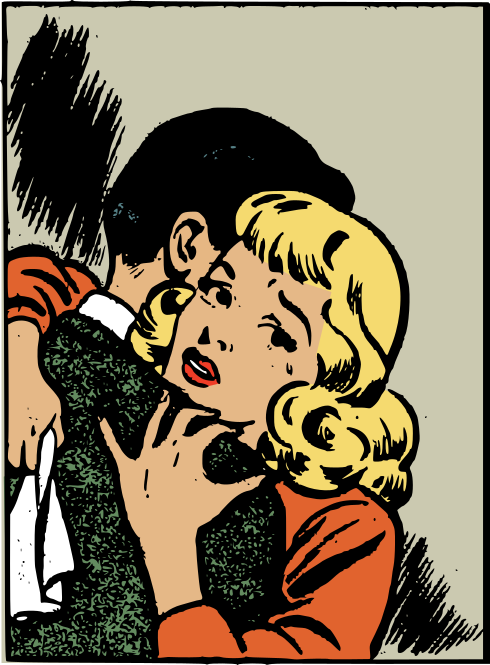
Image from ClipSafari, an online collection of Creative Commons designs.
Posted in Prayer, Words | Leave a comment

Priest’s Word to the Wise: Love to Study, Study to Love

This book review first appeared in The Tablet, newspaper of the Brooklyn Diocese, on Dec. 3, 2022.

“Theology” can be an off-putting, academic word. But a priest of the Diocese of Brooklyn has emerged on a mission to enrich Catholics’ everyday lives through that field of discipline, whose name simply means the study of God.

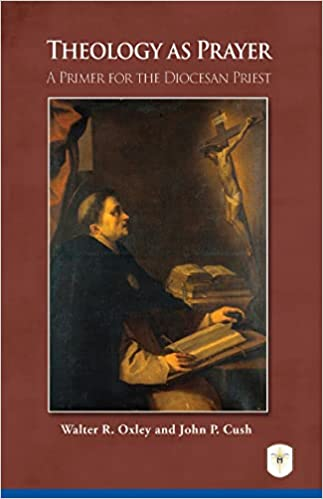
He is advocating his pursuit to others who preach the Gospel—and model it for the sake of people in the pews—with a new book, Theology as Prayer: A Primer for the Diocesan Priest.

“It’s not exclusively for priests,” according to Father John Cush, a native of Windsor Terrace. He asserted in a recent Tablet interview that seminarians, ordained deacons, consecrated religious, and laypersons will find life more meaningful as they encounter God using the works of great theologians.

The book, co-authored with Monsignor Walter Oxley, focuses primarily on suggestions for the parish priest. Serving a diocese, his tasks allow limited time for spiritual reading but generate many opportunities to teach, and demonstrate, “pastoral charity for the people he will lead,” Father Cush wrote in the early pages.

Reflection about God through solid theology has one purpose, namely the salvation of souls, he wrote. “Without this truth firmly established in the minds of priests and seminarians, when problems arise, they can be tossed to the wind, following whatever trend so pleases them, leading to a promotion of decline and a reverse of progress.”

Convinced that prayerful study can help to integrate personal holiness and dynamic love throughout a priest’s life, Father Cush this year joined the faculty of St. Joseph’s Seminary and College in Yonkers, NY.

He previously completed his Doctorate in Sacred Theology (S.T.D.) at the Pontifical Gregorian University and served as academic dean at the Pontifical North American College.

Years before his multiple advanced-degree assignments in Rome, Father Cush attended high school at Cathedral Preparatory Seminary, Elmhurst, and studied English and Philosophy at St. John’s University, Jamaica, graduating in 1994.

He went on to priestly formation at the Cathedral Seminary Residence of the Immaculate Conception in Douglaston. Ordained in 1998, he ministered to two parishes—Good Shepherd in Marine Park and St. Helen in Howard Beach.

His return to the United States in 2022 has allowed him to visit his Windsor Terrace home. He contributes frequently to The Tablet. This Yonkers-based professor of systematic theology also reaches out nationwide as the new editor-in-chief of a leading magazine for clergy, Homiletic and Pastoral Review.

“I’m loving every second of it,” Father Cush said of his primary job—preparing seminarians. He has welcomed a challenge set forth by St. John Paul II, who called for integrating “the four dimensions of priestly formation”—the human, spiritual, intellectual, and pastoral.

Aspirants to the priesthood must start with a life of Christian love and prayer, Father Cush told The Tablet. “Unless we have the foundation on the human level and on the spiritual level, our priests won’t really be effective ministers of the Gospel.”

All study of theology should be done “in a spirit of faith,” as he instructed in the book. “With the help of the Holy Spirit, whom you implore before your reading, you are allowing the meaning of the text and the deeper intentions of the theologian to permeate into the deepest recesses of your heart.”

The book’s co-authors make practical suggestions. Based on Church tradition, they show how theological texts can lead to meditation and purposeful conversation with God. They also give tips on how a busy pastor might set up time periods and circumstances where contemplation is possible.

Father Cush shows intellectual heft by describing noted theologians in valuable mini-biographies which, he promises readers, will “whet your appetite.” His menu of prospects includes Hans Urs von Balthasar, Bernard Lonergan, Henri Cardinal de Lubac, St. Thomas Aquinas, St. Bonaventure, and Pope Benedict XVI.

Speaking with The Tablet, Father Cush expressed thanks for the inspirations of Monsignor Oxley, another Doctor of Sacred Theology, who contributed extensive experience as a spiritual director serving clergy and parishes.

Their book was published this summer by the Institute for Priestly Formation.

But the technique of spicing theologians’ thoughts with practical tips and prayerful intent has a precedent in Father Cush’s first book, The How-To Book of Catholic Theology: Everything You Need to Know But No One Ever Taught You.

Published by Our Sunday Visitor in 2020, it explained to a wide audience that the study of God isn’t only for saints and scholars.

Humans instinctively seek deep, authentic relationships, Father Cush said. “They want time to study about someone whom they love—Our Lord. When you fall in love, you want to know everything there can be about that other person. That’s hopefully what the study of theology does for us—as priests, as lay, as deacons, as religious people—as we go forward in our own lives of faith.”

Posted in Education, Prayer, Spirit of communication | Leave a comment

Game of Kings, King of Games

First published in “Phronesis in Pieces” at billschmitt.substack.com on Dec. 19, 2022.

The world of political reporting groans with a desperate need for graduates of the Shelby Lyman School of Journalism.

This is a problem because there is no Shelby Lyman School of Journalism, and most people don’t remember its namesake. Lyman did exist (1936–2019), but he never practiced journalism per se.

He did write a popular chess column that appeared in dozens of newspapers for years. And, most famously, he was the TV anchorman, you might say, covering what The New York Times has called “one of the most ballyhooed competitive events of the 1970s, a Cold War confrontation in Reykjavik, Iceland, between the two most brilliant chess players in the world.”

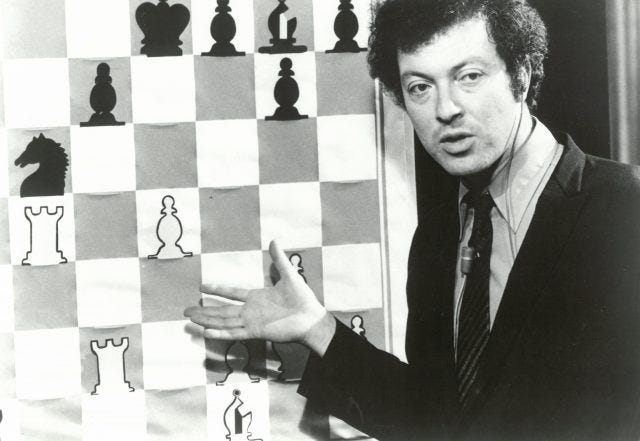
Lyman volunteered during the summer of 1972 to host a pioneering endeavor—live coverage for PBS stations of the World Chess Championship match between Brooklyn native Bobby Fischer and Soviet grandmaster Boris Spassky.

Some of the combatants’ 21 games consumed copious time, but Lyman did not tire. Fans called for more, so coverage of the rounds (which were riddled with controversy) was even allowed to pre-empt Sesame Street.

An informal New York Post survey of bars in the city revealed that most of them had their single TV tuned to PBS’s slow-paced sport, according to a blog at chess.com. The coverage drew the highest ratings of any show that had appeared on the young public network. At some points, an estimated 2 million viewers were said to be tuned in.

Lyman broadcast the series of programs from a bare-bones studio near his upstate New York home. A 35-year-old Harvard grad with no media experience, he invested TV time in the regimen which chess experts like him typically adopted at other high-level matches—namely, back-and-forth banter about how the game was going and what the moves meant.

He sparked detailed, esoteric, but oddly appealing dialogues with a few chess-club champions seated around him. He shifted cardboard chess pieces on a demonstration board whenever a bell rang to announce that Fischer or Spassky had made the latest move. This news was phoned in from spectators in Iceland.

While he carefully updated one board to show the current state of play, Lyman could walk over to a separate “analysis” board, where he and his panel of commentators could critique moves and visualize options or opportunities. They discussed the likely gambits the players were forging in light of all 64 squares as a connected whole.

Participants’ differing insights, looking backward and forward, sounded like this: Fischer was “setting up a couple of threats,” or “he was justified in moving that pawn.” Spassky’s queen was “being harassed” by major and minor pieces, or he initiated the “Schliemann defense.” You can pick up the lingo by watching these videos of “Chess Chat” and a follow-up Lyman broadcast in 1984.

I was a rising high school sophomore in 1972, with no training in journalism yet and little exposure to the art of play-by-play sports coverage, except for some Mets games. But I found the “color commentary”—and the “suspense” of waiting ten minutes or more for the next move—downright addictive.

The experience nurtured my zeal for a kind of “Washington bureau” vocation that seems old-fashioned to many. I never mastered the model, but I admired its focus on rigorous curiosity and enlightened dialogue, alongside the necessary dedication to solid research, deadline reliability, and well-crafted writing.

Extra qualities of this ethos include: patient but proactive waiting for a federal government that was designed for a deliberative pace; responding to “breaks in the action” by asking questions of knowledgeable sources; sharing varied visions of the possibilities ahead; and trying to read the minds of newsmakers without grasping for instant headlines or jumping to narrative-based judgments.

I do not question other forms of journalism, practiced by professionals with different approaches. But I like to think uncomplicated, inquisitive engagement at the intersection of knowable facts and human nature constitutes the ethos—or the curriculum—of the Shelby Lyman School.

Today’s coverage of national policy-making would benefit from a larger cadre of political reporters who are allowed and able to take time, to piece together a spectrum of details, and help their audiences see a big picture containing clues for fresh, constructive ideas.

Don’t assume that such journalists would be bland geeks, lacking strong opinions or the ability to build and inspire an audience. Back when I finally did study journalism, at Fordham, I recall discovering I.F. Stone (1907-1989) as an admirable variation of the Lyman paradigm.

His newsletter about Washington, I.F. Stone’s Weekly, became influential through its simple perspicacity—his willingness to delve into transcripts and government documents that revealed what people in power actually said and thought.

Communicating the fruits of his phronesis, his virtuous pursuit of wisdom in service to the common good, he became a progressive thought-leader who helped to advance such causes as civil rights.

Whatever causes and values formed the whole of Lyman’s good life, one of his goals was to promote a game he saw as a source of meaning and happiness. He is quoted as saying:

“Chess is a dramatic event. You could hear the swords clang on the shields with every move. They went at each other. The average person is turned onto chess when it’s presented right. Trying to figure out the next move is a fascinating adventure—an adventure people can get into.”

I have one more reason for promoting a “school” that exists only in my imaginative metaverse: You might say that all participants in the political arena and the public square need to be fans of chess, or at least of its thought patterns.

In these days when serious societal concerns are viewed through lenses of entertainment, persuasion, and gamesmanship, you might say we often must choose between two models of play—the good order of chess or the demeaning chaos of Rollerball.

There are plenty of smart, powerful leaders playing their “long game” of strategy regarding particular issues—or broad goals on a global scale. They hold a full complement of castles, knights, and bishops, and they naturally aim to control the “whole board.” While they are preoccupied with their high-stakes chess matches, they benefit when we are distracted by the bursts of sound and fury, the dopamine hits of bread and circuses, the rules of manipulation and confusion, which were portrayed in Rollerball, a classic 1975 film.

The latter arena generates play-by-play announcements from the loudest voices and biggest egos, armed with the most compelling statistics (or clickbait), grabbing and wasting the sporadic attention of hyped-up crowds.

The former arena is the quieter, more personal, more nuanced setting where an informed public enjoys taking a serious thing seriously. We are waiting and watching for each successive move, encouraged to think and converse about individuals’ gambits and incremental steps toward victory. Who is doing what, to what end, in what context, with what implications?

Our announcer for this “Game of Kings” coverage, applicable to politics, should be some future Shelby Lyman. Not weighty in the world’s eyes, but still the show’s anchor, he or she will help us all to become better analysts—and, eventually, better players in contests where the world needs champions.

Image from ClipSafari, an online collection of Creative Commons designs. Photo of Shelby Lyman from the U.S Chess Federation.

Posted in Education, Spirit of communication, Writing | Leave a comment

Illuminated by Gaslighting: The Word of the Year

This commentary was published first in my Substack publication, “Phronesis in Pieces”–found at billschmitt.substack.com. If you would like to see more of that twice-monthly mix of news, commentaries, and resources for the pursuit of virtuous wisdom, contact me at billgerards@gmail.com and receive a free-of-charge subscription.

When Merriam-Webster announced this week that gaslighting is its “word of the year” for 2022, it implicitly called for a moment of reflection that should send chills down the spine of America’s body politic.

The dictionary gurus have literally “spread the word” about a trend whose importance far exceeds an uptick in online research or a welcome addition to the public’s vocabulary.

I haven’t experienced such an uncomfortable wave of linguistic and sociological insight since Oxford Languages declared its 2016 “word of the year” to be post-truthIndeed, the combination of these two award-winners speaks volumes about the need to ponder our confrontation with a kind of spiritual warfare being waged in the rhetoric of a polarized nation.

This week’s revelation is simple enough. According to an Associated Press report, Merriam-Webster discovered that lookups for gaslighting on its website jumped 1,740 percent in 2022 over the year-ago period.

“It’s a word that has risen so quickly in the English language, and especially in the last four years, that it actually came as a surprise to me and to many of us,” Merriam-Webster editor at large Peter Sokolowski told AP. “It was a word looked up frequently every single day of the year.”

The dictionary definition for gaslighting calls it “psychological manipulation of a person, usually over an extended period of time, that causes the victim to question the validity of their own thoughts, perception of reality, or memories and typically leads to confusion, loss of confidence and self-esteem, uncertainty of one’s emotional or mental stability, and a dependency on the perpetrator.”

Such manipulation is not only a weaponization of words, but an attack against the sense of truth and grounding in reality which human beings need for the sake of a rational, meaningful life. It is a challenge in the pursuit of phronesis because it starves wisdom of its air supply and its ability to enlighten our endeavors.

No doubt one reason for the recent abundance of digital inquiries about this well-worn word is a widespread unfamiliarity with Gaslightwhich many Americans might know as a theatrical drama from 1938 and a classic film from 1944. As CNN described the plot this week, “a nefarious man attempts to trick his new wife into thinking she’s losing her mind, in part by telling her that the gaslights in their home, which dim when he’s in the attic doing dastardly deeds, are not fading at all.”

The movie is a disturbing tale of emotional abuse and dehumanization imposed upon a woman, already vulnerable and weakened by an earlier trauma, by a husband to whom she has turned for love and renewed stability. Hiding his criminal intent, he replaces her access to others’ knowledgeable feedback with a home-bound artificial reality, filled with lies that negate her actual memories and affronts that decimate her reasoning and dignity.

To illustrate contemporary views of gaslighting, CNN’s writer mentions its occurrence in a film called Don’t Worry Darling and a series called Gaslit. The article’s two references to politics both refer to criticisms of President Trump, one from 2017 and one regarding “the severity of the January 6 insurrection” of 2021.

Without worsening divisiveness by connecting the word to more recent or specific political developments, one can surmise that the 2022 leap in lookups has arisen partly from large-scale concerns. People wonder if they are witnessing attempts at gaslighting on a macro level, as well as in the all-too-common instances between spouses or within families.

This is where we find the tie-in to Oxford’s 2016 verbal tribute spotlighting our “post-truth” society. The husband and wife portrayed in the film were living in a “post-truth” home with bygone illumination. That setting, where everything—or nothing— could be believed, became a performance space that set the perpetrator free to implement his plan. But, in the end (forgive a mild spoiler here), reality won. It always does.

Numerous people today believe that creating “post-truth” narratives allows extra freedom for establishing one’s own contrived reality, exercising power, taking credit, gaining favors, shedding accountability, making a good impression, denying problems, avoiding challenges and conversations, minimizing the need for deep knowledge or reflection, manipulating meaning, overcoming others, and claiming a kind of godlike creativity and admirability.

These aims have proven especially useful in the arena of politics. Our relationships in the public square have become more nervous and arms-length, like zero-sum contests of psychological and emotional strategy. Other realms of human interaction—religion, science, academia, news, entertainment, and pursuits of peace and justice—also have become more fractious and politicized.

Many lives are now less grounded in actual human encounters. Among relativists and narcissists, who may not agree on what is true, real, or meaningful, we tend to short-circuit conversations, reject learning from unacceptable facts and disturbing viewpoints, and try to impose our truths on others.

Supreme Court Justice Anthony Kennedy encouraged vigilante enforcement of personal narratives in the legal language of a 1992 decision. “At the heart of liberty,” he wrote, “is the right to define one’s own concept of existence, of meaning, of the universe, and the mystery of human life.”

Like the unhappy home in Gaslight, this freedom becomes a trap where power is the only mediator and enforcement tool. The only two options are ongoing faux-conquests for the manipulators and a head-shaking fatigue for those who suffer, or opt out of, the manipulation. We have heard people use words that don’t have to be googled when they describe current situations as “crazy” or “creepy.”

We join the gaslit wife in fearing a downward spiral that could include many negative emotions, along with indifference, anxiety, clouded thinking, hopelessness, and a retreat into fact patterns for which we have no innate desire. These yield no integrity or love, which is the ultimate reality. It is hard to think of a solution other than God that could give us the strength to steer clear of this spiral toward evil, but how do we know He isn’t part of the mythology!

In short, as the “search” statistics of vocabulary stewards have shown us, a post-truth world paves the way for a world of gaslighting. Those who cling to the power for defining truth, or for forcing others out of the truth-defining process, are helping to disable a large portion of the population whom they see as enemies. Recall that the en masse googling for this year’s word surprised the online monitors, possibly because they now deem the phenomenon banal.

Reality gradually defeats the immoral mind games of every era, so no one should lose hope. But let’s also hope that, several years down the line, Oxford or Merriam-Webster will find neither of these digital developments: a world where practically no one is inquiring about the actual meaning of any words or facts, or a world where the most popular inquiry—perhaps a desperate, last-ditch plea from those in the afterglow of gaslight—will be a search for the word truth.

Image from ClipSafari.com, a collection of Creative Commons designs

Posted in Spirit of communication | Leave a comment

50 Ways to Love Your Leader

This is a special entry from the November post at billschmitt.substack.com.

Please read it on Substack as part of “Phronesis in Pieces”–along with background on the project–or access the four-page “phronesis focus letter” here.

Posted in Uncategorized | Leave a comment

The Abstract Arts, Framing Reality

Published 10/28/22 at billschmitt.substack.com, reprinted here with some modifications.

Previously on Substack … We talked about the “Brights” as a movement of liberal atheists who introduced themselves in New York Times commentary in 2003 and continued promoting their doctrines of illumination. Those ideas helped to set progressive agendas in societies around the world.

Today, I focus on a different group, no less influential but more informal, and in need of a name. Let’s call them the Abstractionists. Strax for short. Catchy? Yes, that’s the whole idea.

In pursuit of phronesis, or virtuous wisdom that serves the common good, we need to examine not only what we think about, but also how we think. Beyond categories like right vs. left, capitalist vs. socialist, or spiritual vs. secular, here is a way to analyze the “how” behind today’s polarization.

My thesis: Broadly speaking, human beings think about the world in two alternative ways—based on abstractions, or based on cold, hard facts. There is plenty of “intersectionality” between these options. Neither is perfect, both are needed. Critiques of either can go to extremes, and I hereby apologize if my critique does just that.

Consider these yin-and-yang scenarios.

Think of abstract art, in contrast to Renaissance art.

Think of the sixteen Myers-Briggs personality types, some of which might favor abstract understanding, some favoring the concrete.

Or think of the Catholic Church’s contextual protocols for judging sins “mortal” and behaviors “sinful,” while declining to condemn people as “evil.” In other circles, talk of sinful actions is broad-brush, but people can be slapped with hellish, demoralizing labels.

Think of teachers who praise their most avid students as diligent future scholars. They also identify a different group as unfocused, or falsely focused–namely, the party-goers, the kids who ask, “Will this be on the test?”

Or think of narcissists who see the world orbiting around them, in contrast to altruists who focus on others as neighbors in a literally wonder-full world.

Now consider the cognitive hodgepodge complicating American culture: relativism and moralism, atomized individualism and groupthink, indifference and activism, compassion and apathy, atheism and dogmatic fervor, entertaining distractions and paralyzing anxiety, demands for true information alongside blithe, blatant assertions of misinformation. This multidimensional pattern is such a perfect storm, or patchwork brainstorm, we might guess our meteorological charts have been melded with astrological charts.

People are simply more complex than superficial analysis can explain. The process of thinking can become chaotic unless we build our intellectual house on rock. We shouldn’t settle for a makeshift shack. While some minds are soaring through 5-G internet, some are watching cat videos. Our ideal brain food is a healthy balance of abstract and detailed diets; we need to watch what we’re eating–and to be honest about what we are serving up for others.

British writer G.K. Chesterton said thinking is a hard job that humans often try to avoid and must develop a skill for. We need to work at it, he warned in the Illustrated London News in 1914: “If you think wrong, you go wrong.”

Chesterton suffered from depression as a young man. In his darkest moments, nothing made sense, but he realized his intellect (and faith) could function so long as he started with a first principle. This had to be an assumption, with some degree of abstraction, but he could use that as the launch pad for a constant flow of well-grounded reasoning—purposeful thinking which made him one of the 20th century’s great truth-seekers.

According to Dale Ahlquist, a scholar of Chesterton, this nascent Abstractionist rebooted by making one initial, confident statement, namely that existence is better than non-existence. He then found renewal on a pilgrimage toward meaningful existence, radiating curiosity about the essence of nearly every subject. He also became a Catholic, relishing the paradoxes and connections he discovered in the world’s fine points.

One dictionary meaning of abstract is “existent in thought or theory but having no physical existence or concrete examples.” The word often implies the lack of a purpose, direction, or sense of completion. An idea, motivation, or action described as abstract has little inherent value. It can be redefined, or even made up. It imposes few demands on a person if the person so desires.

Today’s culture encourages abstract thinking of all kinds. It immerses leaders and audiences in mixed messages, seriocomic situations, emotional theatrics, hybrids of fear and frolic, artificial or virtual reality, dopamine hits, a marketplace of ideas and idiocy. As discussed in a previous Substack, politics currently has less to do with policy issues and problem-solving than with imagery and propaganda designed to make voters say, “That’s the candidate for me!”

The fire hose of information pushes constructively creative individuals to connect to, add to, contextualize, and utilize every fact they can acquire, embracing existence and uncovering value-added meanings. But others fear the fire hose; its stream of content causes “information inflation” (to coin a phrase), prompting Abstractionists to devalue and discard “irrelevant” data, along with opportunities to link and hyperlink with other people and ideas. For these one-track minds, ignorance—and indifference—are bliss.

In secular American politics, and other institutions, the dark side of the abstract arts is not only convenient, but a source of false empowerment. All-in (or nothing-in) Abstractionists will still start out with a guiding assumption, but it may be a self-serving, righteous-sounding slogan, scheme, or strategy. It seems to offer self-aggrandizement and reputational gain, but it has no ambition for the common good.

Whatever they build or promise, the skills of the Strax create in a deconstructive way, manipulating words, ideas, truths, and people. They can level hyperbolic charges against opponents, without concern for those whom they demonize or injure.

Abstractionists, after all, tend to see their words and actions as performative tactics bringing them closer to their short-term goals, not as concrete realities with serious, long-term impacts. Casually taking one step at a time, focused on the ephemeral, they might easily forgive their allies’ errors and cheer for fleeting causes while watching opponents suffer for their enduring principles.

The Strax game is thriving in a post-truth marketplace where the “Bohemian Rhapsody” on Muzak reminds us that “nothing really matters.” Orchestrators in this bazaar—including politicians, advocacy groups, elite donors, communicators, and other influencers—supply their minions with marching orders, talking points, and timely strategic tips, which must be adhered to, but not necessarily understood or believed. The orchestrators may be ideological. Many of their followers are more idea-illogical.

Of course, cold, hard facts will occasionally contradict and interrupt Strax plans, endangering their short-term gains. But those addicted to this method of dealing with reality will try to stay the course, instead tweaking their strategies and meanings. They will rely on others’ limited attention span, forgetfulness, distraction, denial, and confirmation bias.

What of those concrete thinkers in the population who prefer deeper inquiry, purpose, and connection-making to the maximum level their skills allow? The Strax strategy allows for their pre-emptory embarrassment, intimidation, and cancellation.

Abstractionists enjoy another advantage—the ease of measuring their own success. Ironically, they use tools that resemble cold, hard facts—namely scorecards of accomplishments. The checking of boxes is a high priority. They concoct simple metrics which look objective, indeed fundamental, but are applied subjectively.

Leaders atop the Abstractionist pyramid will ask their loyal loiterers: How many of our strategic goals did you achieve? Did you stay well-aligned with the prescribed group-think, reverse-projection, and virtue signals? Those responding will say yes, or “guilty with an explanation.” Asked if they have encountered opposition, they will boast, “Never is heard a discouraging word.”

This false brand of “management thinking” flourishes in many corners of a post-truth society, far beyond the political scene we observe through pundits’ eyes. By the way, it is not limited to those who hold “progressive” values. Indeed, some of those values have real merit; they should be part of commonplace, wide-ranging conversations about “what we think” in the public arena. But many prospective interlocutors have been intimidated or neutered.

Again, the bigger stumbling block is “how we think.” At this moment in America’s political history, it seems Abstractionists hold many of the cards and are playing them in favor of progressivism. One might argue progressive approaches are an all-too-easy fit with vague Strax argumentation. As Chesterton wrote, “Progress is a useless word, for progress takes for granted an already defined direction, and it is exactly about the direction that we disagree.”” 

The grading system which doyens of detail apply to themselves is much tougher. They look at quality as well as quantity of outcomes, plus various impacts across a whole integrated, interactive spectrum of people, principles, values, and purposes to be accomplished. They insist on asking, “Are we progressing toward a more rational existence?”

The pursuit of meaning is the key; we try to think well in order to enhance our existence, to exist for a good purpose. It is vital for those who measure success through reason and faith, using cold, hard facts tied to reality and a greater good, to pursue ongoing, charitable dialogue with Abstractionists.

We who crave a renaissance must continue conducting, explaining, and promoting our alternative approach to the Strax world. Ironically, those who employ pragmatic, utilitarian reasons rather than intellectual reasoning will decry our goals—informed by faith, hope, love, and truth—as utterly abstract and impractical, even extremist or supremacist, while we see their “practicalities” as tragically blind to the richness of reality.

The Catholic Church, with its embrace of natural law as a guide for what is seen and unseen, with its insight into the panorama of grace, beauty, truth, and goodness perduring in the created world, is the best response to the Strax manifesto of “progress” through autonomous self-creation.

The Church’s not-so-secret weapon is the Real Presence of Jesus Christ in the Holy Eucharist, consecrated in the hands of a priest at the altar. Even though many Catholics tell pollsters the bread and wine, transubstantiated into Christ’s body and blood according to 2,000 years of teaching, can be described as symbols, deep down we know that empty ritual and performance art would not have kept our families coming back on our knees for millennia. We acknowledge our weakness in the face of a mindblowing, transcendent reality, and we ask God to “help our unbelief” because we know we need to share truth as a blessing in our lives.

The US Conference of Catholic Bishops is undertaking a three-year initiative to renew appreciation of the Real Presence dogma grounded in the Word becoming flesh, saying “This is my body,” and bestowing unique, unquenchable dignity on human life.

Why? This Catholic sacrament of resilient communion and community reminds doyens of detail how to think rightly so that things might not go horrendously wrong for us—in this life and the next. We hold on to Christ, and Christ holds on to us.

We are all potential Abstractionists, but we have the Eucharist as a bulwark. As those disinclined toward substantial reality and unitive insight try to slow or stop our pilgrimage, the Host in our churches, in our hearts, and in our communities of faith and reason can be the rock-solid resource allowing us to say to the Strax, “This far and no further.”

Please think about it.

Image from ClipSafari.com, a collection of Creative Commons designs

Posted in Education, Spirit of communication, Words, Writing | Leave a comment

Right Side of History? Wrong Side of Mystery?

Published in Substack on 10/15/22 at billschmitt.substack.com

Religion is making a lot of news. Some pundits say its conventional forms are a remedy for the chaos in society today. Some say religiosity has morphed into a secular theology particularly common in the “woke” culture.

Do-it-yourself theologians are crowning their political allies as righteous and condemning their opponents as evil. “They know not what they do,” as Luke’s Gospel puts it, because they are members of generations which were largely un-catechized. They don’t know their alt-religion is a religion at all. To the degree it is, it misleads them and society at large.

Huge percentages of the population are now growing up, or simply growing older, without positive experiences of God and religion in their lives. This is tragic because, as St. Augustine said, the human impulse toward religion is deeply ingrained: Our hearts were created for God, and they are restless until they find Him.

The search for Him, or a substitute, proceeds on various levels. Some folks assiduously dig for meaning and true happiness in their lives, naturally gravitating toward time-tested, “conventional” answers from philosophy and theology. But in recent decades, much of the practice of religion has been poorly taught or modeled by churches, ministers, families, and cultures. It has been too easily replaced by a therapeutic, intellectually lazy and hazy, self-centered and post-truth understanding of life.

American society has allowed the DIY religious impulse to grow among people all along the political and cultural spectrum, but progressive or “woke” folks seem recently to have embraced it with fervor. Influential sectors of society have helped them build structures and practices embodying their theology.

Like most people, they desire faith-like features that give them a sense of right and wrong, a sense that they are on the right side. They so far have missed developing a relationship of endless discovery with the loving God, so they have experienced religion as static, even irrelevant.

Many of those disenchanted with religious practice still demand a measure of stability, but their houses built on sand rely upon contrived, narcissistic foundations: My truth is what matters. I know what I need to know. I am right, good, and in control. My self-confirmation is more practical, intelligent, and rewarding, the disenchanted say, than the established religions I have perceived among old-timers and various “deplorables”!

Indeed, these aspirants to pragmatic religiosity say, we can enjoy the same benefits we accuse those backward believers of inventing. The deplorables send out signals of old-fashioned virtues and values. They exercise a judgmentalism born of moral superiority. But we know better!

Yes, the pragmatists have adopted similar traits, displaying a sense of infallibility while canceling advocates of traditional principles, trying to paralyze them with shame, guilt, and fear. Alt-religionists, who have not done their homework of prayer, suffering, and learning, have become what might be called “secular clericalists” at the top of a hierarchy resembling the Tower of Babel.

The do-it-yourselfers know they need to lead their lives “on the right side of history.” But, they ask, why invest time, talent, and treasure to appreciate real history? That stuff is being rewritten (or ignored)! Instead, history is a magical force that sweeps elite humans into a new and improved future.

Today’s oversimplified religious impulses empower the DIY crusaders to establish dogmas, rituals, and communities of solidarity. They grant privileges to adherents and impose punishments on opponents. But they don’t realize a crusade must be based on solidarity and communion, not anything-goes autonomy.

Of course, our circumstances should never become violent or take the form of religion vs. religion. Creeds of progressive values (or other values from elsewhere on the political spectrum) have become popular nowadays because they offer bonding and encouragement to a world where economic, political, health-based, and spirit-based forces have left many souls needy. We must be genuinely sympathetic toward those trapped by addictions, poverty, physical and mental health crises, and disconnection and despair.

Loving responses to such people include compassion, self-sacrifice, encounters of affirmation, and maximum patience with their complaints and demands.

But the needy now clustered under the “woke” hierarchy have gained such a critical mass—enabled by politicians, activists, the greedy, the power-hungry—that many well-intentioned people have become enablers, quietly allowing the secular shepherds and sheep of DIY religion to make broadly harmful changes in social mores and rational discourse. Theologian Scott Hahn has called this a kind of “Stockholm Syndrome” response among Catholics.

Why must we resist the DIY toolkit for self-centered religion? The box has no room for forgiveness, empathy, or merciful love; the misled manufacturers assume individuals can block out sin, shame, and sorrow on their own.

Nor does the kit include a God with whom we can be in a helping, healing relationship through good times and bad. Alt-religion designers see this role played by governments, corporations, technologies, social-justice policies, and groups we call our allies. These components cannot heal by making people immune from guilt, shame, and fear; they only make the scourges worse.

Sooner or later, the inadequacy of this DIY toolkit becomes obvious. Remember, many of the “woke” already have given up on religion once, failing to appreciate the real thing. They might be prone to give up on an alt-religion, too, if it does not meet the high standards of their cost-benefit calculus. They may become alt-heretics, returning to the humbling mysteries of more “conventional” faith, if the magical force of history does not propel them to demigod status..

Meanwhile, followers of Christ can provide a valuable, authentic alternative. We must model strong relationships with the Lord and with each other, in families, parishes, and communities. These still draw stability from our humble pursuits of truth and love, our patience with reality’s ups and downs, and our reaching out for supernatural hope. Fortunately, these resources remain available to all through the Catholic Church.

We can respond to the DIY impulse not merely with the aforementioned compassion, but also with a “tough love” that reveals the truths and principles we stand up for. This confidence will give the lie to the alt-theologians who wrongly condemned old-timers’ “pretenses” of faith. Charitably, without combativeness, we can help the disenchanted to see that the common good benefits when the Holy Spirit acts and reality wins.

They will see that their toolkit succeeded only in assembling what is called an ouroborosa snake swallowing its own tail. These newly hopeful “heretics” will abandon their post-truth doctrines. They will stop merely imitating religion when even secularized people around them are acknowledging (along with old-timers, going back to America’s founders) that a healthy society needs God.

Image from ClipSafari.com, collection of Creative Commons designs.

Posted in Uncategorized | Leave a comment

The Foresight Saga

Published on 9/1/22 at billschmitt.substack.com.

The prescient 1977 book Mediaworld, written by John M. Phelan, who taught my Broadcasting 101 course at Fordham, defined propaganda as “the control of behavior through the control of belief.” Phelan wrote, “The evil of propaganda is not that it is false. It is its indifference to the very question of truth. Human expression is seen merely as a means, as an instrument, to get people to do what is desired.”

Phelan rightly complained that the understanding of “issues” has changed. Politicians, along with media and marketing practitioners, have reacted to a more complex world and a widespread materialism that tends to dehumanize and manipulate audiences. They have also helped to infect public discourse with a propaganda state of mind, and we all have played a part.

In the old days, my media studies professor argued, issues emerged at clear crisis points to help shape communities into “purposeful publics” that would seek out and debate relevant information, leading to a decision on how to solve a particular problem. Issues could be phrased crisply: Shall we do this or that? Fish or cut bait!

Then dawned the era of “programming the public,”according to Phelan. Political candidates—especially at levels beyond local government—adopted stands “not on issues of policy, but on deeply divisive cultural clashes of fundamental principles” and the values with which people identified, such as anti-sexism, counterculturalism, or free enterprise. With help from advocacy groups, lobbyists, and others, it seems we started paying attention less to the issue at hand and more to the lenses through which we could see and experience the issue.

(This foreshadowed Justice Anthony Kennedy’s famous statement in a 1990s Supreme Court decision: “At the heart of liberty is the right to define one’s own concept of existence, of meaning, of the universe, and of the mystery of human life.”)

Phelan observed: “Issues were beginning to melt and fade into vague wraiths of attitudes toward the meaning of life in general.” Specific policy questions became “promptings for the public unveiling of personality traits—compassion, sincerity, vigor, wit, intelligence.”

This disconnection from the virtues of wisdom and participative problem-solving fostered propaganda as a higher priority. Now, the goal is not to win over hearts and minds with facts, but to “manipulate drives and needs” through mechanistic assumptions about what the “public” will respond to, what “product” they will buy to find relief, and where they will place blame.

Those marketing these products/programs/candidates/ideas to generate alliances, Phelan said, tend to see the people they influence as children to be guided, rather than unique, valued individuals who deserve to be informed, served, and empowered.

Accountability wanes. What’s more, if the propagandistic “easy answer” fails to yield the promised improvement, the next step is to point a finger toward a segment of the public so that the product and its marketers escape blame. “Whatever is said effectively” becomes the “truth,” and morality is defined as “the assigning of responsibility to others.”

Phelan foresaw today’s retreat into inauthentic, performative leadership: “Politicians perform for audiences who will mark them on their charm and, above all, on their sincerity.” Imagine him putting air-quotes around “sincerity.”

As I reread these pages in Mediaworld recently, I pondered how principles of civic duty, healthy debate, and robust democracy are in conflict with propaganda. Ironically, propaganda itself has become a hot topic; back-and-forth allegations of thought-manipulation, domestic and foreign, sometimes garner more attention than the realities being assaulted.

Can we observe the propaganda state of mind as a factor in the pandemic-management controversies which have arisen since 2020? When some government leaders took aggressive stands on masks, injections, and lockdowns, did they aim to promote hopeful obedience by projecting strong governance and infallible expertise?

Did they over-perform the trait of certitude despite the ongoing stream of scientific doubts and incomplete information about Covid developments”? Could they have tried harder to boost knowledge, solidarity, and encouragement at the grass roots by calibrating their exercises of power and controls on information to the latest discoveries, mysteries, and needs for reasoned resilience?

Perhaps in an age that has lost its ability to define issues in a constructive binary way, we are clumsy in our attempts to “meet the moment” of crisis. When are urgent mandates and stark decisions called for? When is it time to take a pause and avoid jumping to the most negative conclusions?

Governments need to trust their citizens, and vice versa, but this comes from seeing reason and prudence at work. Leaders who pander may get rewarded for treating the public as children. But, without honesty and moderation on both sides, the public will resent being treated like kids, whether it be spoiling them rotten or imposing disciplines they do not understand.

Civics courses of the future should include careful study of books about the qualities of true leadership. Those qualities usually include possessing and sharing a meaningful vision, as well as a sense of purposeful teamwork. Our media world has imparted false lessons. Keeping up appearances and forming unproductive alliances are insufficient strategies for surviving tough times.

Along with books on “how to be a leader,” I would recommend that any up-to-date civics class also study John Phelan’s Mediaworld from 1977.

Image from ClipSafari.com, a collection of Creative Commons designs.
Posted in Education, Spirit of communication, Writing | Leave a comment

Privilege Has its Memberships

This two-part blog post combines (and adapts) commentaries written for my regular contributions to “Substack” (found at billschmitt.substack.com). The pair of reflections, which carried dates of August 16 and September 15, respectively, appeared under my Substack title, “Phronesis in Pieces.” Please see the end of this post for a few words about phronesis.

Part One, Mid-August: The Blessed Mother

Our pastor at Our Lady of Victory Parish in upstate New York used a potentially controversial word in describing the feast of Mary’s Assumption, which Catholics celebrate on August 15. He said the Lord extended to His mother the great privilege of joining Him in a way not yet afforded to other human beings—instead of dying an earthly death, being raised, body and soul, into heaven for all eternity.

Merriam-Webster gives this definition of privilege: “a right or immunity granted as a peculiar benefit, advantage, or favor … especially, such a right or immunity attached specifically to a position or an office.”

Our culture speaks today of a privilege that attaches to people because of their skin color. I will not argue about this meaning, but let me note that privilege, in the minds of Merriam-Webster and my pastor, is something granted directly to a particular person by dint of special circumstances.

The unusual idea of the humble Mary of Nazareth receiving a privilege prompts a couple of thoughts.

First, her assumption into heaven was not the first privilege God gave to Mary. She said yes when offered the amazing role of mother to Jesus, and she had already been granted liberation from the human curse of original sin. These were privileges that were hardly luxurious; as the Blessed Mother, she suffered a great deal and provided a lifetime of loving service to the Holy Family and to the Apostles.

When privilege is granted as part of an important role to be played, we can see clearly that privilege is best experienced as a gift that has been earned or which entails responsibility. It is not a pre-existing condition destined for ill effects. Some kinds of privilege, including skin color, definitely can be misused (because humans other than Mary still have our full complement of sinfulness); we need to treat privilege as a purposeful blessing to be re-gifted.

Second, let’s examine the privileges we have received in order to discern clues to the mission of love God has in mind for us. He is the giver of all gifts, skin-deep and far beyond. And He has others in mind when He gives us gifts.

Our New York pastor offered a beautiful idea. He recalled how, when he was a kid, he came home from school every day and knew that his mom would be home to welcome him. During those years when it was less common for both spouses to have paid jobs, there were few things that reflected the strength of family love better than the mom’s sure presence.

This blessing gave our priest, Fr. Tom Morrette, a special sense of the love found in God’s family. He commented that the Catholic belief in Mary’s privileged body-and-soul presence with her son is a comfort to all of us. No matter our earthly circumstances, we know we have our Blessed Mother caring and interceding for us in heaven, right up to our own deaths. In other words, we can say what Fr. Morrette was able to say throughout his childhood: “Mom’s home.”

Part Two, Mid-September: Queen Elizabeth II

The juxtaposition of two news stories on September 11—abundant updates about Queen Elizabeth II’s passing, looking back a couple of days, plus the commemorations of the terror attacks of 2001, looking back a couple of decades—set up a restless sabbath filled with homework for the heart.

A few thoughts emerged for me on that recent day. But first, a bit of background.

The British monarchy has never struck me with inspiration or frustration on a large scale. But I am fascinated by the style of leadership and followership which appreciates dignity, rigor, and aspiration in Great Britain’s collective mind frame. These qualities can be doorways to phronesis. I now understand how Queen Elizabeth practiced, or at least fostered, phronesis over a lifetime. She helped her commonwealth to “stay calm and carry on.”

Meanwhile, regarding 9/11, calmness is not my greatest attribute. My personal experiences on that day, starting when I witnessed from three blocks away the fiery crash of the “first plane” into the World Trade Center, somehow make phronesis visceral for me. I shed tears every year when certain sights and sorrows rush back via the TV documentaries, especially as people’s lives change forever amid chaos unleashed by irrational hatred.

On this 21st anniversary, thoughts crowded my head as I looked for meaningful linkages.

President Biden gave a speech connecting Queen Elizabeth’s compassion to sentiments of the day of terror. He quoted her insight, “Grief is the price we pay for love.” He also tied the continuing defense of the United States together with a summons to defend democracy anew.

I must say, the events I viewed in those documentaries, looking back at 9/11, did not prompt me to think about democracy per se. I do see democratic politics as a sine qua non for our beloved country. They are prized principles of wise governance like those I studied long ago at the Princeton School of Public and International Affairs. But what I recalled most from 9/11 were the lessons about solidarity, vulnerability, and compassion which Americans retaught each other that day. I remember admiring key parts of the national culture that resides upstream from politics.

The suffering, resilience, and solidarity captured in memories and TV programs are found in the cultural headwaters which feed our democratic processes still today.

You might have read my previous Substack about two categories of national leaders, called “head of state” and “head of government.” In the United States, the election of wise and good “heads of government” is an essential democratic duty.

Our founders wrote down key values to instruct us, and they established in the Executive Branch a presidential office which can be said to integrate the functions of head of government and head of state. Many candidates for the White House these days might easily dismiss that second function—the duty to edify.

Queen Elizabeth II received only the “head of state” role, but she fulfilled it with magnificent clarity and charity, motivated by an oath she made to God. She represented the qualities of phronesis to other nations of the world, and she reflected those qualities to her own royal subjects. She personified tradition and remembrance, sharing her Commonwealth’s good times and bad, showing how grief and love go together.

For me, this was a thought worth connecting to the anniversary of the terror attacks. On days of crisis and fear, which occur much more frequently than 9/11 anniversaries, doesn’t a nation need a head of state just as a family needs to know that “mom’s here” and “dad’s here”?

September 11 this year reminded me that America’s paradigm for national sovereignty does not promise us the same privilege—access to a person with the duty and capacity to edify. Our “chief executive” has been granted certain privileges of administrative power and process, but these are not privileges which one would call “all in the family”—able to be passed along, conveyed through relationship.

An American president can and should try to keep elevating our country, acting as a “head of state” who sees the big picture of transcendent values and common-good virtues. But, in lieu of special aspirations and graces, he or she will be mostly a downstream dweller, dealing in politics, speaking of democracy, not its components.

Presidents need to tap into culture flowing from a community of diverse communities. They are wise to avoid the accumulated sludge of propaganda and relativism which gathers on top of otherwise lively waters.

Ultimately, it is up to the individual to grasp the sometimes-painful privilege of being one’s own head of state, and one’s head of government. We play these roles collectively in a democratic key, milling around in the hills and valleys, discovering ourselves as ambassadors among others, filling out the panoramic picture we are expected to present and represent.

Toward that goal, we can utilize resources of tradition and remembrance—lessons learned from good people, messages of faith and dignity from trusted institutions, and TV documentaries showing us how a day of terror can bring out our inner statesman.

Our reactions to life’s joys and sorrows will be shaped by our relationship with God. Like Queen Elizabeth II, we only need to accept, and properly exercise, the privilege of being His.

Phronesis can be defined as practical wisdom that leads to virtuous action, with an eye toward the common good. Cardinal Robert Sarah’s describes this well in his excellent address for the 2022 commencement ceremonies at Christendom College. The insights were published in May in Catholic World Report. Cardinal Sarah did not use the term “phronesis,” but the magazine attached the word as an identifying tag for his text.

The pursuit of phronesis, now an avid avocation of mine, can occur in the world of secular philosophy. But I believe it thrives in a Catholic context of urgent evangelization, offering American society a gift we need, a process that can add structure and purpose to the decision-making essential for reining in today’s intellectual, emotional, and spiritual chaos.

xxx

Image from ClipSafari.com, an online collection of Creative Commons designs.

Posted in Uncategorized | Leave a comment

Pronounced Flaws in Our Messages

(This was also published on August 6 as the first segment of my newsletter at billschmitt.substack.com)

Words demand good stewardship. They are multi-dimensional containers of meaning. Never have they been more definition-fluid, and never have they shown more definition-intersectionality, thanks to the creativity Americans bring to our vocabulary.

Good communicators must be ready to hit the dictionary websites at a moment’s notice to avoid not only embarrassing errors, but also accidental insults. In an instructive example of this danger, hot from the week’s headlines, Beyonce removed the word “spazz” in her song “Heated” after the disabilities community raised concerns.

But our responsibility toward words goes beyond their meanings. This must be said: Our roles in the clear, respectful, informative communication of messages extends to pronunciation.

I am always surprised at how newscasters and others in the audio and video media seem to take lightly their duty of correct pronunciation. In cases of breaking news, we can forgive journalists if they mispronounce a word that has sprung suddenly from obscurity into prominence. However, they should make it their homework to learn the proper vocalization—and to glimpse its connection to a language, a culture, and a history, not to mention a person!

The recent drone attack on al-Qaeda leader Ayam al-Zawahiri presented a challenge. One YouTube clip offered a pronunciation that sounded authentic but did not become widespread.

Why? It’s complicated. There is often a tension between a simplified Americanization of “foreign” sounds and a complex, distracting dive into the voices of native speakers. News anchors may strive for both an accurate vocalization and an accessible, recognizable version. They will repeat what other anchors, news sources, and news audiences are saying themselves. They also need to feel comfortable with their own pronunciation for the sake of personal consistency. But favoring the familiar may literally and figuratively send the wrong message. We all should exhibit habits of independent research, intercultural learning, and the honoring of different voices.

The Internet provides pronunciation guides that promote global standardization. One handy website belongs to the Voice of America news service. VOA compiles an updated list of recent problematic words, accompanying each with a phonetic spelling and an audio clip.

However, even this is not always a simple solution. For example, the VOA site accompanies the Ukrainian capital’s name, Kyiv, with a phonetic spell-out that suggests it is a two-syllable word, not too different from the old Kiev, while the audio clip slides those two sounds together to yield the now-commonplace “Keev.”

While many difficulties may arise in covering international news translated from numerous languages, sometimes I can see no reason other than indifference to explain cases of mispronunciation. Presenters aim to say something clever and contentious before they consider what is correct and contributive.

A few months ago, journalists carelessly told us about the “omnicron” variant of Covid-19. That misreading didn’t even get close to the more legitimate debates about more precise and understandable vocalizations of “omicron,” an omnipresent Greek letter. See Pfizer’s Greek-born CEO speak out.

We also continue to hear about “fentanol,” with a sound akin to “fentinawl,” when the actual word is “fentanyl,” with the last syllable sounded as “ill.”

We see, or rather hear, the need for better pronunciation everywhere. Lectors in church need to rehearse and study the Bible passages they will read so that congregations truly benefit when “faith comes by hearing.”

At an All Souls Day liturgy several years ago, a lector read the names of the congregation’s family members who had died during the past year. Because there was no apparent rehearsal or research, we could hear that many of the ethnic surnames were clumsily mangled. I considered this an unintentional slap at families’ members and memories.

Let’s hope that people from all walks of life will realize that our pronunciations, like our awareness of meanings, deserve greater attention for the sake of fruitful, dignified communication about people and the world. Sadly, we must realize our first task is to salvage the art of conversation itself.

Signs of a mass-market interest in grammar might offer us hope that words still matter. You can find a newly published book, Ellen Jovin’s Rebel with a Clause: Tales and Tips from a Roving Grammarianjoining a “sharp, funny grammar guide” from 2020 called Dreyer’s English and a clever classic about punctuation from 2004 titled Eats, Shoots and Leavesby Lynne Truss. The book by Benjamin Dreyer has even spawned a “grammar geek” home game called “Stet!”.

When all is said and done, any campaign for better vocalization is a campaign for diligence and curiosity, outreach and collaboration—as well as a campaign against sloppy, disrespectful thinking—among speakers and listeners alike. As vocabularies and perspectives become more complex and polarized, this should be campaign season. We do so declare!

(Image from ClipSafari.com, a collection of Creative Commons designs)

SEE BILL SCHMITT’S LINKS TO PRINT, AUDIO, VIDEO WORK (recent and archived)

FIND MORE INFORMATION AT “ABOUT BILL SCHMITT” IN THIS BLOG SITE

Posted in Uncategorized | Leave a comment