
As America turns 250, there’s no better time to spark a revival of our nation’s commitment to human dignity.
One essential element of a new beginning would be an appreciative review of our remarkable history, with the Declaration of Independence serving as a mission statement which still can guide and elevate us.
But a real surge of revolutionary spirit also requires a refreshed, restated cause we can carry into the future. Mindful of our unalienable rights and self-evident responsibilities, we should reach for ever-bolder goals; Job One is to reverse the entropy in today’s society.
Five decades since the Bicentennial, this Semiquincentennial reveals that many of us have aged into an angrier, disengaged populace. America’s heritage deserves bold heroes, not demoralized spectators. Though we want to rise to the occasion, our current political leaders generally fail to deliver the cultural coherence, shared truths, and enduring aspirations that would unite us.
Fortunately, there’s a new, apolitical document that recently set forth a sense of purpose for the 21st century. It galvanizes its readers with notes of caution we do have to heed.
The text is an encyclical signed on May 15 by Pope Leo XIV. Magnifica Humanitas: On Safeguarding the Human Person in the Time of Artificial Intelligence examines the grandeur [magnifica] of our inherent dignity—and the growing challenge posed by technology. It maps a path toward authentic human flourishing via a mission to know, love, and serve God and our fellow man.
The founders in 1776 longed for a similar, cooperative flourishing, but they had already reached a crossroads. Thomas Jefferson, appealing to natural law and “Nature’s God,” said the colonists had sought peace, but he declared that numerous grievances had become the last straw.
Appealing to the “Creator” and “Supreme Judge,” he wrote that people of the United States must defend their dignity by waging war “to provide new guards for their future security.” The Declaration, informed by English common law and Christian roots, set forth noble principles—the “voice of justice” rebuking royal policies and the colonies’ “firm reliance on the protection of divine Providence.”
The Vatican’s AI message embraces not only security and justice, but additional existential values, such as group identity, personal integrity, responsibility, and societal sustainability. It paints a panorama which, unlike the Declaration’s bilateral face-off, spreads its sense of urgency across a span of geography and governance. It reflects an era of digitized reality in which acting locally and thinking globally, as well as seeing spiritually, are essential.
Aware that history can repeat itself, Catholics and all fans of the pontiff’s critique of artificiality should consider raising awareness of Magnifica Humanitas in discussions about America’s future. We need rational reflection to discern the direction of humanity’s complicated journey. Whether July 4 sparks conversations or we put off debates until Election Day, clarity from Leo XIV’s checklist of AI challenges and possibilities can encourage us to keep pace with what’s coming.
Provided we keep this moral impetus informed and balanced, we can forge together a healthy mix, acknowledging past mistakes and rebooting our internal strengths. Such constructive tension will yield a renewable power source for the country’s character—a democracy entrusted with critical thinking and sound judgment, expected to use its liberty for the common good.
Nowadays, tectonic shifts in culture threaten our relationships to each other, to technology, and to God. We must double down on human dignity, safeguarding both dignity and humanity. We no longer can take for granted the special nature of the human species. It’s our role to collaborate with wisdom and wonder; neither AI nor any other resource provides this functionality, and even humans need some help!
The pope warns that all persons today face “a pivotal choice.” In one scenario, AI can contribute to the fulfillment of mankind, maximizing the combined potential of faith and reason in our souls’ unique connection to God. Or else, Pope Leo says, we risk a scaled-up version of the “Tower of Babel” story. A surrender to pride, power, and confused, cheapened communication will topple the human race’s ability to connect well with anybody.
We have been building an ultimate battlefield where minds, hearts, and relationships are weaponized. We must restore and deepen the American story of unity drawn from individual dignity—as well as civilization’s other success stories of purpose and principle.
When we review the compelling links between the aspirations of America’s founders and the obstacles from modern developments, our primary lesson is that “we’re all in this together.” Political and religious experiences alike teach there are seasons for self-sacrificial doggedness, for solidarity rising at the grass roots of everyday life.
The world’s hierarchies must speak with validity and virtue, but more and more words are being manipulated or misinterpreted thanks to artificial intelligence and the psycho-social delusions called hyperreality.
We must hear and amplify the “still, small voice” of the Holy Spirit at the core of our consciences (1 Kings 19:11), as well as the muffled cries of the poor and marginalized, plus the Word himself—the Logos, the Way, the Truth, and the Life. Christ connects to humans in communion, both the sacramental rite and the interpersonal intimacy which AI can only mimic. When Jesus said “where two or three gather in my name, there am I with them,” he was speaking of persons, not chatbots.
Shortly after the release of Magnifica Humanitas, a Catholic literary figure wrote an opinion piece in The New York Timeswith the headline, “The Pope Should Be Going to War Against AI. Why Isn’t He?” Matthew Walther, editor of the journal The Lamp, said the new encyclical naively relies too much on cooperation among global executives and regulators to rein in technological excesses.
“For those of us who see the rise of AI as unambiguously evil, Leo’s emphasis on its ethical use is a nonstarter,” Walther complained. He was telling Leo XIV to sound his alarms more forcefully, reading the riot act to those who influence messages worldwide using persuasive rhetoric, and relativism.
“How exactly the Church’s message will reach a distracted world is unclear,s” he continued. ”But it will almost certainly not be a top-down endeavor, dependent upon the actions or personal charisma of a pope,” he continued.
“What seems more likely is that in the decades to come we will see the emergence of a distinctly Christian cultural movement [emphasis added] that defies standard political categories, but is united against technological utilitarianism and the subsuming of human life into digital frameworks.”
This insistence on authentic remedies that arise from community and communion is indeed our best hope. Again, we must envision a populace boosting its awareness with candid storytelling, becoming watchdogs of artifice. A faulty or numbed remembrance of the human pilgrimage leaves plenty of room for toxic mind-viruses to grow.
Pope Leo, who stands out as a preacher of peace, does not want cognitive or emotional overloads to divide us. His encyclical prescribes “authentic realism,” making prudent progress while charitably keeping people’s lives at the center of our endeavors. We should avoid copycatting utopian or ideological playbooks.
As British poet-philosopher Malcolm Guite said in a recent podcast, the big worry about AI is not that machines will come to think like humans, but that humans will come to think like machines.
One allegory that might energize our renewed movement for dignity in light of 1776 and 2026 is the threat of colonization. The concept has become highly politicized and weaponized nowadays, so we’re wise to reserve it for somber reflection about the tragic impacts from “colonizers” throughout history.
We should heed the danger that something like artificial general intelligence (AGI) could enable its masters (or itself) to colonize on a “meta” scale—robbing indigenous earthlings of the material and spiritual ecology which is our inheritance from God and ancestors.
Communities and civilizations we have built reflect our unique self-consciousness, shaping identities and a sense of belonging. They connect our gifts of creativity, imagination, memories, dreams, happiness, and the joy of truth, goodness, and beauty. These are the figurative homelands of humanity, our sacred sandbox where AI might become a misplaced playmate, an invasive species.
This is not literally a fight over territory. However, America is seen as a hopeful place because the Judeo-Christian air breathed by a variety of cultures over centuries has inspired dedication to freedom and dignity. We’ve seen our share of chaos and craziness, but our bracing environment has spawned structures, institutions, traditions, and imaginations worth preserving.
The adventurous vision of human collaboration answerable to God, set forth in America’s founding documents and global religious traditions, remains a driving force which always needs refueling. It will be up to us, as individuals in communion, to hold on to what’s imprinted in our nature. As John Adams put it, “Our Constitution was made only for a moral and religious people. It is wholly inadequate to the government of any other.”
A proper celebration of our Semiquincentennial should evoke zeal for the adventure persists—on earth as it is in heaven. Even if belief in “American exceptionalism” fades, we should strive to remain a place that recognizes human exceptionalism.
Pope Leo rightly believes this exceptionalism exists everywhere, if only all people can receive and share their unique gifts. America’s mission statement must include exercising our influence to ensure that leaders and communities worldwide respect the unalienable rights of persons created equally to be loved equally.
Despite our flaws—we’re only human!—we must safeguard this potential from intrusions by AI or any other machinations whereby we play God or drift from the connectivity he provides. Our dignity—and our duty to magnify and honor it—constitute the grandeur described in Magnifica Humanitas.
Its echoes are present in the patriotic songs, fireworks, inspiration, grateful loyalty, and family and community gatherings which mark every American birthday. May disillusioned, distracted, or isolated young people embrace not just the symbols, but the transformative experiences, of building “a thoroughfare for freedom” and asking God to “mend thine every flaw.”
The idea of a distinctly Christian cultural movement should encourage us to cultivate renewed relationships between God and human nature, strong enough to endure another 250 years.
Perhaps we’ll evolve a “Magnifica Movement” from the impressive convergence of independence and dependence, of liberty and responsibility, of past, present, and future.
This movement could yield a vision of natural solidarity so compelling that it precludes the false pride of setting God’s vast intelligence in competition with artificial substitutes. Such tools as AI can serve our solidarity in various ways, but we must not let them colonize or constrict the personal dignity through which Nature’s God is doing revolutionary work.
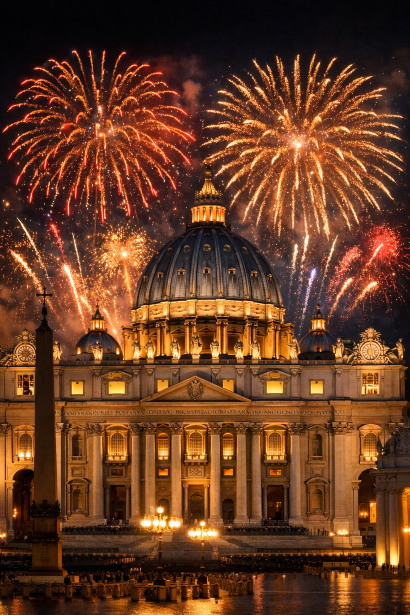
Image from Microsoft Bing AI design tool.


