Save the Date: Our Secular World Needs a Homecoming

“Holy Days of Obligation” raise questions of congruency and truancy among Catholics. Some folks resist these Church mandates for Mass attendance as random intrusions on our workaday world. Many merely ask to be reminded whether, and why, a particular feast is “still a holy day.”

This uncertainty is understandable, although it’s uncomfortably close to our secular culture’s broadly casual approach to holiness on any given day. Church leaders have allowed leeway on the scheduling of solemnities, but we laypeople dare not lose our all-purpose respect for solemnity.

We need concrete dates to aid our efforts toward disciplined discipleship. As French priest Teilhard de Chardin (1881-1955) reportedly said, “We are not human beings having a spiritual experience; we are spiritual beings having a human experience.” Our faith and reason rely on a mindfulness of values, participation in community and communion, and an infrastructure of duties.

An imminent date on the 2024 liturgical calendar—November 1, the Solemnity of All Saints—is a doorway to important insights about Holy Days of Obligation. We can explore how our plans to attend Mass on that Friday fit together within regular life patterns which nourish us as followers of Jesus and responsible members of society.

For those inquiring into Catholic thinking on these matters, we’ll build a bridge between the earthly and the transcendent by asking two questions.

First, what are some days throughout the year that your family considers its own obligatory moments for celebration, or at least attentive participation?

Second, what are some secular holidays, established by law or tradition, which you typically set aside with particular practices or relived memories?

The first question might yield answers like birthdays and anniversaries, which come around annually on a certain date. This list could also include days which we observe on an ad hoc basis: weddings and funerals, for example. Not surprisingly, the list may include holy days too, such as Christmas and Easter Sunday.

The second question will prompt mentions of the Fourth of July and New Year’s Eve. Again, the Venn diagram of social custom will show intersections; we might feel distinctly spiritual ties to Memorial Day, Veterans Day, and Thanksgiving.

In both of these arenas, we give ourselves occasional permission to make a holiday a movable feast—if, for example, travels and other exigencies require the family’s big Christmas meal to be moved a day forward or backward, or the annual visit to a relative’s grave must occur on a different date. Of course, still other important events, joyful or sorrowful, will be penciled in spontaneously.

It’s the thought that counts—in our homes and in our hearts. The thought ultimately “counts” when we put it into action. Our calendars, posted officially and customized with our personal notes, set forth the full range of mileposts and reminders which constitute a well-balanced picture of meaning. We can collect in one place the basic actions which represent being a family, a nation, and a Church.

That’s a useful way to link our “homey” obligations to a Christian calendar. It reflects a heavy emphasis on historical consistency and coherence across the years but also ample room for adjustments. These aren’t capricious or random, though they can cause Easter to “arrive late this year” or the Fourth Week of Advent to be truncated.

Holy Days of Obligation, which embrace Mass as the summit of Catholic prayer, illustrate how serious protocols can co-exist with appropriate modifications. Two factors describing these special convocations will end any uneasiness and make us feel right at home.

The term “Holy Day of Obligation” applies to every Sunday of the year, as per the Ten Commandments. Catholic Bible translations cite the third Commandment: Keep holy the Sabbath Day.

Theologians embody this in the five “Precepts of the Catholic Church,” which summarize for the faithful “the indispensable minimum in the spirit of prayer and moral effort.” The first precept calls Sunday “the foremost holy day of obligation in the universal Church.” (Catechism of the Catholic Church, paragraph 2142)

The Catechism, in para 2177, expands the explanation. It goes on to list ten additional days for obligatory celebration: Mary, Mother of God (Jan. 1); the Epiphany (Jan. 6); Saint Joseph (March 19); the Apostles Peter and Paul (June 29); Mary’s Assumption into heaven (Aug. 15); All Saints (November 1); Mary’s Immaculate Conception (December 8); Christmas (December 25); Christ’s Ascension into heaven (a Thursday in spring); and the Body and Blood of Christ (“Corpus Christi,” a Thursday in summer).

These memorials concerning Jesus, Mary, and the saints celebrate people and events at the core of the Church’s identity, so they are built into the liturgical calendar.

Over time, bishops and their nationwide conferences around the world have been permitted to make adjustments. For one thing, as America magazine points out, they can “transfer days of obligation from a weekday date to a Sunday, where appropriate.”

In the United States, bishops have also opted to make feasts (other than Christmas) non-obligatory if they fall on a Saturday or Monday, America explains.

In Hawaii, the days of obligation are limited to Christmas and the Immaculate Conception—this Dec. 8 feast honors Mary, conceived without sin, as patron saint of the United States—because of “travel issues in these tropical islands,” says America.

We might say our country is an “obligation minimalist,” to use the magazine’s phrase.

The bottom line for America is that 2024 brings only three distinct Holy Days of Obligation—the Assumption, All Saints, and Christmas. (Several clusters of dioceses chose to celebrate the Ascension with a Mass obligation on May 9.)

What about the patronal day of December 8? It falls on a Sunday this year, and Sundays in Advent take priority over feast days as a liturgical protocol, the magazine points out. Hence, the nation’s bishops have moved the Immaculate Conception day to Monday and made it non-obligatory.

Let’s face it, such shifting is not unique to liturgical planners; these are the kinds of adjustments we see in families—and in our country, where various major holidays are tweaked to create three-day weekends.

Again, it’s the teaching that counts; certain feasts and their meanings consistently stand out for their crucial relevance to our paths toward eternal life, regardless of how or when we celebrate them. Families and communities of all sizes, including religious communities, are wise to preserve their history and understandings “on the books” in this way.

We’re especially fortunate that All Saints Day, whose meaning led to All Hallows Eve (Halloween), remains as an opportunity for Mass recovery from the materialism and secular messaging increasingly rampant on October 31.

The biggest takeaway from any catechetical discussion about Holy Days of Obligation harkens back to the word “hallows.” This call to “hallow” aspects of our lives—to make and keep them holy, to apply the principle of hallowing God’s name which we assert in the Lord’s Prayer—is an excellent lesson to spread ad infinitum.

All Saints Day points us to the Apostle’s Creed, in which we affirm belief in “the communion of saints.” That’s a good name for the Church as Christ’s mystical body, consisting of all the faithful people of God, on earth and beyond, whose lives are joined with Jesus in an intercessory family that prays together and stays together.

“Since all the faithful form one body, the good of each is communicated to the others,” says the Catechism in paragraph 947.

We’re still working on our own sainthood. Thank God we can find amid the Church’s panoply of canonized, recognized saints—and its assortment of holy days—particular role models or patrons with special inspiration for us. That helps us make our best connections to the family, nation, and world, feeling “much obliged” to give each other the gift of alertly reliving what’s really important.

We can be both orderly and spontaneous in honoring our “homey” days of solidarity. Meanwhile, the Christian calendar is at hand to hallow our secular routines, inviting God’s family into a year-round habit: making dates with holiness.

Image from ClipSafari.com, a collection of Creative Commons designs.

Posted in Education, Prayer, Spirit of communication, Words | Leave a comment

It’s the Playoffs—Look for Angels in the Outfield

There is nothing like a universe to spark one’s imagination. Two Christian feast days arrive at this time of year to boost our souls’ awareness of big things to come. The feasts append our scorecard of saints. And they can expand our dream to be part of the team.  

You might say some major-leaguers took the field on September 29. On the annual Feast of Saints Michael, Gabriel, and Raphael, the Archangels, that trio reaffirms a context of remarkable history. They turned in great individual performances, but we need to remember everything they represent.

The Catholic liturgical calendar skimped a bit on publicizing them in 2024. Their feast fell on a Sunday. A US Conference of Catholic Bishops document that lists all the saintly anniversaries pointed out that this is the Lord’s Day, so keep it holy. That certainly suffices to immerse worshipers in wonder, but someone omitted from the official announcement an optional mention of those three heroes.

In an ideal universe, we’d all be on Cloud Nine marveling at Michael, Gabriel, and Raphael. There’s no worry or blame; angels aren’t looking for stardom. This year, we can simply gear up for October 2, the Feast of the Guardian Angels. Also, focusing on the Lord helps remind us He’s actually got nine “choirs” of angels in the game.

The Wisdom of Clouds

We need to entertain the thought of angels these days because this is hardly an ideal universe. Our secular lives are chock-full of astronomical change, global generalizations, spaced-out experiences, and cosmic angst. Many folks have a love-hate relationship with anything “bigger than themselves,” and they weaponize every little thing.

Plenty of us are level-headed fans of big things—comets, eclipses, cutting-edge science, and superhuman technology, as well as the awesome beauty we see in the sky. Some “creatives” are working on their visions of virtual worlds and uplifting art, aspiring to enliven the humdrum in a positive way.

Sadly, others are building private bubbles of isolation, addiction, and utopian or dystopian distraction, providing small retreats from earthly reality.

Some elitists prefer to make thoughts their giant contribution, constituting what theologian Dietrich von Hildebrand called “cults of cognition.” Narcissistic, utopian “insights,” scientific or sociological, emerge from enclaves of confirmation bias. Their bubbles of bias veer around the supernatural. Advocating “progress,” they present themselves as masters of the universe.

The Church must evangelize our culture by offering alternatives to self-centeredness, instead pointing upward, saying, “The truth is out there.”

What we’ll find is stability and surprise, requiring both reason and faith. The Psalms make the connection: “The heavens declare the glory of God, the firmament proclaims the work of his hands. Day unto day pours forth speech, night unto night whispers knowledge.”

To learn about God’s universe in an orderly way, we should talk more about angels. Few people study them, even though Judaism, Christianity, and Islam all affirm their existence in similar terms, as do the Old and New Testaments. Their story is intriguing and inspiring.

A 1995 introduction to angelology, Angels (and Demons): What Do We Really Know About Them? by noted Catholic philosopher Peter Kreeft, acknowledges we can’t offer scientific proof that angels exist. But they fit well into enduring wisdom about God’s approach to creation.

From the Minors to the Majors

His ecology embraces hierarchy and fullness. He delegates roles in a structured, interactive way and ensures that all the bases are covered, so to speak.

From the human perspective, “we see that the universe is filled with all sorts of species. Every possible rung on the cosmic hierarchy is filled,” says Kreeft. Mankind is at the top rung of earthly species and is kindred to animals and all of earthly creation. Humans are meant to cooperate as caretakers, lovingly tending our planet and its life forms.

The Holy Spirit animates our souls to be immortal spirits, which are ultimately inseparable from our human bodies. There is a huge leap between God and the spirit of man, but angels are created to close that gap, reflecting the continuity and order inherent in God’s abundant birthing.

As French priest Teilhard de Chardin reportedly put it, “We are not human beings having a spiritual experience; we are spiritual beings having a human experience.” In our earthly existence, we are linked (imperfectly) with higher realms of spirit.

God dwells with His people, and Jesus Christ was incarnated to walk with us intimately. But there’s also a support structure for us. Our delegator God created angels as communicators, or “messengers”—that’s what “angel” means, explains Kreeft, crediting St. Thomas Aquinas as the chief source of his angelology.

How to Be a Heavenly Host

Kreeft writes that angels are bodiless spirits with intelligence and will. They live eternally in God’s presence, obeying His will to communicate with us in two ways. As situations warrant, they can assume temporary bodies, or they can influence our imaginations to inform us, as through dreams (Saint Joseph, Jesus’ foster father, was a dreamer).

The nine choirs of angels, another hierarchy, are topped by the angels totally engaged in worshiping and contemplating God. The choir closest to God is the Seraphim. That’s why we imagine them on Cloud Nine. Their group of colleagues includes the choirs called Cherubim and Thrones.

The middle trio, which Kreeft casually compares to middle managers, are the Dominations (or Dominions), Virtues, and Powers.

The group on the lowest tier, specialized as warriors and guards, offers the closest companionship to humans. They are remarkable allies in a universe where spiritual warfare (between angels and their fallen counterparts, the demons) is a constant behind the scenes.

More and more people, secular and religious alike, admit they see this warfare in today’s headlines. Humanity is caught up in the “good vs. evil” battle.

Aleksandr Solzhenitsyn described it this way: “The line separating good and evil passes not through states, nor between classes, nor between political parties either—but right through every human heart…. Inside us, it oscillates with the years. And even within hearts overwhelmed by evil, one small bridgehead of good is retained.”

Kreeft writes, “Our natural battles are surrounded by a supernatural battle.”

The army of the loyal angels is stronger than the rebel angels. The demons have lost the war, but deadly skirmishes, where souls face grave risk, persist in our time and place. Kreeft warns us: “We desperately need to recapture this vision today.”

Angels, as allies alongside us, come to our aid when we believe in them, invite them in, and respond to them with an action-ready “yes.” It’s actually a “yes” to God’s love and will.

At the top of the third tier of angels are the Principalities, guarding communities and nations. Archangels come next as the crucial message-runners in the fighting force, conveying important information/transformation from God to mankind.

Within the last-but-not-least choir, honored on October 2, all human beings have ever-present Guardian Angels. Because they can’t violate our free will, they literally wait upon us. Imagine them saying wistfully, “Give me something to do!”

The September 29 feast arises from the fact that Michael, Gabriel, and Raphael are the three archangels mentioned in Scripture.

Parts of the Bible refer to St. Michael as the “prince” of God’s warriors, wielding a sword in spiritual warfare against Satan and the other rebel angels. Some bishops around the country have reinstated the Prayer to St. Michael, traditionally said after Sunday Mass. It was written by Pope Leo XIII (1810-1903).

St. Gabriel is likewise mentioned in several Scriptural settings, largely playing the role of a great communicator of good news. He speaks in the Book of Daniel to prophesy the coming of the Messiah (Daniel 9:21-27), and he later informs Mary that she shall become the Mother of God (Luke 1:26). The Vatican has named him a patron saint of communication.

Islam also honors Gabriel for a very prominent role—as the angel who conveyed the Quran to the prophet Muhammad. The religion also recognizes Michael, as Kreeft points out.

St. Raphael is honored as a great healer in the Book of Tobit, an Old Testament book deemed inspired by Catholics but rejected by Protestants. This archangel accompanied Tobit and his son Tobias on a difficult journey and cured Tobit’s blindness (Tobit 12:5-17).

Don’t Just Wing It

These heroes singled-out for the Christian feast of archangels can help people of various faiths to picture a universe with greater spiritual “population”—and potential—than we have imagined.

That recalls a riddle: What is the difference between a paranoid and a mystic? The paranoid believes the universe is conspiring against him. The mystic believes it’s a conspiracy in his favor.

This mystic’s conspiracy theory is one in which we should want to participate. Even though the Church does not require us to believe in angels, anyone intrigued by the universe and suspecting that collusion therein must have a meaning will want to sign up with those forces who are working on our behalf.

This elevated, mitigated field of competition resonates with us whenever we call to God for help. It should also appeal to those who have started to think they must be God in their own little universe. Why undertake that effort? We need a universe that minimizes chaos, maximizes fulfillment, and has a reliable infrastructure.

Let’s summarize the sustainable ecology represented by Michael, Gabriel, and Raphael, along with guardian angels and the other choirs loyal to God (and us). At this time of year, in these kinds of times, we’ll allow our imaginations to venture beyond Kreeft’s authoritative text.

We can reflect on a universe where a loving and creative God, who knows all, encourages contemplation and action, faith and reason, justice and mercy. He bestows great dignity on an immense diversity of creatures who can use all their faculties freely and fruitfully.

Of course, free will also implies that some creatures will carelessly go rogue against God’s inclusive, unifying plan for “no vacancies” among heaven’s many mansions. The rebel angels tried this, and there was hell to pay.

As we see on earth, the looming presence of rebellion and chaos within and among us requires a high level of orderliness, attentiveness, diligence, and accountability. We have role models for the rigors of preparedness we should undertake. Think of the warrior angels as Navy Seals—or the US Secret Service (at its best).

Consider this: Our guardian angels are accountable to God for responding to our properly registered requests! Remember George Bailey’s “angel second class” Clarence in It’s a Wonderful Life. His duty involved a gigantic task serving a stubborn client, but together they made a wonderful movie.

A sense of hierarchy, which earth’s history and our natural selfishness have taught us to resist, is actually a great boon on the universal scale. Humans—and angels—are most liberated and joyful when we discern where we’ve been posted and what our delegated roles are, when we humbly follow the lanes on the highway to heaven.

Christian author G.K. Chesterton famously said, “Angels can fly because they take themselves lightly.”

Angels? Guardians? Cardinals? Miracle Mets?

We recognize responsibilities toward—and receive beneficence from—many fellow creatures in our spiritual travels. They are the points of triangulation helping us to navigate our paths. If we’re busy moving people around like pawns through manipulation, we might think we’re on-course, but our internal gyros are fried. It’s like cyber-warfare against ourselves.

Everyone should receive what is due to them. Like the denizens of clouds seven, eight, and nine, humans owe praise and worship to our perfect, all-powerful, all-loving Creator. Moreover, we owe other creatures the same love which God bestows on them. We’ve been told, “Love one another as I have loved you,” and “Do unto others as you would have them do unto you.”

Lastly, the universe (scientific and spiritual) is an amazing example of connectivity. God wants angels, saints, and humans communicating all the time, praying for each other, celebrating creation, learning and teaching, keeping each other humble and whole. Pope Francis has reminded us, “Love always communicates.” Nothing is hidden that will not be revealed. (Luke: 8-17)

These are a few things we might learn from the Feast of the Archangels and the Feast of the Guardian Angels. The fact that these angels know what they are doing can encourage us to make at least a best guess about ourselves.

Whether or not we use a liturgical calendar, let the baseball playoffs remind us of this season of heightened awareness. It’s no fun if we don’t choose our loyalty to a team—in this case, a team that’s loyal to us.

These days, our polarized culture’s conflicts between good and evil can no longer be downplayed like a national pastime. This is serious business, universally. The eternal presence of the angels is a frame of mind worth constructing and maintaining. If we build it, they will come.

Image from AI designer function of Microsoft Bing

Posted in Prayer, Spirit of communication, Words | Leave a comment

‘Try to Remember, And If You Remember, Then Follow.’

“Never forget!” It’s an urgent call that requires not only personal serenity sufficient to recollect truths, but also a strong social infrastructure able to reignite awareness.

Although the terror attacks of Sept. 11, 2001, seem far behind us, we who have felt their impact probably agree they still deserve a place in our memories and emotions—and in some sort of “lesson plan” for the future. Shouldn’t succeeding generations examine that day through the insights of their parents and ancestors?

Yes, but Baby Boomers and others will differ about what they want to remember, maybe what they can remember. Some individuals signed up for the military. Others faced deep sorrow they want to leave behind.

We have set aside September anniversaries for 23 years in order to ponder how America was transformed in the short term and long term. We’ve seen a lot of greatness, learning, anger, fear, and grave error.

On the positive side, Americans have instituted activities which recall virtues illuminated at the time, providing inspiration and healing. President Biden and our presidential candidates, Vice President Kamala Harris and former President Donald Trump, attended the 2024 memorial service to show solidarity at New York’s Ground Zero.

But the current environment of rapid change and serial crises worldwide outpaces the healing. Large groups this year have faced critiques of their reactions to the events of a newly prominent date of terror—Oct. 7, 2023. That day hearkened back to a “never forget” call issued long ago.

After the Holocaust, decades of efforts to capture that encounter with evil in words and images, museums and initiatives, and disciplines like history and philosophy built a potent but partial bulwark against blights like antisemitism.

However, no “lesson plan” can transform human nature or dictate uniform judgments about justice. Any endeavor to spell out the meaning of 9/11 will be vulnerable to changing fact patterns and priorities, not to mention our short attention spans and imperfect wisdom.

So, what can we do? As with all matters of jeopardy, let’s frame our answers in the form of a question.

We can prompt discussions about 9/11 by assembling stories from that day and its aftermath which continue to challenge us. The best stories will drill down into themes about protecting human dignity. Honest inquiries will encourage young people to reflect on connections between the personal and public, specific and multidisciplinary, fact-based and passionate, earthly and transcendent.

Jesus, following his own people’s traditions, expanded hearts and minds by asking questions and telling parables that prompt ongoing interpretation, even today.

“I will open my mouth in a parable, unfold the puzzling events of the past,” says Psalm 78. “What we have heard and know; things our ancestors have recounted to us. We do not keep them from our children; we recount them to the next generation.”

We should formulate our parables and perplexity now while we’re attuned to the mystery in our history. We’re nervous that society’s puzzles have missing pieces.

“Those of us reared on reason, logic, and basic human decency find ourselves a bit befuddled these days, trying to make sense of what is rapidly devolving into a Grand Guignol of political, moral, and cultural horrors,” Liel Liebowitz wrote in the latest edition of First Things. Questions now debated about such fundamental topics as law and order, rights and freedoms, and nationhood provide “all the proof we need that this is a grave moment for our republic.”

Our stories of concern will be hopeful but raw, confronting souls with the fog of war that rose up after the Twin Towers collapsed. We must invite help in today’s battles against isolation, polarization, and despair.

The post-9/11 secular society craves strong anchors like the wisdom of our founders, who cobbled together faith in God, ourselves, our communities, and our country to establish an orderly (albeit flawed) whole.

With those aspirations in mind, here are six components of a lesson plan, or discussion guide, which might promote justice down the road while also doing justice to those who perished in New York City, at the Pentagon, and on United Flight 93.

Help the nation come together.

Most Americans earnestly want to find unity amid our diversity, and 9/11 reactions offered a glimpse of progress, at least at first. Now, liberty seems geared more toward expressive individualism than solidarity among citizens. Suspicion toward “nationalism” overshadows patriotic pride.

NewsNation TV host Chris Cuomo recently voiced deep frustration over the societal damage done by political purveyors of violence and chaos. He opened his Sept. 16 program mulling the previous weekend, when President Trump faced a second assassination attempt.

“United we stand, divided we fall,” Cuomo said, quoting patriot Patrick Henry. “And it’s even more true today…. We need a reason to believe in who we are at our best, and we are starved of that…. And I keep seeing the use of the word ‘hate’ everywhere in our politics.”

Cuomo demanded soul-searching. “We’ve got to get out of the judgment business, unless it’s judging ourselves…. Why aren’t we caring about each other?”

The neglect of human dignity is not bubbling up from the grass roots, Cuomo assured viewers; most Americans “don’t feel a connection to [the partisan rancor] in your life.” That’s because “our communities are strong, our people are strong, we care about one another,” he said. “But there is a top-down phenomenon, and it is corroding us.”

If our leaders are obscuring the opportunity to renew compassionate camaraderie, an outline of learning from 9/11 is neither necessary nor possible.

Beware of overreaction to hatred and violence.

The average American’s direct experience from 9/11 was not hatred or violence, but literally terror. In 2024, hatred and violence seem to have spread organically.

Too many thought-leaders have found that fear—whether personified by migrants or “extremists” or other assorted labels—is a powerful influence. It’s fertile soil in which to plant seeds of enmity, promises of protection, and risks of overreaction, military or otherwise.

We can remind young people of a legendary leader, Mahatma Gandhi (1869-1948), who told us, “The enemy is fear. We think it is hate, but it is fear.”

Terrorism claims many victims. Besieged individuals take cover. Nations “watch over” their people and take action abroad, perhaps overdoing one or the other, or both.

When President Joe Biden met with Israeli prime minister Benjamin Netanyahu shortly after last year’s murderous raid by Hamas, he combined his appeal for humanitarian aid to suffering Palestinians with an admission of guilt.

“Justice must be done,” Biden said as quoted in The Guardian. “But I caution that, while you feel that rage, don’t be consumed by it. After 9/11, we were enraged in the United States. While we sought justice and got justice, we also made mistakes.”    

Cherish first-responders, “look for the helpers.”

Almost 3,000 people died in the attacks on September 11. According to the United Nations, more than four hundred first-responders lost their lives in New York alone.

UN Secretary-General Antonio Guterres pointed out on the twentieth anniversary in 2021 that firefighters and others headed toward the World Trade Center that day, “with many making the ultimate sacrifice, exemplifying the very humanity and compassion that terrorism seeks to erase.”

Before turning our heads away from documentaries about that day’s horrors, or from coverage of other human tragedies, it is wise to recall the script-flipping guidance of a more grass-roots influencer, television personality Fred Rogers (1928-2003).

This host of the long-running gem for children, Mr. Rogers’ Neighborhood, is known for the timeless advice he offered for viewing scenes of terrible harm and fear. Quoting his mother in a scene archived on YouTube, he instructed, “Always look for the helpers. There will always be helpers….”

Self-sacrificial instincts for heroism, seen every day in big and little forms, are a worthy subject for meditation in the post-9/11 world.

How can people develop this preferential option for service? The Gospels, with the Beatitudes and the parable of the Good Samaritan, are a good place to start.

The Tunnel To Towers Foundation has created a “9/11 Institute” website with educational resources. They’re intended to teach children “about the extraordinary heroism and goodness of everyday people who inspired our nation and demonstrated the strength and resilience of America’s spirit.”

Be prepared.

It’s neither cliché nor sexist to admonish people with the traditional Boy Scout motto, “Be Prepared.” Today’s Boy Scouts of America has emerged from bankruptcy and welcomes girls as members in such programs as “Scouts BSA.”

The BSA website says its mission is “to prepare young people to make ethical and moral choices over their lifetimes by instilling in them the values of the Scout Oath and Scout Law.”

Here’s the oath: “On my honor, I will do my best to do my duty to God and my country and to obey the Scout Law; To help other people at all times; To keep myself physically strong, mentally awake, and morally straight.”

What’s the law? “A Scout is: Trustworthy, Loyal, Helpful, Friendly, Courteous, Kind, Obedient, Cheerful, Thrifty, Brave, Clean, & Reverent.”

We could add to that checklist of holistic health a diligent pursuit of excellence, an embrace of teamwork, and the kind of fortitude which enabled so many emergency workers to perform grueling duties at Ground Zero for many months.

Much of what we can absorb from the Boy Scout oath was taught in a mightily adult way by the passengers of United Flight 93 as they resisted their captors in the skies above Shanksville, Pennsylvania.

Speaking to families at that memorial site on the twentieth anniversary of the terror attacks, former President George W. Bush highlighted even deeper qualities all citizens should be prepared to display—such as sympathy, empathy, self-reflection, and loving memory.

“Today,” he said, “we remember your loss, we share your sorrow, and we honor the men and women that you have loved so long and so well.” Across the country on the day of terror, “there was shock at the audacity of evil and gratitude for the heroism and decency that opposed it.”

Bush continued: “As a nation, our adjustments have been profound. Many Americans struggled to understand why an enemy would hate us with such zeal. The security measures incorporated into our lives are both sources of comfort and reminders of our vulnerability. And we have seen growing evidence that the dangers to our country can come not only across borders but from violence that gathers within.”

Be imaginative.

There’s one form of preparation in which America proved insufficient on 9/11. It may elude us more than ever in these times of passive, indifferent spectatorship and addictions to entertainment and sloppy thinking.

We should never forget the insightful warning found in the Final Report of the National Commission on Terrorist Attacks Upon the United States. The 9/11 Commission’s observation about the failures which led to that disastrous day has eye-popping relevance to this moment before our 2024 elections:

The most important failure was one of imagination. We do not believe leaders understood the gravity of the threat. The terrorist danger from Bin Ladin and al Qaeda was not a major topic for policy debate among the public, the media, or in the Congress. Indeed, it barely came up during the 2000 presidential campaign.”

We must demand more of our government even as contemporary democratic governance demands more of us. If indeed this year’s selection of a new president is largely about each candidate’s character, as some pundits argue, we must seek characteristics that go way beyond those cultivated by partisan machines, superficial popularity, and political paralysis through fear or personal animus.

A lack of candid, informed, and widespread debate in the public square about crucial issues deprives us and our leaders of outside-the-box ideas and ingenious, foresighted overviews.

Find the Cross at Ground Zero.

Good questions about, and good uses of, imagination lead us into the world of philosophy and theology. Many people today—whom we might place in such categories as relativists, positivists, materialists, progressives, or the depressed—limit their own power for creative thinking. The 9/11 Commission would probably call that limitation suicidal.

“When you are anxious or worried, you shut imagination down,” wrote Robert Evans Wilson Jr. in a Psychology Today blog. He quoted motivational writer William Arthur Ward (1921-1994) as saying, “Nothing limits achievement like small thinking; nothing expands possibilities like unleashed imagination.”

Just as it can be true that “seeing is believing,” we can sometimes say that “believing is seeing.” We find what we’re looking for, Wilson pointed out. We see only what is familiar.

We need open minds and keen imaginations—not to invent fanciful distractions, but to see a wider range of important possibilities more clearly. That’s the purpose of a liberal arts education, ideally one blending faith and reason.

In The Cross at Ground Zero, Franciscan author Father Benedict Groeschel (1933-2014) discussed how post-9/11 rescue workers preserved a cruciform remnant of World Trade Center girders because it spoke of their belief in Christ’s redemptive presence at that scene of devastation.

Groeschel said in an archived video that the cross was a reminder of mysteries which, when acknowledged, can be liberating. “Evil is a mystery,” he commented, adding that it does little good to keep asking “why did this happen?” Instead, the useful questions are: “Where do we go from here? What do I do now?” For those rescue workers, the answer was, “Keep digging.”

When Pope Francis visited New York City in 2015, he spoke to representatives of various religions at the 9/11 Memorial and Museum. He called it a “place of sorrow and remembrance,” but he added that “our presence together will be a powerful sign of our shared desire to be a force for reconciliation, peace, and justice in this community and throughout the world.”

Many additional faith-filled insights emerged from the terror attacks, including the view—now echoed even by some secular commentators in connection with today’s turmoil—that society is in a spiritual battle. In other words, we need strong alliances with our guardian angels.

The angels are a good reminder as we strive to follow the lesson plan presented above. We’re not alone, either on this mortal plane or higher. Learning from 9/11 is a group exercise, an open-book test, with plenty of resources available, and we get credit for showing our work.

When the twenty-fourth anniversary of that day arrives, perhaps we’ll be better prepared to assess the information guiding our minds, hearts, and homeland. All generations should want to improve at reacting to, and shaping, the opportunities for transformation ahead. Our simple message can be: Try to remember the kind of September we should never forget.

Image from ClipSafari.com, a collection of Creative Commons designs.

Posted in Education, Spirit of communication, Words, Writing | Leave a comment

Not Unburdened: Why You Gotta Be So Meme?

It’s like I just fell out of a coconut tree. I still don’t fully understand what Vice President Kamala Harris means by promoting “what can be, unburdened by what has been.” Please join me as I seek help through the not-so-ancient art of memesplaining.

Like all Americans who want to minimize misplaced emotions, misleading messages, and mysterious policy promises in the world of public affairs, “Phronesis in Pieces” enjoys discerning what our 2024 presidential candidates really say and mean.

Memesplaining, or using wisdom and wit to sort through trends in internet culture, ultimately boosts our insight into “we the people,” not politicians alone.

What’s New? And What’s Old?

This semantic scrutiny of the Kamal-axiom we’ll call “Unburdened” intends no ridicule toward a person or perspective. Interpreting Harris’s turn of phrase is a worthwhile effort because she’s addressing a serious duty we all face—to balance change and coherence, past and future, accountability and opportunity.

Voters and leaders must try to interpret each other. Our social-media dance comprises hyperbole, hypocrisy, and other brain gymnastics performed in a politics of shortcuts.

The conclusions we draw about candidates’ intentions and approaches become as weighty as the more focused, practical “issues” typical in old-school campaigning.

When Harris told CNN in her August 29 interview, “My values have not changed,” she was using a “macro” that left many supporters satisfied while other viewers demanded more specifics. Her comments criticizing or dismissing former President Donald Trump as untrustworthy and weird arguably said all she needed to say.

Rich Lowry, a journalist who favors Trump, set the scene for this in an August 26 New York Times guest essay. He predicted that issues in this race largely will be “proxies for character.”

Online assaults against the “Unburdened” axiom suggested Harris is a Karl Marx groupie. One wag, or many, also mocked the quote with a meme of Yoda speaking a Jedi word salad.

The references to Marxism, echoing Trump’s insults and hyperbole, came from voices such as conservative commentator James Lindsay. He disparaged Harris’s phrase as an example of class-struggle rhetoric. Marx, analyzing labor vs. capital, foresaw that humankind could “self-create” and the present could “dominate the past.”

Pundits imply Harris remains vague about how her past positions have changed so she can focus on impressions of the present. Trump impresses people with nostalgia for yesterday. But more crucial for American voters is each candidate’s vision of tomorrow.

The Sum Will Come Out Tomorrow

Harris seems predisposed toward making new policy. Her recent tinkering with economic plans may be a proxy to build fervor about cultural change. The plans entail “opportunity” and monitoring of big business.

In a 2023 “Fight for our Freedoms” presentation at the Reading (Pennsylvania) Area Community College, context showed her Kamal-axiom fits a culture of the new: “The point about progress is to have the ability to have a vision, and a belief, and some faith in what can be, unburdened by what has been.”

Her call for optimism and imagination reaches voters uninspired by Trump’s grumpiness. After all, it’s commonly said that “the people perish without a vision.”

One biblical caveat: A Catholic translation of that maxim is more conservative in tone. Proverbs 29:18 reads, “Without a vision, the people lose restraint; but happy is the one who follows instruction.”

The idea of having “faith in what can be” prompts one more caveat: While a group’s vision of future possibilities can be grounded in faith, it needs detailed, democratic bona fides before it gains status as an article of faith for all.

Progress isn’t a religion. Secular utopias we conjure might offer no safe space for pearls of great price we cherish. Christian writer G.K. Chesterton (1874-1936) warned that “men invent new ideals because they dare not attempt old ideals. They look forward with enthusiasm because they are afraid to look back.”

In today’s cultural mash-up of relativism and moralism, a utopian pursuit without broad buy-in might only divide the public into “oppressed vs. oppressor.” A candidate’s embrace of tomorrow’s changes could be seen as defiance toward time-tested traditions, institutions, knowledge, and values.

‘When I Lay My Burdens Down’

Voters will do well to reflect on Harris’s keyword, “Unburdened.”

The Democratic National Convention liberated supporters to breathe the fresh air of “a new way forward.” But others might fear winds of change that once honored “creative destruction” in business. Facebook’s original motto, “Move fast and break things,” has been repealed, opponents might say.

No one’s calling Harris a nihilist, who paves a new path over a “scorched earth.” Think of another Kamal-axiom, “Coconut Tree.” An NPR report took us back to an event where she commented, “My mother … would say to us, ‘I don’t know what’s wrong with you young people. You think you just fell out of a coconut tree?” Her mom, she explained, meant that “you exist in the context of all in which you live and what came before you.”

In other words, Harris was well-taught that we should not take our identities lightly. We must be free to be who we are. US Supreme Court Justice Anthony Kennedy gave this idea wider berth in 1997: “At the heart of liberty is the right to define one’s own concept of existence … and of the mystery of human life.”

Many folks try to create their own identities in isolation, or sign on with pre-established groups. They may downplay all the forces, from God to family to everyday life, which shape their unique personhood in a broader context of connection.

One’s own history may be filled with pains and injustices—burdens which ache to be addressed, maybe redressed. Couldn’t we agree that generally it’s good to be freed from those things?

Well, we unburden ourselves in various ways—perhaps rationalizing different pieces of our puzzle; or healing a relationship through forgiveness; or pointing a finger of blame; or exacting a penalty to negotiate a new balance. Applied society-wide, the latter two approaches tend toward a “victim vs. victimizer” motif which polarizes us further.

We must unburden wisely. Many times, we have caused or contributed to our own pain through our emotions and behaviors. Or we carry the weight of guilt. These may be burdens we should set aside, but it helps to begin by better understanding what placed us in our current state. Individuals, and nations, must learn from our errors and correct them.

This often requires confronting uncomfortable realities—and seeking truth and forgiveness in relationships with God and neighbor. Religion offers healing for burdens of guilt. It’s refreshing to hear candidates, and ourselves, occasionally say, “I was wrong, I came up short, I’m sorry.”

Changing Your Mind in Public

Likewise, we might hinder dialogue and wisdom with the mantra, “My values have not changed.” Judeo-Christian values call for a personal penitence which looks backward and forward. The Greek word for repentance, metanoia, means “to turn around,” or change one’s mind.

If we fail to admit our own responsibility, we add to the burdens of others. Families and governments can pander to us, but someone’s got to pay for it.

Strategic promises of joy and “good vibes” are a growing political tactic in our emotion-driven age. This unburdening is cruel if leaders merely promote escapism to win elections or build group loyalties. It’s doubly cruel if they trade in schadenfreude, making an audience feel happier by blaming or maltreating the strawman du jour.

We must face facts. In many cases, people and societies simply must grapple with their burdens, not shed them. There is a long, sad list of problems against which American leaders has failed to marshal forces.

“Feel-good” politicians must courageously resist unburdening themselves and others from a nation’s enduring responsibilities. These include defending the U.S. Constitution; respecting human dignity and inalienable rights; and promoting ever-greater justice, especially for those on the margins.

Pertinent to our concern about the present dominating the past, we do well to remember everyone’s burden to support righteous customs and structures which have anchored generations. Our debt to history and civilization was described eloquently by Chesterton:

“Tradition means giving a vote to the most obscure of all classes—our ancestors. It is the democracy of the dead.” He went on, “Tradition refuses to submit to the small and arrogant oligarchy of those who merely happen to be walking about.”

Today’s leaders and voters should also extend the promise of our democracy to those not yet born. Any “new way forward” logically must care for our children and safeguard the world’s future.

Please Come Up to Receive Your Burdens

This deep exploration of the Kamal-axiom has attempted to model the kind of serious assessment Americans should conduct regarding their candidates for U.S. president. If our marketplace of ideas supplies us mostly with shallow knowledge and meme-talk, we must make the best of our raw material.

But it’s only a cognitive game unless we connect current events and real experiences, personal and societal, to each candidate’s professed awareness of life’s profound burdens.

To help us plan our own ways forward, we must viscerally grasp responsibilities we have heard both Harris and Trump acknowledge in different ways: holding tight to our values, being open to change, seeing ourselves in a historical context, and envisioning “what can be, unburdened by what has been.”

Then we must dig even deeper. Plentiful sources of information and inspiration can help us appreciate our call  to duty. Look at our fellow citizens—neighbors, heroes, the elites, the homeless. We can add another politician, whose comments have also fallen victim to memes.

Senator J.D. Vance, vice-presidential nominee on the Trump ticket, has hit bumpy rhetorical roads while trying to take our republic and his role seriously.

The New York Times published an in-depth piece on August 25 identifying Vance’s 2019 conversion to the Catholic faith as evidence of “some core values at the heart of his personal and political philosophy and their potential impact on the country.”

Vance “absorbed the lived Christianity of his grandmother” when he was raised as an evangelical, as described in his own book, Hillbilly Elegy.

Elizabeth Dias wrote in The Times that Christianity provided structure and “moral pressure” for Vance during his difficult childhood. She quoted him as saying, “That feeling—whether it’s real or entirely fake—that there’s something divine helping you and directing your mind and body, is extraordinarily powerful.”

Catholicism later gave Vance a way “to counter what he saw as elite values, especially secularism,” Dias wrote. “He was drawn not just to the Church’s theological ideas, but also to its teachings on family and social order and its desire to instill virtue in modern society.”

This meshed with his concerns about America, including “what he saw as the abandonment of workers to the unhappiness of childless cat ladies,” Dias reported.  Vance now “seeks to advance a family-oriented, socially conservative future through economic populism and by standing with abortion opponents.”

She continued, “Much has been made of Mr. Vance’s very public conversion to Trumpism and his seemingly mutable political stances,” but he found clear ways to express his personal philosophy.

The treatise City of God, by St. Augustine (354-430) with its rebuttal of Rome’s hedonistic ruling class, impressed Vance as “the best criticism of our modern age I’d ever read.”

That’s one example of living beyond our memes. Many other people, historical or contemporary, have compelling stories about the responsibilities they choose to bear and the burdens they have laid down.

Finding the Golden Meme

The best way to practice memesplaining as part of our preparation for voting is to listen to candidates, to assume the best about them, despite  mushy, messy, or mean statements.

They reflect “we the people.” We can then “turn around” to examine the visions we have formed through the years.

This pastime brings us into vicarious dialogue with the electorate and its vast resources for discernment. After all, the word “meme,” besides being a form of amusement on social media, is defined as “an idea, behavior, style, or usage that spreads from person to person within our culture.” There’s plenty of potential for constructive content, and discontent.

Our candidates—and our presidents—become thought-leaders whether or not they emerge as wise and true “leaders.” If we diligently inquire into the context of this race, especially if we rise above the party games played on our screens, we become the leaders needed for tomorrow.

We might discover new guidance from God, who’s always in the chat room offering truths which are indeed hard to express. One way or another, we’ll strengthen the philosophical sinews of democracy.

I will continue grappling with Kamal-axioms like “Unburdened.” Harris has a way of opening our eyes, getting us talking, arising from the “same old” political funk of recent years. In equal and opposite measure, Trump is pointing us toward principles to bear in mind, to make new again.

The need for meaningful memesplaining—expanding beyond mundane messages, distractions, and emotions—has never been greater.

If the 2024 campaign is indeed giving us a clear choice about the future, that’s a burden we should propagate mimetically throughout the electorate, encouraging more reflection and engagement.

It’s time to ask: “Seriously, what can be? What should be?” Now that we’ve fallen out of the coconut tree, we can return to Yoda, demanding a clearer translation.

Image from meme posted by Leor Sapir, included in Know Your Meme article published July 2024.

Posted in Spirit of communication, Words, Writing | Leave a comment

Surprised by Politicized ‘Joy’—An Ode to Decode

This commentary is also published in “Phronesis in Pieces,” at billschmitt.substack.com. Please consider subscribing there to support a large archive of articles at the intersection of faith, public affiairs, journalism, and our society’s craving for truth, hope, and love. You’ll also find aditional coverage of the Vatican’s annual World Communications Day messages and abundant links to online content for students of wisdom as a virtue we citizens are called to practice.

Vice President Kamala Harris “does it all with a sense of joy.” That’s how her running-mate, Governor Tim Walz, has described the current campaign of “happy warriors.”

Their opponent, former President Donald Trump, briefly evoked exuberance in an August 14 speech. He promised his audience that “every day will be filled with opportunity, hope, and joy”—so long as they “never let [Harris] get anywhere near the White House.”

Trump’s grumpier approach to happiness—his salesman-like focus on a “burning platform” for which he’s the ideal firefighter—had already prompted TV’s Morning Joe host Joe Scarborough to summarize the two candidacies. The Democrats reflect “hope and optimism,”  he said, and the Republicans show “dourness and anger.”

Beloved Christian author  C.S. Lewis (1898-1963), whose many books included Surprised by Joy, might have balked at such casual descriptions and distinctions now common in secular American politics.

Lewis once called joy “the serious business of heaven,” cautioning against extended earthly embraces of festive “dance and game.” Appeals to “frivolous” optimism are “unimportant down here,” he wrote, “for ‘down here’ is not their natural place.”

We still should defend joy. It’s not a bad thing, and the Lord knows we need to experience it before our eternal reward. It’s one of the fruits of the Holy Spirit (Galatians 5:22), not just a free sample for shoppers in the marketplace of ideas.

One can expect it to be a theme, or at least the tone, of the 2024 Democratic National Convention, starting August 19.

Recall that attendees at the Republican Convention last month showed authentic joy about their candidate, who had just survived an assassination attempt. They also danced to country music and applauded the showmanship of Hulk Hogan.

Episodes of delight bring people together and boost their resilience. A journalist for Politico opined that “the joyful aspect” of the Harris-Walz campaign helps them to “not get bogged down in the attacks which are coming on them.”

But we can acknowledge that joy is most meaningful as “an unsatisfied desire” which points beyond itself, toward the real bliss to which God invites us, according to Lewis. We dare not make the world’s escapism our false idol if we believe that, one day, we will escape.

This long-term view is akin to Aristotle’s description of true happiness: the one thing you can choose for itself. “Everything else is selected for the sake of happiness,” as noted by the Magis Center, a Catholic  website about faith and reason.  

Our task is to decide wisely where we shall seek and find the fulfillment called happiness. Perhaps in hedonism or egotism. Better choices would be a contributive life or a loving relationship with God and others, Magis recommends.

These are high-minded ideals which challenge us to think critically and elevate our perspectives.

Sadly, many folks have a more mundane reading of the “pursuit of happiness” promised in the Declaration of Independence. And “joy” now has a dubious role as a popular buzzword in the marketing of food products and luxury items.

A strategy called “joy marketing” drew attention from Advertising Age back in 2015. The makers of Reddi-Wip hired a psychologist to help them sell whipped topping, and they created ads exclaiming, “Share the Joy!”

Other companies also sought psychological help based on a finding that “93% of Americans want to find more ways to experience joy,” the newspaper reported. Fully 83% “would like to experience small amounts of joy daily vs. larger, occasional doses.”

Marketing Scoop commented this year that we’ve seen many more examples of feel-good marketing. Think of the “I’m Lovin’ It” campaign McDonald’s adopted. Burger King tells us, “Have It Your Way! You Rule!”

Joy is in danger of being dumbed down.

Especially these days, when so many people are suffering from depression, anxiety, stress, isolation, and polarization, we naturally want to bring some delight into others’ lives right now.

Politics has become a space for offering respite or revenge in a culture of victimhood and quick complaint. As noted by comedian Chris Rock, society has become an “emergency room” full of people with paper cuts. It’s tempting to resolve grievances with hefty doses of affirmation and occasional pandering.

But C.S. Lewis would advise people to question government handouts of joy by citing life’s inevitable ups and downs, summoning a sense of solidarity with a recognition that we all carry crosses. In light of the diligence we must cultivate, we can be forgiven for occasional outbreaks of grumpiness.

Happiness stands as a counterpoint to the sacrifices and tough choices we must make although we prefer easy answers. Suffering deepens and sweetens the message of joy, making it less propagandistic, more realistic, and prone toward community-building. 

St. Francis of Assisi (1181-1226) is known for his philosophy of “perfect joy”: Even those who suffer an offense or marginalization can survive when an opportunity for earthly joy has gone awry. They can become more keenly aware of the superior sweetness which awaits them.

This awareness is most fruitful when both the bestower and the recipient participate.  

For example, a Franciscan residence where humility is lacking might erroneously become “closed to the poor and forsaken, to those who knock uninvited and unwanted at the friary door,” as explained at the Franciscan Media website.

Once the residents have grown in humility, however, “the friars have learned to see their own brokenness, their jealousy, their desire for power. And they have learned to forgive that in themselves and in each other.” They can laugh at themselves, develop perfect joy, and welcome the stranger. That makes their friary “a healing place for others.”

This is a lesson for politicians—and voters. If we don’t adopt a more forgiving and people-centered mind frame, joy shrinks to a marketing gimmick that can’t be deeply shared.

The Judeo-Christian call to accompany others on their life journeys requires understanding their pleasures and pains, as well as cooperatively choosing paths toward hope and change. For politicians, this demands honest clarity about policy proposals and the reasoning behind them.

Voters are now turning to presidential campaigners Harris and Trump for more details of their plans, plus transparency regarding their perspectives. Next steps must include not only debates between the candidates, but also lively deliberations among Americans, fostered by the news media.

It’s not sufficient for aspiring leaders to exchange insults which enrage and engage electoral warriors. Likewise, it’s silly to recruit warriors with pacifying messages like “You Rule!” or “Share the Joy!”.

Voters should settle for neither political condemnations of “victimizer” groups nor politicians’ vows that they have America’s best interests at heart.

Tokens of goodwill are inadequate in 2024. Our imminent decisions are complicated by fundamental differences in how one defines America and its proper trajectory among powerful global movements. Think of such catchphrases as “oppressor vs. oppressed” and “you will own nothing and be happy.”

Louis Brandeis (1856-1941), who served as an associate justice of the US Supreme Court for more than two decades early in the 20th century, warned about easy answers based on good intentions, whether they’re evinced by smiles or smirks, whether they spring from expertise, gut instinct, or focus group findings.

“Experience should teach us to be most on our guard to protect liberty when the Government’s purposes are beneficent,” he said. “Men born to freedom are naturally alert to repel invasion of their liberty by evil-minded rulers. The greatest dangers to liberty lurk in the insidious encroachment by men of zeal, well-meaning but without understanding”. (emphasis added)

The urgency of Brandeis’s wisdom has grown at our “moment in time” when emotions and social-media videos, often centered on promises of joy, are all too dominant in our thought patterns.

Many of today’s appeals to mere optimism echo the old General Electric slogan, “Progress is our most important product.” Members of the Baby Boom generation (including Trump, born in 1946, and Harris, born in 1964) grew up with this ethos.

Both candidates need to scrutinize their own worldviews. The allure of progress is similar to the allure of joy. Both must be seen in a bigger context of short-term realism and long-term purpose, as Lewis told us.

Another great Christian author, G.K. Chesterton (1874-1936), agreed that secular societies set oversimplified goals. “Progress,” he wrote, “is a comparative of which we have not settled the superlative.”

In other words, we in this secular age must determine our answer to the pressing question Jesus asked in Mark 10:36. “What do you wish me to do for you?”

The political observations above are intended not as judgments against particular campaigns or parties, but as thoughts to help us decode what joy might mean when it pops up in political news headlines.

Clearly, the word captures something humanity craves at this time, at all times. We have witnessed that its impact is limited when God is banned from competing in the public square.

Dismissing “the serious business of heaven” makes our thinking less coherent, our ideas less compelling, our society less compassionate, our spirits less buoyant, and substantive change less likely. Or maybe the chance of change has grown more likely, given this world increasingly poised to pivot.

Thank goodness, we can still be “happy warriors,” staying anchored amid today’s mix of danger and occasional delight. When we embrace a robust pursuit of happiness, it creates an informative and formative framework for our lives. The pursuit might even spark fruitful political discussions. We should sing an ode to joy, hopefully within earshot of our future leaders.

Image from ClipSafari.com, a collection of Creative Commons designs.

Posted in Education, Spirit of communication, Words, Writing | Leave a comment

Book Sheds Light on a Media Mentor’s Outreach

Published in The Tablet, the newspaper of the Diocese of Brooklyn, on July 20, 2024. Reprinted by permission from DeSales Media Group. Find the content here.

by William Schmitt

PROSPECT HEIGHTS — For years, Father John Cush has taught and mentored seminarians as a priest of the Diocese of Brooklyn. As an author, his new book sharpens the focus on Catholic identity — exploring how it connects directly with Jesus Christ and, through Him, with a society we hope to evangelize.

Our faith is “not merely something one does,” said Father Cush, now a professor and admissions director at St. Joseph’s Seminary and College in Yonkers, New York. It is “a way of seeing” through which clergy and laity can reach today’s secularized culture marked by misunderstood, self-centered identities.

He attributes the “way of seeing” quote to another respected theologian, one of the most popular evangelists who uses technology to illuminate Catholicism’s wisdom and hope.

The man on that mission is Bishop Robert Barron, whose brainchild for ministry, “Word on Fire,” produces podcasts, books, and videos for vast audiences as he shepherds the Diocese of Winona-Rochester in Minnesota.

Over time, the two scholars discovered that they share many insights at the intersection of theology and state-of-the-art spiritual support, especially for priests.

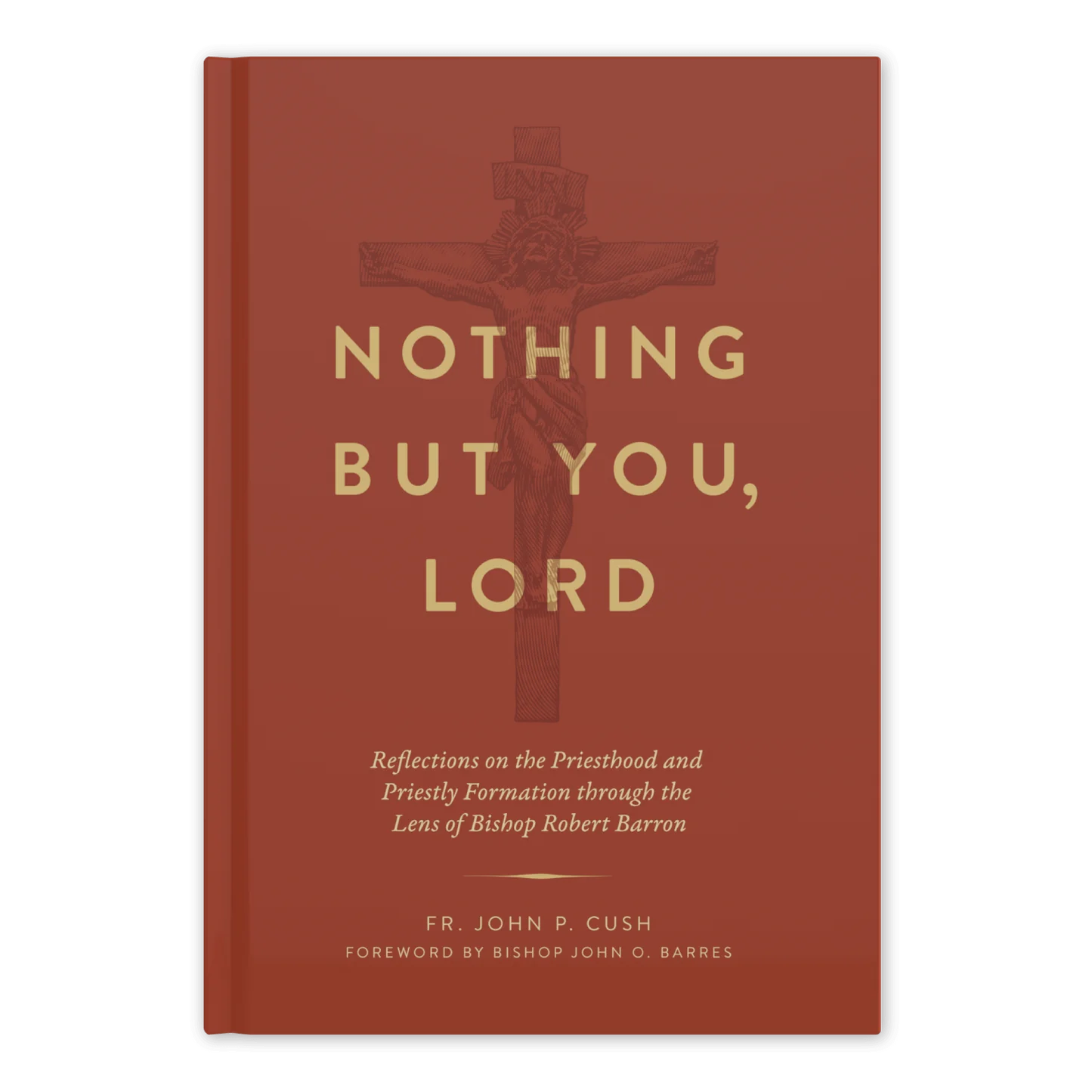
This led Father Cush, a Windsor Terrace native who holds a Doctorate in Sacred Theology from the Pontifical Gregorian University in Rome, to write his recently published book, “Nothing But You, Lord: Reflections on the Priesthood and Priestly Formation through the Lens of Bishop Robert Barron.”

The work offers up-to-date guidance for professors and others who accompany young men in their vocational discernment.

However, Catholics in the pews will also benefit from this inside look at the practical craft and profound values forming the authentic, energetic identities people need to see in Church members who spread the Good News.

Father Cush says Catholics, and especially priests, must reflect on “who Jesus is in His humanity, which we share with Him, and His divinity, which He shares with us.” This appreciation for everything Christ is — in and for us — prompts Father Cush to examine seminary formation in four dimensions: human, spiritual, intellectual, and pastoral.

From a sturdy foundation of well-balanced character and personality, plus wide-ranging prayer and ongoing study of Church knowledge, a seminarian prepares for pastoral work — sharing Christ’s compassion with wisdom as a “soul doctor,” to use Bishop Barron’s term.

Father Cush reasserts the connectedness we patients should pursue: “Who we are flows from who we know — the Eucharistic Lord.”

This Catholic path toward gratitude and humility recalls a story about Saint Thomas Aquinas, which yielded Father Cush’s book title. In prayer, God praised St. Thomas’s written work and asked what he desired in repayment for his labors. Thomas replied, “Nothing but you, Lord.”

Father Cush sees special roles connected to a priest’s personal identity, but he points out that all baptized Catholics participate in Christ’s anointing as “priest, prophet, and king.” Laypersons join in the Church’s “way of seeing,”  drawing upon their preparation in their parishes and beyond.

“No priest can hope to evangelize alone,” he says in the book, released this month by Word on Fire. 

With his admiration for a solidly faithful social media icon like Bishop Barron, who he quips is often trending but never trendy, Father Cush implicitly invites a broad audience in service to society.

Posted in Education, Prayer, Spirit of communication, Writing | Leave a comment

OK, Boomer, Looks Like You’ll Be President Again

This article is included in the latest edition of “Phronesis in Pieces,” found at billschmitt.substack.com. The edition also includes the story below, a commentary about the Olympics controversy and our viewpoints on what’s really real.

Passing a torch to a new generation? Not so fast!

President Biden announced his presidential relay-race intentions last week. But don’t let Vice President Harris’s Oval Office prospects conjure up images of a Fountain of Youth rejuvenating America’s soul.

Categories used by scholars of “generational theory”—such as Neil Howe, a guru on Baby Boomers, Millennials, and other age cohorts—suggest the election of Harris this November would merely add to the many years of Boomer control over the White House.

That’s because Harris was born in 1964 (October 20, to be exact), and age-group experts generally apply the Boomer moniker to anyone born between 1946 and 1964. Harris would be 60 years of age when elected.

It is true that Biden would be handing the reins to a younger generation. He was born in 1942, so theorists place him in the “Silent Generation,” as explained in Carrie Weisman’s good overview at the Best Life website.

But, fact-checkers, stay alert: Biden would be passing the torch to the same old generation we’ve seen before. America already has had twenty-eight consecutive years of Boomer presidents—Bill Clinton (born 1946), George Bush (1946), Barack Obama (1961), and Donald Trump (yep, 1946).

At this moment, it looks like the next president will be someone from either the start of the Boomer period or the end of those years. What a difference a birthday makes, or not!

Former President Trump’s vice-presidential running mate does represent a new generation. J.D. Vance was born August 2, 1984. That places him in the Millennial generation, which spanned the years 1981 through 1996.

Such torch-passing actually would bypass the people of Generation X, born between 1964 and 1980.

Members of Generation Z, born 1997-2012, must wait to be considered or ignored. The minimum age for election to the presidency is 35.

There’s one thing Americans don’t have to wait for, according to Howe, whose latest book on generational theory, The Fourth Turning Is Here, was published last year.

Howe differs slightly with other experts—the Population Reference Bureau and the Center for Generational Kinetics, for example—on such analytic details as the names and time-spans of certain age cohorts. But his cyclical view of history and combined generational influences is most notable for its prediction of an imminent “Fourth Turning.”

That’s a major, transformational crisis (on par with World War II and the Great Depression) which Americans of all ages will have to confront together. The turnings occur approximately every eighty years.

Let’s hope the next president will have vim and vigor for crunch-time leadership, plus a nationwide spirit of solidarity into which he or she can tap.

Image from ClipSafari.com, a collection of Creative Commons designs.

Posted in Spirit of communication, Writing | Leave a comment

Beware of Narrowing the Wide World of Sports

American media have long stood accused of partisan partnering to tilt their coverage of national politics. Now, the broadcast of the 2024 Olympics has reminded us of another arena in the world of competitive storytelling. Our society’s participation in reality, sometimes outsourced to movers and shakers, could use a more level playing field.

Much of our  news content, especially as it surfs along the spectrum to opinion and entertainment, emerges from multipart enterprises which package pieces of truth into products for people to consume.

The July 26 NBC broadcast from the opening day in Paris showed us the risk when we say “super-size it.” The network and its associates served up a hefty portion of highly processed food, containing a few by-products and fillers which thoughtful consumers found harmful, or at least tasteless. Their sincere concerns over certain avant-garde videos—which some “creatives” probably had deemed de rigueur—were well reported elsewhere.

The programming didn’t need those narrative-additives in order to impress the audience. Viewers enjoyed the parade of eighty-five boats with their athlete-passengers, plus a range of musical virtuosity. We were dazzled as high-tech wizards played with water and smoke, spotlights and lasers, camera angles, recordings, and more.

When it stayed grounded in reality, the TV script provided authentic parts to play, from French President Macron opening the games, to the youth of 206 countries waving enthusiastically, to a plethora of folks everywhere reflecting our planet’s best efforts at diversité, équité (fairness, in French), and inclusion.

We witnessed the three official Olympic values—excellence, respect, and friendship—inspiring a celebration of unity. We admired the scenes of thousands across the city who were able to position themselves, free of charge, to take in the drama from one or another site.

Of course, only viewers of the exclusive broadcast received the full smorgasbord. Narrators guided our tour as we darted between locations, performers, and genres of content with precise timing and artistry.

The four-hour showcase that evening required months of preparation by teams from many fields. NBC said its production cadre alone numbered about 3,000.

Behind-the-scenes work engaged experts in high technology, leaders in business and advertising, performers, and orchestrators of sports/entertainment, as well as countless governmental and non-governmental organizations, local and global.

This expansive, expensive approach to reality almost demanded  project leadership from communications-sector elites who could properly display the panorama of various talents—just as campaign consultants say U.S. presidents can’t survive on their governance skills unless they’re also masterful communicators. Appearance means a lot.

When observers of national and international alliances cite the usual membership rolls from politics, media, academia, corporations, techies, show-biz wunderkinds, charities, and advocates, we can affirm their powerful outreach.

Such formal and informal networks exist. There’s no need to conjure up “conspiracy theories” or suspicions of wrong-doing when saying this. These folks simply play well together, and their presence is far better than anarchy.

They contribute much more than Olympian spectaculars, often functioning as filters of reality. And yes, many probably pivot to chats about public policy and shared power, strategizing to grow their market clout.

The structures give us hope for global prosperity and solidarity, along with abundant offerings to amuse and distract us in these secular times. Their strategies must evolve, too, because the world is frantic and fragile. No doubt, decision-makers are tempted more than ever to play hardball.

The bulk of the world’s population has no direct connection to most of these dynamics. But lovers of Venn diagrams—you know who you are—will spot many intersections between elites and the masses.

For example, the ethos of public administration and civic life is shaped powerfully by our educational institutions, especially when family, community, and religion surrender their roles in forming hearts and minds.

Profit motives in high technology and other image-sensitive industries prompt executives to hire those who share their values or signal their virtues.

Too many innovators in arts and entertainment want to grow their audiences by diverting popular tastes toward enhanced realities, alternative excellence, artificial intelligence, and escapist addictions.

Unfortunately, artists forget Pope John Paul II’s classic 1999 message about “epiphanies of beauty.” He spoke of a God who calls them “to share in His creative power,” not to claim it for themselves by substituting new truths, or no truth.

We’re told human creativity should be “edgy” and constantly evoke a “wow,” but we become bored with the splendor of God’s creation as our source of wonderment.

Influencers may think the market for their brilliance will be boosted by widespread relativism, isolation, ego, self-identification, emotions, and zeal for the path of transhumanism. They don’t realize these are dead ends, deterring persons from investing in future fulfillment of their innermost longings.

Again, these worst-case interpretations of secular reality—in the Olympics, politics, or any other endeavors—have more to do with myopia than malevolence. They see a shallow humanity, one disconnected from a love for God’s created order. This love moderates our self-centeredness and energizes our relay race toward wisdom and peace we can share.

Ironically, concepts of purposefulness, personal dignity, and pride in homelands and common roots are exactly those seen as godly in a Judeo-Christian sense—and as honorable reflections of Olympic tradition. But some opening night videos opted for less uplifting history, such as a salute to Dionysus, the Greek god of partying.

Another distraction from the highest ideals occurred during the TV blockbuster that evening. As we floated along with the currents of “reality” on our screens, we were treated to a musical performance sung from a craft on the Seine. Hauntingly, the singer was accompanied by a piano that had been set ablaze.

John Lennon’s lyrics from Imagine echoed his critique of such concepts as religion and country. The song provided a deconstructed glimpse of “living for today,” not an orderly integration able to anchor society’s aspirations.

As NBC reported, Lennon’s anthem of pretend-optimism oddly has been customary at Olympics ceremonies since 1996. Can such an anthem proclaim “let the games begin”?

Our duty to occasionally anchor our boats and douse fires of chaos is both an individual and team event. It relies on acknowledging and scrutinizing the realities around us, including those sizeable, audacious forays of imagination and hubris where talents may go rogue and souls may go awry.

We must judge reality wisely in order to serve the truth, which communicates to us in all its joys and sorrows, in its moments of clarity and bouts of mystery.

Greater awareness of higher, unifying truths will help us discourage games of hardball that can do damage in either the public square or the volleyball arena.

Here’s a thought about discerning between those media-aided collaborations we can live with and those which can deaden us:

The Olympics opening ceremony, as a product of our legacy television infrastructure, offered us what seemed like a big, beautiful reality—a piece de resistance to elevate our hearts.

But let’s realize that, in a sense, it was a small reality. One of those multi-talented teams produced and customized the puffed-up experience for our private, individual consumption—albeit consumption reproduced a billion times on screens around the world.

Events were packaged. We were packaged as receptive spectators, digesting a whole product while passively spoon-fed from amalgamated viewpoints and values.

A better alternative to this economy-sized packaging comes from old-school journalism. Writers and readers preferred savoring reality in small pieces, not as a single download of truth. Reporters were told to diligently dig up accurate facts for each day’s story, trusting that those would accumulate into overviews and the “whole story” step by step, with the drama of All the President’s Men.

Of course, we all hope the grandeur of the Olympics will “wow” us right from the start, for many years to come.

However, the best, most complete messages about reality come over time, through community, relationships, and digging where we’re planted. Such insights can be customized gracefully—by the “creative” who really knows His customers.

We couch potatoes should emulate the connectedness experienced by those throngs in Paris cheering as the athletes sailed by, or those attending one of the sporting events—or, better yet, those on the field, striving for a medal.

We don’t want to be mere spectators, letting small but dazzling impressions become our dominant, instant reality. That could overwhelm the rewards of personal growth and agency in our lives.

This general rule applies during election cycles as well as Olympiads. In dealing with political news, our society needs to take time for critical thinking about actual issues. Much of our intake may come from the “media-industrial complex,” but we should diversify our sources and see other people beyond our screens.

We can step up our game as participants in right-sized reality, using plenty of curiosity and a soupçon of healthy skepticism. We might find our own grass-roots collaborators who are less constrained by elite preoccupations, helping us to intersect reason and faith.

The sharing of our own heartfelt stories and beliefs can actually influence movers and shakers. Without instituting a cancel culture, free speech can raise everyone’s consciousness. At the Olympics, amid an ongoing dialogue of different statements and interpretations, the video of Dionysus and drag queens was highlighted on some platforms and removed from others, as of this weekend.

Eventually, we can bring more views of reality to our screens—and more wisdom to our polity—as small but strong communicators of excellence, respect, and friendship. Think of all this as passing the torch.

Image from Clipsafari.com, a collection of Creative Commons designs.

Posted in Education, Spirit of communication, Writing | Leave a comment

Behold Our Post-Truth Society—Breaking News, Broken Politics

The past three weeks of mesmerizing political news revealed one sign of societal mayhem not yet pounced upon by pundits.

“Post-truth” thinking, a virus first diagnosed in the public square eight years ago, outed itself as a major force at the highest levels of American governance. Candidates and voters alike experienced the symptoms of an outbreak, which attacks a nation’s nerves, vision, nimbleness, and sense of direction.

From the shocking presidential debate on June 27, to an assassination attempt, to GOP convention days when both parties weighed their past and future, we could no longer dismiss the chaos as just a little case of truth decay.

Both campaigns for the White House now confront plot twists less driven by well-planned tactics and more akin to epiphanies. This cultural moment reflects the maxim, “There are decades when nothing happens, and there are weeks when a decade happens.”

From Definition to Domination

In 2016, the Oxford Dictionaries declared “post-truth” the Word of the Year. Online editors defined this search-provoking adjective as “related to circumstances in which objective facts are less influential in shaping public opinion than appeals to emotion and personal belief.”

The more foundational concept—truth, or conformity with reality—has preoccupied thinkers throughout history, starting with Socrates, Plato, and Aristotle. Scripture tells us Pontius Pilate wondered what truth is, but he washed his hands of the matter. Jesus, whom he persecuted, said truth was all-encompassing, indeed liberating, and part of a package: “the way, the truth, and the life.”

In recent years, society has been washing its hands like Pilate, and the “post-truth” virus has spread across the ideological spectrum. Everyone now senses we are in perilous times. If we choose to quash this malady, we face a load of learning and reflection to heal our truthfulness. Holistic gurus might call it “truth-fullness.”

President Joe Biden accidentally told us the cure recently during one of his quotable outbursts: “Think about what you think about!” No joke! Many practitioners of post-truth strategies might want to do an examination of conscience. We all should conduct an examination of consciousness.

We can customize our own investigations into how the latest political, journalistic, and deeply personal events have swamped us with confusing thoughts, unclear facts, and amazement or frustration.

Here’s a diagnostic checklist we can apply, without claims to academic expertise from medicine, the social sciences, philosophy, or theology. These are the thoughts of punditry, which has become post-truth terrain itself.

Today’s style of consciousness allows more people to shed or redirect accountability, to escape the challenges of big-picture reality, to manipulate words and weaponize rhetoric, to rely on appearance and performance to persuade others, and to pamper ourselves with a confirmation bias enhancing power, pride, and certitude.

Too many of us find comfort in today’s unsustainable pairing of relativism (“I create reality”) and moralism (“I cure reality”), summed up as “my truth vs. your truth.”

Because knowledge and morality are deemed culturally determined, not absolute, we form fragile or fake relationships based on narcissistic identities and tribal instincts. We follow the simplistic model called “oppressor vs. oppressed” for gain, retribution, or the joy of snap-judgments.

Post-truthers seek to recruit supporters by serving up small bits of information, true or false, while they hide or cancel other bits. They promise that national success, victory, and greatness of one sort or another will unite us again. But we know better. We see a fuller reality, where unifying a country will take hard work, sacrifice, wisdom, virtue, a sense of right and wrong.

Without a hierarchy of principles to put our affairs in order, we blithely continue surfing the daily currents, still at sea.

Many advocates “dumb down” truth, citing only the facts they regard as visible, scientific, and manageable (a philosophy called positivism). They forget that only a range of opinions—ideally incorporating worldviews, experiences, and principles of human dignity—generates meaningful cooperation.

Truth-telling: A Regress Report

Recall that, on June 27, journalists had their plan for covering the debate between President Biden and former President Donald Trump. They deployed teams of fact-checkers to see how many lies each candidate told, assuming this metric could credibly select an ideal leader.

But the minimalist goal of fact-checking stirred little interest compared to a flurry of deeper concerns (health, competence, etc.) more aligned with how human beings actually communicate and discern. The results of simply tallying truths proved partial, in both senses of the word.

As days passed, talking points about big ideas like democracy and authenticity similarly failed to override news consumers’ more visceral thoughts and complicated judgments. Pre-digested biases blocked agreement on paths forward. The real business of a democracy—an informed public building consensus to solve concrete problems—received too little attention.

Post-truth thinking is supposed to speed up governance by leveraging emotions, alliances, symbolism, and social media, but it’s terribly vulnerable when reality intervenes.

Now, as we see major challenges looming, hybrid thinking looks more tempting. To give governance more heft, it must incorporate real expertise and managerial diligence, shorter response times in crises and longer-term contingency planning.

Updating our political consciousness requires better listening, orderly oversight to ensure “the buck stops here,” and a hierarchy of values that forces serious decision-making, not just checking DEI or ESG boxes.

The American people are adapting by sorting out their own priorities, judging what’s most important in their own lives. At the healthiest levels of their hierarchies, where truth resides alongside mystery, many are recovering their spiritual insights—hints of divine providence and prayers for more “normalcy” among people and circumstances.

Tallies of public opinion are likely to show that confidence in authorities continues to slide, with the exception of one data point now arising in more conversations—God. Sensitivity to good and evil, life and death, and amazing grace seems necessary in today’s politics.

When secular post-truthers promote terms like “existential threat” and “America’s soul,” they may unintentionally plant seeds of faith. Of course, we don’t know how far to go toward God-talk; if we cite Him for veracity, He requires that we be humble, true to ourselves, and true to Him.  

These are steps toward our urgent mission to examine—and revitalize—our consciousness. This word refers to our individual and societal awareness of what we think about, as well as how and why. Truth must be an anchor for these thoughts.

Now a Word from Our Sages

Here are some resources we can use to begin assessing what’s absent from our own post-modern cognition.

  • Truth and the Ten Commandments. The Catechism of the Catholic Church’s long section about truth focuses on the Eighth Commandment: “You shall not bear false witness against your neighbor.” Every person is obliged to honor and bear witness to the truth. Individual dignity requires that we seek the truth and adhere to its requirements in our lives. With a few specified exceptions, everyone deserves to be told the truth. (paragraphs 2464-2499)
  • The “Dictatorship of Relativism.” In a homily from 2005, Pope Benedict XVI cautions that secular societies “are building a dictatorship of relativism that does not recognize anything as definitive and whose ultimate goal consists solely of one’s own ego and desires.” Elsewhere, he says relativism either will lead to nihilism [“life is meaningless”] or will expand positivism “into the power that dominates everything [authoritarianism].”
  • Reality, Lies, and the Liar. M. Scott Peck, the psychiatrist best known for his 1978 classic of spiritual guidance The Road Less Traveled, observes that mental health is “an ongoing process of dedication to reality at all costs.” In his 1983 book, People of the Lie, he warns that Satan is “a real spirit of unreality,” aptly called “The Father of Lies.” This unholy spirit, who wins control over us when we “recruit” him for self-gain, hates the truth, does not know how to love, and wants to destroy souls.
  • Lying as Self-Destructive. The noted psychologist Jordan Peterson advises in Twelve Rules for Life: An Antidote to Chaos (and in videos) that we should always tell the truth—or at least never consciously say something false. We should acknowledge that we will seldom know “the whole truth” about something, but generating untrue ideas injects disorder into our minds. Disorganized things suffer disaster; metaphorically speaking, we all need a map to know our purpose and direction in life, and being a liar leaves holes and errors in one’s map of meaning: “It’s very psychologically dangerous to say things you know not to be true.”
  • ”The Truth Will Set You Free.” This was the title of Pope Francis’s World Communications Day message in 2018. Disinformation and “fake news” must be purified by a love for the truth, including diverse discourse, encounters with the marginalized, and avid curiosity, he insists. Quoting Dostoyevsky, the pope warns that people who continually lie to themselves and others “cannot distinguish the truth within them, or around them, and so lose all respect for themselves and for others.”

We should celebrate the whole package that comes with truth-fullness, including a personal drive for excellence and honor, not mediocrity. This means accountability and accepting inconvenient, painful reality for the greater good.

Human beings shouldn’t ignore our natural preference for truth that is served whole. Often, the “facts” in headlines are mere morsels. They should whet our appetite, not encourage or allow snap-judgments about the meal.

We must figure out how to employ and enjoy words with respect—to interpret a speaker with emotional intelligence, even empathy. Dostoyevsky’s warning should be heeded, knowledge needs to be vetted, and much talk needs to be taken literally.

But also ask: Is the person exaggerating, simplifying, or misleading in an attempt to score a point (and disconnect us from reality) or to make a point (respecting us, but prone toward hyperbole and rhetorical sloppiness)?

Our listening should be equitable, not singling out opponents for a “hermeneutics of suspicion,” as utilized in post-modern critical theory.

Discourse should be based in love, and “love always communicates,” says Pope Francis in another World Communications Day message (2019). We assume consciousness is an individual’s sole possession, but our best thinking takes place in the context of solidarity—expanding out to the local and global community, digital and face-to-face conversations, and our communion with God.

This builds trust, while post-truth information strategies do not. We need transparency between organizations and the public. Sharing the pursuit of truth, and acknowledging missteps, will open up our minds and create common ground for solving problems.

Bari Weiss, a liberal journalist and media entrepreneur, recently delivered a TED Talk about the need for Americans to express their views with courage. It’s clear she saw manipulative tendencies spreading before the past few weeks of political news.

As presented in her July 2 “Honestly” podcast, her talk explained how she began to feel unwelcome in some progressive circles, where “fringe” elements tried to constrain the content of public dialogue.

“Truth is a process, sustained by a culture of questioning, including self-questioning,” she says. “My theory is that the reason we have a crisis is because of the people who know better—because of the weakness of the silent, or rather self-silencing, majority.”

She acknowledges, “Speaking up is hard” because it makes us vulnerable. “It exposes you as someone … who makes judgments, someone who discerns between right and wrong, between better and worse.”

But we must communicate if we “want to live in a world that values justice, wisdom, compassion, curiosity, rationality, equality, and the pursuit of truth,” Weiss says. Americans have worked hard to shed hateful dialogue and to “solve our conflicts with words.” It’s often counter-productive to decry free speech as verbal victimization.

Weiss should have the last word here. Since recent weeks have revealed a post-truth virus decaying constructive thought, we need to rebuild consciousness using “the most radical tools in human history”—namely, dynamic exchanges about reality. Of course, they must be nurtured with charity. “Love and compassion [are] only possible if we agree to a certain set of tools many of us took for granted.”

Image from the AI “Designer” function of Microsoft Bing.

Posted in Education, Prayer, Spirit of communication, Words | Leave a comment

Jimmy Carter and Friends: Hope for Today’s Malaise

We tend to shower praise on people who “fit in,” but it’s more instructive to appreciate folks who are unique—which is everyone. Former President Jimmy Carter has blazed new trails, and The Washington Post on June 22 reminded us that he’s three months away from being unusual again—his 100th birthday.

It’s timely to pay tribute to Carter now because it takes the whole book of one’s life, not the first or last chapter alone, to establish a unique legacy. In Carter’s case, he has become exceptional step-by-step, piecing together his special set of endeavors, values, and relationships in a changing world.

He has been a farm-owner, Navy submariner, governor, president, humanitarian, Nobel Peace Prize recipient, and now a hospice patient.

We learn much by cherishing people’s entire lives as they unfold, intertwine, and move forward, not merely judging one aspect or awaiting a definitive obituary.

Carter has sought to influence the whole world and to let the whole world influence him. We can illustrate this by remembering a unique friendship he formed. Twenty years ago, on June 28, 2004, he delivered the eulogy at a 13-year-old’s funeral service.

A shared passion for peacemaking placed Carter in contact with Mattie J.T. Stepanek a few years earlier. The Make-a-Wish Foundation inquired whether Carter could visit Mattie, who had asked to meet his hero. Doctors deemed Mattie’s death imminent.

Suffering from a particularly cruel form of muscular dystrophy (MD), he had known for a while that each day could be his last. His similarly afflicted siblings had died. But he had plunged into a vigorous existence filled with faith and purpose—to be a kid while building a legacy.

He wanted to be remembered as “a poet, a peacemaker, and a philosopher who played.”

Raised by a Catholic mother who is alive today facing a less corruptive form of mitochondrial disease, Mattie spent time in prayer and received insights he called “heartsongs.”

These thoughts affirmed for him every person’s distinctive worth and mission, and God’s unifying love, prompting Mattie to write poems. His simple eloquence yielded a 2002 book, Heartsongs, plus six other New York Times best-sellers during a four-year span. (Two were published posthumously.)

Mattie gained media attention, sharing hopes of peaceful human flourishing and personal striving—a beacon of both childlike wonder and understanding deepened by his painful disability.

Meanwhile, his local Maryland parish and the Archdiocese of Washington, DC, made it possible for him to receive the sacraments of First Communion and Confirmation by age 8. He became a parish catechist, teaching the faith to sixth-graders.

His growth in knowledge, reason, and faith was swift, as told by his mom, Dr. Jeni Stepanek, who was interviewed recently on EWTN. She quoted his motto: “Think gently, speak gently, live gently.”

His buoyant spirit lifted up countless adults, leading to TV appearances with super-influencer Oprah Winfrey and MD celebrity-fundraiser par excellence Jerry Lewis. (See Lewis and Mattie together in this video at about the 1-hour mark.)

President Carter did indeed visit Mattie. The boy had singled out Carter as a peacemaking paradigm. Jimmy and Mattie began to correspond, exchanging many thoughts, spiritual musings, and plans for the future.

Of course, this ended in 2004 when the doctors’ prognosis eventually proved correct. Carter contributed two sets of remarks to the final collection of Mattie’s poetry and prose, a book titled Just Peace: A Message of Hope, published two years later.

The former president wrote a foreword, plus closing notes whimsically called a “forthword.” Even the word was unconventional. It may have been a neologism sparked by Mattie’s creativity. Internet search engines still today do not recognize it. Such a clever term should have spawned more copycats!

Carter’s implication was that Mattie had put his finger on a starting point from which young and old alike could go forth on pilgrimages of peace.

He wrote that the boy “has been able to comprehend his own inner feelings, to extrapolate them with a unique resonance for the understanding of other people, and to embrace in his brilliant mind the challenges and opportunities of the entire world.”

But the most quotable part of the forthword was Carter’s observation that his friend was “the most remarkable person I have ever known.”

The former president made a video in 2014 repeating that assessment. He honored Mattie’s courageous exploration of humanity as an amalgam of wisdom he had not seen in any world leader.

A message about lifespans and legacies is worth considering in civil society and public affairs today. No specific level of experience or age, from teen to senior citizen, can guarantee leadership that resonates with reality. We need to stay alert for out-of-the-ordinary inspirations whose seeds are sown gradually, in partnership with others, in dialogue with God and the world.

The unscheduled synchronicity and synergy of lives—including our own—are hints that God is working at the intersections of one-of-a-kind gifts. As Scripture (1 Kings 19:12) suggests, He is present in the quiet breeze, not in a political windstorm or an individual’s bluff and bluster.

When the time comes for Jimmy Carter’s obituary to be published, we would be foolish to read his life only as random headlines. The best role models boldly surf a current of connectedness which flows where it will, in the right direction for the right duration.

Such paths will be roller coasters. Carter’s one-term presidency was marked by his promise of truthfulness amid a full measure of tumults and errors. Later, he served on crucial diplomatic missions and worked to monitor democracies’ free and fair elections, but he was also called antisemitic for his criticism of Israeli policies.

Pundits mocked this compassionate evangelical Christian for his 1979 “malaise speech,” in which he coached Americans to overcome their “crisis of confidence.” He spoke prophetically:

“We can see this crisis in the growing doubt about the meaning of our own lives and in the loss of a unity of purpose for our nation. The erosion of our confidence in the future is threatening to destroy the social and the political fabric of America.”

The June 27, 2024, debate between President Joe Biden and former President Donald Trump affirmed Carter’s prediction of disabled governance.

A polarized populace witnessed that societal structures and party machines which once generated unifying leaders are now producing shadows of statesmanship who merely “fit in” and hardly bring us solace. Imaginative, big-picture ideas have morphed into performative survival strategies. Malaise has decayed into malice.

Upon Carter’s death, presidents of the past and present will gather at ceremonies to remember him, prompting millions to review the paths we’ve taken together. Sadly, we may see we’re stuck in ruts of narcissism and relativism. Perhaps too few people have stepped forward to share fresh, authentic, virtuous messages, or to respond to them when recognized.

An extra dose of quotes from the former president will help us recall, and maybe recapture, his heartsongs. This founder of The Carter Center and long-time partner with Habitat for Humanity has said he wants to be known for “waging peace” and championing human dignity.

His “tough love” for our nation carries the power to stir and strengthen us: “America did not invent human rights,” he said. “In a very real sense, human rights invented America.”

He wants us to be instruments of those rights: “To be true to ourselves, we must be true to others.” But it all must start with our own initiative, enabled by higher truths.

Carter, like his young friend Mattie, explained he was driven by a relationship with God. He has said, “My faith demands that I do whatever I can, wherever I am, whenever I can, for as long as I can, with whatever I have, to try to make a difference.”

People inspired by Mattie’s similar determination have formed the Mattie J.T. Stepanek Foundation, which provides resources for the teaching of peace studies. A variety of activities named for him continue in various locales to spread the message, “just peace.”

There is also a Mattie J.T. Stepanek Guild, which is gathering information on how this young humanitarian lived and how he inspired others. As they are wont to do, some Catholics are thinking of sainthood as the ultimate legacy—not something to capture and categorize in an obituary, but a reality with which we can always interact.

The guild must compile documentation to present for archdiocesan review, leading to a “cause for canonization.” That would await Rome’s scrutiny and papal review.

Like all worthy pursuits, this will take time. It’s an opportunity for regenerating uniquely dynamic hearts and minds that can lead us beyond 2024. Fortunately, the influential lifespan we desire—for Mattie, for his friend Jimmy, and for all of us—is unlimited. Carter is here to tell us: Go forth.

You can find this commentary also in “Phronesis in Pieces” at billschmitt.substack.com. Please consider subscribing and sharing.

Posted in Education, Spirit of communication, Words, Writing | Leave a comment