
“I ♥ Valentine’s Day,” When the Church Shows the Love of its Life

heart photo for blog

Initially posted on the McGrath Institute for Church Life blog, published at the University of Notre Dame, on February 14.

Valentine’s Day can be awkward for a lot of people. It’s unlikely the holiday will come up in Church conversations, except in the young adults group. Catholics may see little connection between their faith and the chocolate overdoses of February 14. But it is a day that takes on new dimensions when viewed through a Christian lens.

Unfortunately, we can’t “baptize” this celebration of love as was done in the past; we can’t call it “Saint Valentine’s Day” anymore. Doubts surrounding historical details about Valentine of Rome, believed to have been a third-century martyr, resulted in his removal from the liturgical calendar of feast days. Nevertheless, he’s still the patron saint of virtuous romance. And it’s arguably still good to give human love its own place on the calendar, albeit a secular one.

The downplaying of Saint Valentine is not a crisis. True love still has many champions. The connection between Feb. 14 and eternity is secure. Every saint is, ipso facto, a patron (supporter) of loving, just as every saint is a patron of thanksgiving. More to the point, God is Love. Jesus Christ incarnated on earth the highest form of love, agape, marked by self-donation and transformation. In 1 Corinthians 13:4-8, St. Paul painted a picture of love more comprehensive than any saint’s hagiography. Love is patient and kind. Love never fails.

Valentine’s Day is also a great time to focus on the human heart. The standard image is omnipresent in media and marketing, but it remains an evocative symbol. My New World Dictionary Concordance to the New American Bible says this: “In biblical language, the heart is the vital center of life that is specifically human: sense life, the life of the will and intellectual life. For this reason, the figurative use of the word is vaster in the Bible than in modern languages.”

The Bible speaks of thoughts arising from the heart. Both Old and New Testaments describe numerous qualities possessed by the heart: It sees and listens; it responds and understands; it is obedient and steadfast. “Blessed are the clean of heart, for they will see God.” (Matthew 5:8)

Our Catholic faith and human nature are especially drawn to the particular qualities of the Sacred Heart of Jesus and the Immaculate Heart of Mary. These inspire our efforts to cultivate compassion, perseverance, purity and contrition, flowing through wounded hearts.

No amount of advertising, sentimentality or ostentation will overwhelm our whole-hearted witness. Perhaps we can keep the Valentine vision elevated through our reflections and conversations, both in parishes and in our encounters with those on the margins of human affection.

February 14 can challenge us to take love more seriously. My wife Eileen and I, in discussing our evening restaurant plans, can share our backstory: We’re celebrating our gratitude for blessings that have made our home a domestic church.

Priests and chaste singles can evangelize through their discoveries that true love still abounds even if it doesn’t fit the greeting-card mold. The word “heart” is indeed vaster in its spiritual meaning than in the languages of popular culture and the marketplace!

Kids can treat themselves to those chalky candy hearts. First, help them realize that some of the “platitudes” imprinted thereon— “Hug Me,” “Smile,” “Be True,” “For You”—hint at deep longings of the lonely.

Catholic families and parishes must be refuges where dumbed-down interpretations of love visibly rise to the higher ideals of agape. Do we allow the culture’s standards to sink, or do those candy hearts connect to the Sacred Heart? Let’s share and exemplify our love stories—especially how our relationships with the Lord make Valentine’s Day sweeter.

It may be awkward. But, knowing there’s a Saint Valentine interceding for us, we can follow his lead—standing in as patrons for a day. Love never fails, so we shall not fail love.


Posted in Spirit of communication, Words | Leave a comment

Healing Culture–and Hearts–So Politics Can Work

chris-stirewalt

https://www.c-span.org/video/?457649-1/every-man-king

No discussion at the three-way intersection of our polarized society, our use of news and our faith-based values that can help renew healthy communication will bear fruit without the kinds of insights Bruce Stirewalt recently presented on Book TV.

Stirewalt, digital politics editor at Fox News and author of Every Man a King: A Short, Colorful History of American Populists, served up some important thoughts at the Savannah Book Festival. The most valuable thoughts for the discussion mentioned above come from his answer to the last question, found at the 56:00 mark in the Book TV video.

These are comments that illuminate our exploration of toxins at work in politics and journalism today. They are comments about the human being and about culture.

They speak for themselves, so I present several of them here—perhaps out of order, but definitely “what the doctor ordered” regarding culture-healing priorities to be prized by Catholics and all people of good will:

  • “We are a soul-sick, broken-hearted country.”
  • “The object of every heart is to be truly known and truly loved.” As we cry out for unconditional love, our insecurities and anxieties prompt us to lash out at each other rather than reach out with compassion.
  • “We’ve replaced more precious, more valuable, more meaningful things with the shoddy work of politics.”
  • “That soul-sickness will never be fixed by politics.”
  • “Politics is what lets us do the right thing. It’s not the right thing or the point of anything.” –attributed to the late Charles Krauthammer
  • “Our broken culture is the headwaters of our broken politics.”
  • “We need strong social capital to create a culture.”

(video from Book TV, promotional photo from Fox News)


Posted in Spirit of communication | Leave a comment

New Finger-Pointing, New Point-Making

the-full-story baloocredit

I want to contribute to a renewal in 2019 at the intersection of three of our society’s most crucial questions: How can we reduce the polarization in our culture in order to solve urgent policy problems? How can we reinvigorate inclusive, civil and well-informed conversations in the public arena about the things people care about most? Are there changes in journalism–and in the generation and consumption of news–that could help achieve the first two goals, building on faith-based values and professional standards?

Here are a few things I’m doing:

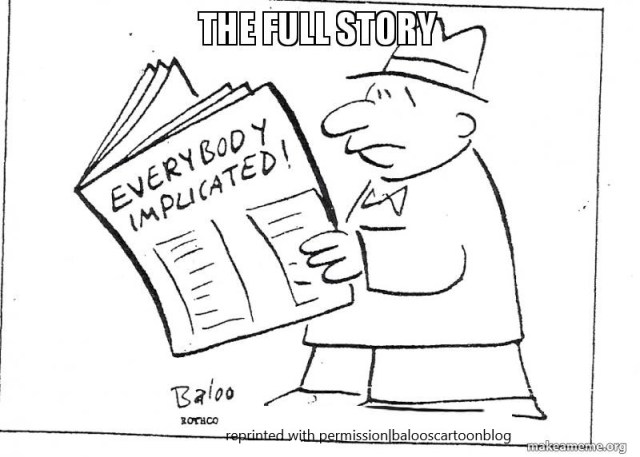
  • Seeking out more media interviews and public presentations to help guide discussions about this renewal. I was privileged to be interviewed by Teresa Tomeo on her “Catholic Connections” daily radio program on Feb. 4, 2019 archive: You’ll find our 15-minute discussion starting at about the 17:00 mark of her second hour. We discussed the growth in negative trends like jumping to conclusions, weaponizing facts and interpretations, and pointing fingers rather than seeking truth.
  • I’m compiling a growing list of resources for people to use in research and collaborations aimed at answering the questions above. Here’s the first iteration of the list, published at my LInkedIn page.
  • As a subset of my content at this OnWord.net site, I’m compiling the commentaries related to my When Headlines Hurt: Do We Have a Prayer book and the polarization-related questions in the “When Headlines Hurt” blog (“me-dia.blog”). You’ll get a good idea of my opinions and writing–and what I can bring to media interviews and public speaking engagements.  Contact Bill Schmitt at billgerards@gmail.com and at 574-276-0340.


Posted in Uncategorized | Leave a comment

Make a “Net” Work Better (4 New Ideas for 2019 World Communications Day)

When Headlines Hurt CVR_final_smaller

For my blog dedicated to my particular focus on news, social polarization, and Christian values encouraging conversation for the common good: Click me-dia.blog in navbar above.

World Communications Day 2019 won’t be officially celebrated until June 2, the Sunday before Pentecost. That’s part of the tradition behind this annual opportunity for reflection, established after the Second Vatican Council to generate insights about how we’re all getting along with each other via the mass media.

Pope Francis has once again allowed us to open this gift early, thanks to the online preview of his 2019 World Communications Day message posted on January 24. That’s the feast of St. Francis De Sales, patron saint of media, writers and journalists.

Here are four useful quotes from this year’s message, titled “We Are Members One of Another: From Social Network Communities to the Human Community.”

  • “The net works because all its elements share responsibility.” Pope Francis praises the power of the digital media to spread an abundance of information and bestow a sense of vast, interactive community. But he cautions that too much of the information we share is used to defame others, spread untruths, violate human dignity, and affirm our narcissistic identities by defining our social-network communities in terms of whom we exclude. Real communities, in physical places or in virtual “social media,” require us to build connections of trust and interdependence, he says. The most resilient communities contain networks we form with others not because they are “the same” as us, but because they are unique, bringing different perspectives.
  • “Therefore, putting away falsehood, speak the truth, each to his neighbor, for we are members one of another.” This quote (Ephesians 4:25) extends the community metaphor to the idea of a body and its many parts, a powerful mirror of the Body of Christ. It echoes the Epistle reading (Corinthians 12:12-30) from the Sunday Mass of January 27, where Paul describes for a different Christian community how the eye must not wish it were an ear or a hand. Each member provides something uniquely valuable: “God placed the parts, each one of them, in the body as He intended.” One might say these roles should inspire a sense of empowerment, along with humble truthfulness and responsibility, in each of us. We owe it to each other to be authentic and cooperative, not identifying ourselves by our supremacy or our adversaries. Our community strength comes from our otherness, Pope Francis says, as well as “the connections between that otherness.”
  • “God is not Solitude, but Communion; He is Love, and therefore communication, because love always communicates.” The pontiff extends the network and community metaphors to God as Trinity, a relationship between the lover, the beloved, and the very act of loving. We humans participate in that trinitarian love in our life-giving encounters with others. We must always communicate love, thinking not in individualistic terms—as the media often encourage us to do—but in personal and interpersonal terms. If we use “the Net” to share stories of beauty and suffering that build up our best selves and encourage us to pray and learn together, “then it is a resource.”
  • “The Church herself is a network woven together by Eucharistic communion, where unity is based not on “likes,” but on the truth, on the Amen.” Our joint “Amen” in worship and thanksgiving, clinging to the Body of Christ, encourages us to welcome others as brothers and sisters, and particularly as “traveling companions” on a purposeful journey toward the Way, the Truth, and the Life.

The Pope has many other inspiring thoughts in his World Communications Day message, and we among the first readers can start now to consider our responses.

He draws a connection between one’s devotion to the love of God and the networking we do through values-informed conversations in everyday life. That recalls what St. Francis De Sales recommends in Introduction to the Devout Life, as discussed in the January 24 post in the McGrath Institute blog.

Francis sees truth, trust, mercy, and justice as essential to the proper use of online media. Otherwise, our huge daily doses of information may be weaponized. We turn against each other in relativistic wars of labeling and lies. Today’s networks can become traps of vulnerability and isolation, as was discussed in this blog’s January 23 post, with reference to insights from the “Higher Powers” conference of the de Nicola Center for Ethics and Culture.

The pontiff’s reference to the “Amen” we give in our Church communities reminds us we can activate good stewardship of real-life relationships with God and our neighbors right where we are. As I comment in a book of reflections on Pope Francis’ 2018 World Communications Day message, our Amen in prayer can gratefully affirm the dignity among imperfect children of God. We’re peacemakers called to stem tendencies toward social polarization. God’s communion of redemption overrides any notion of “me-dia” that spotlight me. We share a journalistic role reaching out to a world hungry for good news.

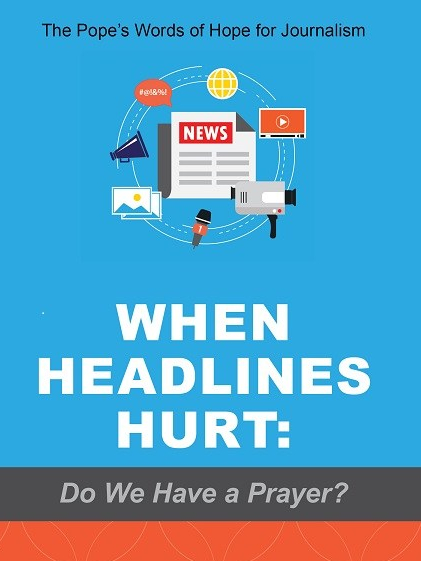
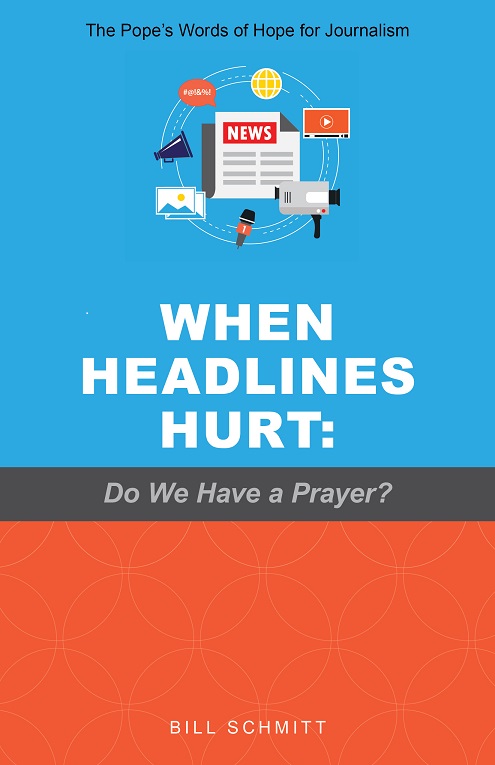
Bill Schmitt is the author of When Headlines Hurt: Do We Have a Prayer? The Pope’s Words of Hope for Journalism (2018), available from Amazon as an e-book and paperback.

An independent journalist, author and marketing-communications consultant with clients in higher education, community-building, and faith-based collaboration, Bill is an experienced commentator on the subject of news, social polarization and problem-solving conversation.

Blog & bio: OnWord.net | LinkedIn: billschmitt-onword | billgerards@gmail.com | 574-276-0340

mary and me april 18

Bill Schmitt

Posted in Education, Spirit of communication, Words, Writing | Leave a comment

“The Devout Life” As a Conversation-Starter

Initially posted on McGrath Institute Blog, published at the U. of Notre Dame, January 24

The fine art of conversation, used as an instrument to share hope and advance the common good, has taken a beating. Many Catholics feel inhibited in their discipleship, fearing their beliefs and values aren’t welcome in discussions of crucial public issues. They don’t want to be called “haters.”

Freedom, human flourishing and our eternal destiny are at stake if our faith is set on “mute” much of the day. Polarized societies are unable to solve problems, or see solutions, when there’s no trust, no agreement on truth. Stalemated discussions risk stagnant souls. Jesus—the way, the truth and the life—taught us, “What I say to you in the darkness, speak in the light; what you hear whispered, proclaim on the housetops.” (Matthew 10:27)

St. Francis de Sales, a witness of charitable dialogue

The feast day of Saint Francis de Sales, on January 24, is a good day for us missionaries to recommit as advocates, not administrators. De Sales (1567-1622) is the patron saint of writers, journalists and the Catholic media. As bishop of Geneva, he became an avid writer of books, pamphlets and correspondence focused on lay people. He defended transformative truths simply and gently.

This Doctor of the Church completed work on the final edition of his spiritual classic, Introduction to the Devout Life, 400 years ago, in 1619. But notice how timely his guidance is today. De Sales asserts the everyday pursuit of devotion to our loving God is inseparable from effective outreach to minds and hearts. His Introduction includes a substantial section about virtue in discernment and discussion. Chapters 26 through 30 offer valuable remedies for this coarsened culture.

“Your language should be restrained, frank, sincere, candid, unaffected and honest,” he writes. “Be on guard against equivocation, ambiguity or dissimulation.” Elsewhere, we’re cautioned that jumping to conclusions—so common amid the media’s labels and exaggerations—can deaden devout living and, by extension, toxify debate: “Rash judgment begets uneasiness, contempt of neighbor, pride, self-satisfaction and many other extremely bad effects,” such as slander.

St. Francis de Sales, a model of the personal touch

For De Sales, respect is at the core of communication with God and people. Both connections are deeply personal and yet rooted in relationships and encounters, not pretenses or assumptions. Pope Paul VI updated this message when he said, “Contemporary man listens more willingly to witnesses than to teachers.”

That’s what De Sales means when he describes a devout life. It comprises experiencing God’s profound love, then responding with “ardor and readiness in performing charitable actions.” These are one-on-one actions, not merely an attitude toward mankind in general. De Sales personifies this, addressing his Introduction not to some faceless population, but to a particular person—a woman named Philothea whom he is instructing. “Throughout this entire book,” he explains in the preface, “I keep in mind a soul who out of desire for devotion aspires to the love of God.”

A uniquely Christian form of dialogue

He’s suggesting a uniquely Christian dialogue we can model for others. Speaking to individuals, about individuals, reflects an authenticity the mass media can’t duplicate. We must nurture families, parishes and communities with infusions of truth and trust; focused on others, not ourselves; recognizing real desolations and consolations. Catechists and other ministers can cultivate these qualities, perhaps by writing in visionary Catholic or secular media, not as office-holders but as correspondents pondering and conveying God’s voice in the zephyr.

First, we should let His love remove our own fear of speaking up. Francis de Sales can provide inspiration and practical wisdom. Devout communication is not distracted, disruptive or pro forma. It’s proactive. This saint, echoing Jesus, tells us to keep spreading the word to brothers and sisters, not audiences. If we regard God and His children with joy and ardor, the fine art of conversation can revitalize the fine art of conversion in ourselves and our society.

Posted in Education, Prayer, Spirit of communication, Words, Writing | Leave a comment

A Franciscan Call for News from a “Good Place”

Initially posted on McGrath Institute Blog, published at the U. of Notre Dame, Jan. 23, 2019

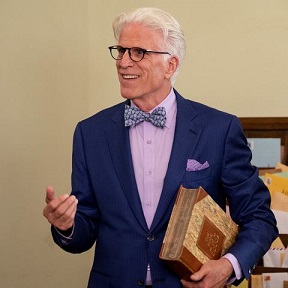
Setting aside the missteps in virtue one often finds in sit-com scripts, the show “The Good Place” offers worthy insights about good and evil from a quirky perspective of the afterlife.ted danson smaller

Promotional photo from nbc.com

In the recent episode “Book of Dougs,” the character played by Ted Danson examines heaven’s files on two deceased “Dougs.” It turns out one Doug, who lived recently, forfeited a lot of scorecard points that could have counted toward his happy destiny. He had unintentionally contributed to environmental damage and exploitative behaviors, among other things. Danson concludes, “Every day, the world gets a little more complicated, and being a good person gets a little harder.”

Living in a complicated, polarizing climate

This scene captured in fiction a wise critique recently made of modern society: In a globalized, information-immersed culture, where unlimited moralism and relativism try to co-exist, the interconnected corruptions we’ve discovered expand the range of our potential moral responsibility and burdens of guilt. At the same time, we’ve sidelined God, losing that ultimate source of forgiveness, resulting in frustration and polarization.*

I’ll amplify and generalize: It sometimes seems we’re blaming everybody for everything, driven to make God-like judgments when wrongs and failures offend our sense of justice. We are all at risk of standing accused, either as individuals or as members of unlikable categories.

At Mass, we admit to serious imperfections and to “my most grievous fault.” But in the secular liturgy of national news media, these deficiencies rise to an even higher threat level. Our cultural discourse adopts labels that go beyond “sinner” to include “extremist” or “idiot” or worse. Weaponized name-calling divides us while we strive to exemplify integrity.

Guidance from Pope Francis on fake news and social media

Pope Francis recognized humanity’s struggle to demand accountability amid massive frailties when he released his 2018 World Communications Day message—“The Truth Will Set You Free”—a year ago this week. Francis criticized “fake news” attacks but also pointed out how we all need to exercise the best journalistic values today because we’re all information gatekeepers when we publish online.

The pontiff cautioned against spreading disinformation that erodes trust and insults human dignity. It is good to seek justice, so he urged rebuilding compassionate communities and cultivating a marketplace of ideas that prizes reality and discerns sharable values. As discussed in a book I published last year, our pope drew heavily upon the healing words commonly called the Peace Prayer of Saint Francis of Assisi.

The humble, sacrificial love in this prayer offers sustainable ways to become instruments of peace. Another aid is the Serenity Prayer, embracing moral diligence while understanding everybody’s limitations. The Holy Spirit’s gifts and fruits, plus redemption through Jesus Christ, help wonderfully!

How to make it easier for people to be good

The Catholic Church is blessed to share this Good News of the Gospel, which overcomes bad news and mad news. I suggest framing it more intentionally to answer the dilemma Doug faced on TV: As social issues become more complex and urgent, can we make it easier for people to be good and counteract wrongdoing?

Be more imaginative – We in the Church can be more proactive in answering yes to the above question. Gatherings in parishes and elsewhere could increase our attentiveness to the pain and fear of people burdened by name-calling and greater evils. We could group-watch news programs and popular culture, then model follow-up dialogues, welcoming many voices—from the pews, including family members, and from the marginalized we encounter.

Seek fellowship and engagement – Our Church is global and local. We can foster fellowship opportunities that cultivate agreement on principled priorities and strategies. We “Dougs” can generate and share news about community consciousness at grassroots levels, pursuing truth in charity. Information about the successes of subsidiarity will engage, rather than enrage, others.

Start small, leave the rest to God – This quest for virtue requires relationship and cooperation with a God who isn’t me or you. Jesus taught, “No one is good but God alone.” Acknowledging and trusting transcendent wisdom brings mercy and understanding, not shame or disempowerment. We can only address the world’s complexity incrementally, in modest but meaningful ways.

Accept your label from Christ – The renewal of news through the Good News does not promise that we won’t be grouped or labeled. But let’s take valid identity from the Lord. “Blessed are the peacemakers, for they will be called children of God.”


*For quotes more exact than my notes and deeper wisdom, watch the whole talk by Wilfred McClay. It was part of the “Higher Powers” Conference hosted at Notre Dame in 2018 by the de Nicola Center for Ethics and Culture   –Bill Schmitt

Posted in Education, Prayer, Spirit of communication, Words, Writing | Leave a comment

Every Town Should Have a “Village”

tmv logo

Just a note of personal thanks to The Music Village, which has become one of my “second homes” in South Bend, Indiana. Since I became one of the villagers nearly two years ago, this community of musicians and music-lovers has been a source of great friendships and great joy. I share this note–it’s such a good pun, I’m using it twice–because I think every town should have an instrument like TMV–I promise that’s the last pun–for sharing the gift of song with all its citizens. If you have that gift, either as a performer or avid audience member, please consider sharing it more abundantly across families, generations, and diverse segments of your local population.

I was privileged to be elected to the TMV board of directors in December, 2018. My participation in marketing functions for this musical arts center, as well as my joining in the weekly gatherings and frequent public performances of the TMV “Jammers” and my offering of accordion lessons, will be an enriching part of my life again in this new year.

You can see my brief comments as a member of the faculty here in the latest issue of the organization’s newsletter.  Get to know us, and “like” us, on Facebook.

I’m also collaborating with members of The Music Village to write a book about the South Bend area’s rich history as a place for live music and outstanding musicians.

The “music goes round and round” for me because, based on my rediscovery of the accordion as an instrument I learned in my youth and I love to play for others, I will be teaching as part of South Bend’s Forever Learning Institute for a second semester starting in March. And you can find me and several of my Jammer colleagues playing on the shuttle bus that traverses downtown as part of South Bend’s “First Friday” celebrations of community and nightspots.

Posted in Spirit of communication | Leave a comment

Inhibition in the Air, Creativity in our Hands

Don’t miss Peggy Noonan’s Jan. 3 commentary in The Wall Street Journal. She gives thought-provoking reasons why political correctness should not be allowed to stifle conversations, focusing on folks who lean left and progressive, especially artists and entertainers. This argument deserves to be heard by people on all parts of the political spectrum and by news generators and news consumers alike.

“The producers and network chiefs, the comics, writers and directors—so many of them hate the air of inhibition under which they operate,” Noonan writes. “They’ve all been stopped from at least one artistic act by the forces of censorship, in the same way that there is hardly an American the past quarter-century who hasn’t been shamed for saying, doing or thinking the wrong thing.”

Based on the perspectives I wrote about in When Headlines Hurt: Do We Have a Prayer?, I salute Noonan for remarks which I believe arise from a genuine respect for people, their potential for creativity, their hunger for truth, and their appreciation for beauty. This includes the kind of beauty–an epiphany or a fresh perspective that inspires a sense of wonder–which arises from probing, from listening and responding, and interacting with realities, even ugly or uncomfortable realities. As John Keats wrote in “Ode on a Grecian Urn,” beauty is truth and truth is beauty.

But Noonan’s commentary sparks a few additional thoughts. It is true that beauty and truth are inseparable in some sense. In today’s culture, entertainment and news are too often deemed inseparable, as well, and what becomes popular in the entertainment world is too easily deemed acceptable or laudable or, in some sense, true. So it behooves us to be prudent and balanced when we make our latest contributions to the expanding universe of entertainment and information.

In communities on both the right and left of the political spectrum, undesirable censorship is rising partly because there is some need for what might be called self-censorship, or inhibition, or at least a desire to serve the good–the common good. Undesirable shaming is rising partly because there is some need for what might be called shame, or a personal sense of accountability to ideals of the true and the good. Calls for political correctness are rising partly because their is some need for what might be called compassion or sensitivity or a personal sense of wonder that draws us closer to the other. Unique persons are so darn interesting, important, and inseparable from our pursuit of the beautiful and true.

When we sense our conversations and contributions (related to news, entertainment, and thought) being stifled, perhaps the first step to combat that stifling is an inward review of the goals and methods underlying our creativity. People from all walks of life and all parts of the political spectrum need to fight censorship on various fronts, but one of those fronts is the personal exercise of accountability for the common good, of self-restraint according to the golden rule.

Yes, we need to be concerned when we’re stopped from an artistic act.  But we also need to be concerned about the artistic act itself, or the contribution we’re about to make to that universe of entertainment and information. Whether we think such an act is too edgy or not edgy enough, we’re gifted when we learn that there is an edge–an edge implicit in our respect for the common good and for all the individuals whose good is held collectively in our creative little hands. Is our act really going to contribute to authentic conversation and productive engagement? As Ralph Waldo Emerson put it, “Beauty without grace is like a hook without the bait.”


Posted in Spirit of communication, Words | Leave a comment

3 Resolutions for Journalists: Salutes to Truth as We Enter 2019

Thought-leaders in the journalism community are starting to talk more openly and urgently about the need for practitioners of the craft to recognize their need to stand tall for truth. Since so many people today are journalists or other purveyors of facts and interpretations, it’s a good New Year’s resolution to consider at least three rallying cries we all should recall from 2018.

Alan Rusbridger, author of a new book titled Breaking News: The Remaking of Journalism and Why It Matters Now, warns that “the traditional role of journalists has been weakened in all kinds of ways” at a time when “we need journalism more than ever.” Interviewed by Washington Post executive editor Marty Baron, Rusbridger, a distinguished former editor-in-chief of Britain’s Guardian news organization, said his country’s “Brexit” vote and the issue of climate change are examples where too many professionals have failed. Some media have shouted and oversimplified, giving news consumers less than comprehensive, fair, reasonable information to sufficiently allow democratic institutions to confront those complex areas of policy well.

“I wanted to make some kind of case for journalism and for journalistic institutions,” Rusbridger added at the December 7 National Press Club event, because he senses “some kind of precipice ahead”–a turning point where the quality of news and the public’s diminished trust in news might no longer enable societies to tackle their urgent crises in a collaborative, effective way. See his prediction early in this video provided by C-Span.

Speaking at a different National Press Club event on November 29, Baron warned of an even more severe problem–a challenge he said has grown outside the media and has been promoted even at the highest levels of the U.S. government. “The goal is evident and it is cynical,” he commented: “Obliterate the very idea of objective truth,” sewing the seeds of distrust, aiming to “disquality the press as an independent arbiter of fact.” See his declaration that “there is such a thing as truth” starting around the 1:40:00 mark in this video posted by the Press Club.

Also consider reading the 2018 World Communications Day message in which Pope Francis assessed disinformation and “fake news” as crucial moral issues of our time. A book containing my reflections on this message is described in my OnWord.net blog, including this post. The pope reminds us that “the truth shall set you free,” and he warns that a society embracing untruth slips into arrogance and hatred–the polarization that has continued to divide many institutions and individuals.

These three predictions are galvanizing enough to keep us all on our toes for the whole of 2019–because they apply not only to news media employees but to countless communicators who read and spread content on social media. But any journey begins with a few steps, and the sobering messages are suitable for New Year’s Eve, when we’re still looking back at lessons learned. Should old acquaintance be forgot?

Posted in Education, Spirit of communication, Writing | Leave a comment

“I Don’t Know”–That’s Music to my Ears


A television commentator recently made a remark that has caused me to ponder once again some trends in our culture and in the way we communicate. With tongue in cheek, he predicted that, in the not too distant future, the phrase, “I don’t know”—as a natural, casual response to factual questions in conversations—might become obsolete. I don’t know if that’s a good thing.

The commentator explained that nowadays more and more people, when a gap in their knowledge is revealed, simply go to their mobile phones and search for the answer, or they ask Siri or Alexa to play the role of encyclopedic sage. Siri, how old is Paul McCartney? Often, an answer materializes quickly: He’s 76! Perhaps the searcher gets both a jolt of serotonin and an ego boost from dodging a potential stumper. This segment of cocktail party chatter is enhanced and efficiently concluded. Everybody comes away satisfied, feeling smarter.

I shouldn’t get too nervous about this. After all, robust curiosity and the search for truth and the encouragement of fruitful conversations are all things I believe in. Certainly, no harm has been done by an iPhone or Siri reflex that discovers Paul McCartney’s age.

But I don’t want that reflex to spread too widely, especially when the questions become more complicated. Or when they become more akin to the inquiries that used to send me to a book or library, or to a friend or family member. Or to an acquaintance with particular expertise (as with the “lifelines” Regis Philbin offered on “Who Wants to Be a Millionaire?”).

Sometimes there’s a healthy sense of humility and responsibility, or an impulse for engagement, that comes from saying “I don’t know.” Not always. Siri or the human truth-seeker might make the same mistake we’ve all committed—settling for the instant answer or the easy answer or the first answer that pops up from a search engine. Or an answer without context, or one that quashes our instinct to find out more or seek alternative answers. Sometimes there are no alternative answers. Paul is 76.

I merely suggest that a conversation might bear the most fruit when a question triggers a cascade of answer, follow-up question, follow-up answer, plus an extra jolt of adrenalin from curiosity, surprise, and the entertainment of learning. It’s fun to wonder, “When is Paul’s birthday?” It’s fun to learn he’ll be 77 tomorrow!

Siri, is there a God? I tried that one for kicks. She answered correctly: “I’m really not equipped to answer such questions.” We still must tackle these explorations ourselves. However, there’s a part of me that wonders if, someday, the algorithms informing some of our technology might be tweaked to generate bolder, less humble answers, based on empirical evidence from selected journals or from crowd-sourcing among selected crowds, or from the determinations of future search-meisters. Even worse, might users of the technology tend to assume that, well, if Siri doesn’t know the answer despite her access to all the world’s databases, is it inefficient or unproductive to search elsewhere—or even to ask?

Some of history’s best conversations, communities and collaborations must have been started when someone asked a question, someone else said, “I don’t know,” and multiple people jumped in and said things like: “That’s a good question.” Or “I’ve wondered that myself.” Or even better, “Let’s look into that together.”

The book I’ve written, When Headlines Hurt: Do We Have a Prayer? The Pope’s Words of Hope for Journalism, is largely about our society’s need to rediscover the joy of looking for answers together. We open the door to that pleasure when we admit to not knowing all the answers, to seeing the complexity of human beings and the influences we face, internally and externally. The adventure is shortcircuited when we think we know all the answers or we exclude whole groups of people deemed to offer nothing that deepens our understanding. We certainly shortcircuit our seeking of new insights and our solving of pressing problems if we settle for a Siri one-liner or a label popularized by our favorite media or our own, handy pre-conceived notions.

In fairness, there’s one more danger that must be mentioned. While I’m singing the praises of the phrase, “I don’t know,” I insist we must make it the beginning, not the end, of our interactive explorations. Ignorance is not bliss, and neither is indifference. By all means, we should reach out and ask Siri for her input if the alternative is simply to draw inward. We might say, “Paul Is definitely 52 in my reality,” or “Paul is timeless and that’s enough for me.” We might take shortcuts like, “I’m agnostic on that God thing, so let’s leave it at that,” or even “God is a concept, just like John Lennon said.”

Of course, most of the questions we encounter are somewhere between theology and Paul McCartney trivia; we do ourselves an injustice if we evade them by retreating into our separate bubbles of relativism and confirmation bias. We miss the great fun of a multi-faceted discussion or the exploration of an enduring mystery or the acknowledgment of paradox in human experiences of truth.

We can break through our know-it-all bubbles in various ways, sometimes driven by the need to solve urgent problems or by the discovery that “different” people have some compelling similarities and useful insights and multiple backgrounds which defy our application of simplistic labels to them. The all-in, complex experience of day-to-day life in community, in local organizations, in careers of service, in grass-roots expressions of policy concerns or faith-based values, and in the challenging togetherness of family activities, can also break through. Humor, if we can preserve it, is a great cure for the know-it-all syndrome.

I’ve also rediscovered that music is one way to promote authentic, productive human connections. Singing builds community. Songs stick in our minds and often come out of our mouths when we hum at the office, making them contagious. This doesn’t make us smarter, but it’s one of the things we use to break the ice when creative conversations have been frozen or made uncomfortably chilly.

So there’s the solution to my own immediate conundrum! How was I going to bring this blog post to an end while still celebrating the ongoing flow of questions and answers? I didn’t know. I let that TV commentator’s remark linger with me.

Then I Googled the phrase “I don’t know” and discovered a kindred spirit on YouTube.  I learned Paul McCartney didn’t know either. Of course, he came at it from a different perspective, and he expressed it in a more creative, evocative, ice-breaking way. I enjoyed listening to his approach to the situation, which did not involve asking Siri anything. Now I can share his gifts with you.

Did you know Paul’s 76 years old? Anyway, I hope you’ll want to learn more than that. Click on the video above, which is only a start. We’ve all got so many lessons to learn, he points out, but it’s alright! That message of more challenges, conversations, and creativity still awaiting us is music to my ears.

Posted in Education, Spirit of communication, Uncategorized, Words | Leave a comment