
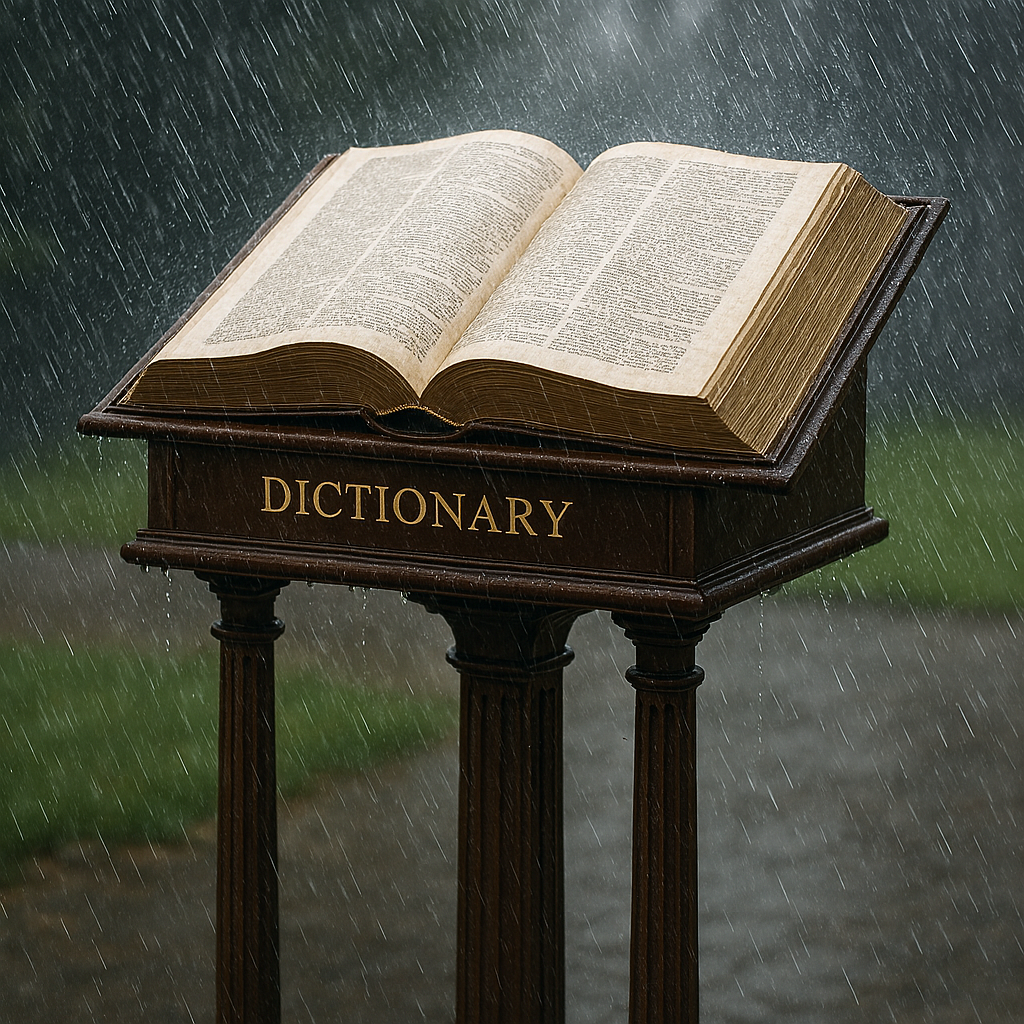
Seldom is heard a discouraging word, but we might admit our malaise after five dictionary publishers revealed their selections of the 2025 “Word of the Year.” The common theme those selections conveyed was a worrisome view of cognitive pollution in a communications world playing with new technology.
In recent weeks, companies which strive to define our expressions have made announcements describing an online culture that is anything but high-definition. Their latest, somewhat esoteric add-ons to vocabulary hint at a rise in artificiality, an inclination toward manipulation, and a retreat from precise, meaningful thought.
Here’s a checklist of what the English language is telling us:
- Merriam-Webster’s “Word of the Year” was slop. It depicts “digital content of low quality that is produced, usually in quantity, by means of artificial intelligence.” The Wall Street Journal has reported that “AI slop is everywhere.”
In other words, easily made and monetized products are grabbing our attention through absurd videos, contrived news, advertising akin to medicine shows, and misleading quotations based on fake voices and images. Our scavenger hunts for quality information, poring through a sideshow of junk, now waste more time and expand society’s “hermeneutics of suspicion.” The sense of veracity and trust we need to make decisions for our democracy and to build honorable connections is being eroded.
- Dictionary.com gave its dubious honor to the dubious word, 6-7. Spoken as “six-seven” and sometimes accompanied by a gesture of balancing two things, this slang observed widely among adolescents reflects a meme’s power to convene people emotionally without real agreement on its origin or significance.
Derived from a few celebrities and mentions in music, sports, and entertainment, 6-7 seems to be a short way to say “so-so” or “right, wrong, whatever” or the French phrase for indifference, comme ci comme ça. Some critics say it has a darker meaning, and in any case such a ritual embrace of emptiness, defined however we desire, can become the devil’s workshop.
- Oxford University Press selected the term rage bait. The Oxford English Dictionary defines it as “online content deliberately designed to elicit anger or outrage by being frustrating, provocative, or offensive, typically posted in order to increase traffic to, or engagement with, a particular web page or social media account.”
For example, a study by Clemson University found a problem with more than 400 fake AI-driven accounts on the X platform. They were spewing Trump administration talking points to agitate readers about demands for the FBI’s Epstein files, a South Carolina newspaper reported in July.
- The Cambridge Dictionary’s choice for 2025 was parasocial. This adjective describes “a connection that someone feels between themselves and a famous person they do not know, a character in a book, film, TV series, etc., or an artificial intelligence.”
The word surfaced some time ago to discuss those who express a parasocial relationship with a celebrity, perhaps as obsessive fans, called “stans.” But last year saw increased reporting on people who develop strong feelings toward a personified AI bot. This trend threatens to alienate and confuse people turning to technology for intimacy and advice.
- The Collins company, a British firm whose products include many bilingual dictionaries for translation, bestowed its annual salute to vibe coding. This term refers to “an emerging software development that turns natural language into computer code using AI .” A prominent engineer reportedly said a chatbot’s capacity for source-coding allowed him to have creative ideas and “forget that the code even exists.”
This means a developer can describe a task, and a “large language model” will build the web page, or app, etc. According to Wikipedia, without the need for precise, conventional human coders, the developer and LLM collaborate on incremental testing in order to judge the project’s success.
Fans of reality and truth in our communications media may be discouraged by this 2025 collection of words—news we can’t use, or probably won’t use. But we shouldn’t be surprised.
After all, as summed up previously in Phronesis in Pieces, other years provided more than their share of ominous or discouraging vocabulary. Recall brain rot and polarization among the honorees in 2024.
Merriam-Webster, a subsidiary of Encyclopedia Britannica, Inc., named authenticity as its 2023 selection. Its editors opined that, “with the rise of artificial intelligence”—and its impact on deepfake videos, actors’ contracts, academic honesty, and a vast number of other topics—the line between “real” and “fake” has become increasingly blurred.
The company’s Word of the Year in 2022 was gaslighting; at the time, a number of media voices had accused former president Donald Trump of that conduct. Of course, the passage of time demonstrated that, in White House politics, the game of “don’t believe your lying eyes” can be played by many participants.
The Oxford English Dictionary sent an early sign of society’s slippage from reality when, in 2016, it made the prophetic pick of post-truth. This adjective was said to describe “circumstances in which objective facts are less influential in shaping public opinion than appeals to emotion and personal belief.”
We’ll wait to see what this new year brings in terms of experiences and expressions. Dictionary publishers say various factors go into the decisions on their annual word choices, such as the frequency of search-engine inquiries, a single-year jump in inquiries or usage, or the desire to make a point about the vibes of each cultural moment.
Lexicographers, now speaking to an online audience, are poised to employ crowdsourcing, inclusivity, “relevance,” customization, and AI for rapid updating of their products. Voicing its own concerns, a September Atlantic article asked in a headline, “Is this the end of the dictionary?”
The irony of the 2025 results—the fact that more companies dedicated to spelling out truth have highlighted words approaching reality with a “comme ci comme ça” attitude—leads readers to ponder: What are the meanings embedded in our thoughts, technology, and society as 2026 begins? We can imagine complex dynamics at dictionary companies in the indefinite future.
Is the desire for publicity or longevity leading them to pick more words which make us think, and to think better or worse? Might the apparent numbing of clarified, coherent, energized, and richly human consciousness prompt the publishers to announce what amounts to subliminal cries for help?
Image by Microsoft Bing’s AI Co-Pilot designer. Happy New Year to all friends of Phronesis in Pieces and OnWord.net.


 OnWord