When Eileen and I attended a Thanksgiving prayer service at Our Lady of Victory Parish in Troy, NY, on the evening of Sunday, Nov. 23, I sampled food for thought that I’m still digesting. It was so abundant, I want to share it now.
The rabbi of a local temple led our extended assembly—members of congregations not only from Catholicism and Judaism, but also from area Episcopalian and Methodist churches—in praying Psalm 146. It begins and ends with the word “Hallelujah,” or “Praise the Lord,” and it thanks God for his trustworthy love.
In call-and-response fashion, Rabbi Robert Kasman intoned the psalm in Hebrew and invited us to sing along with choruses of hallelujahs. When he began the first passage, the notes which I had expected to sound esoteric instead rang true in my memory. The music for each chorus was particularly familiar.
Everyone repeated that sequence of hallelujahs with full voice, whether or not we knew its origin. The rabbi later explained to me that he had adapted the entire psalm as new words for “Hallelujah,” the magnum opus of Leonard Cohen (1934-2016). The song was released forty-one years ago.
After two decades of various “cover version” performances, the somberly hypnotic piece was ranked #259 on Rolling Stone magazine’s “500 Greatest Songs of All Time.” As noted in Wikipedia, “Hallelujah” also reached a new generation via the 2001 film, Shrek.
Thanks to YouTube, we can see and hear Cohen’s performance in London, with the captioned lyrics being especially useful for the analysis that follows. In addition, listen to Rabbi Kasman musical ministry, recorded live at Our Lady of Victory, starting around the 4:10 mark here.
Before Sunday’s interfaith service, I had greeted the song with mixed feelings and ignorance. But I’ve learned more from that powerful prayer meeting, plus my admittedly incomplete research.
Cohen took years to compose “Hallelujah”—including about eighty alternative verses, hyperlinks to snapshots of life. From these, several verses have been standardized for performance. Apart from his personal theological and rhetorical choices, one finds his spiritual and musical diligence in every scene.
In the first verse, he refers to David’s own psalm-writing efforts. One can imagine that, composing music on a lute of his time, called a kinnor, and using the string tones he had available, the “baffled king” sought a chord that exceeded the lute’s limitations.
Metaphorically, this “secret chord” might have been a seventh chord, comments podcaster James Hargreaves. Songwriters will tell you the sound of the seventh directs our mood upward, toward some higher resolution; it’s a ”major lift” in contrast to any “minor” chord, which takes a sad song and makes it sadder.
Now I’ve heard there was a secret chord
That David played and it pleased the Lord
But you don’t really care for music, do ya?
It goes like this: the fourth, the fifth,
The minor fall, the major lift—
The baffled king composing “Hallelujah” – Leonard Cohen
That’s my interpretation based on insights from video sages such as “the Pop Song Professor” and “Lot of Meaning,” as well as Hargreaves—and Cohen himself. The composer spoke about the significance in bits and pieces, waxing either spiritual or secular, referencing the mundane and mysterious.
He presented King David as a providentially chosen man with “issues.” This held lessons for an errant searcher like Cohen, who was troubled by our wounded world—what he called this “vale of tears.” I didn’t hear mentions of Job, but perhaps Cohen struggled similarly to understand good and bad news.
The best response was to keep praising God, or at least to display the poignancy of offering up our various exploits; the saintly and the weak, you might say, all crave a secret chord, or a “secret cord,“ to higher meaning, Hargreaves observes.
He points to the Old Testament passage telling us the bond of love between a man and woman is durable if God is the third party in the relationship: “Where one alone may be overcome, two together can resist. A three-ply cord is not easily broken.” (Ecclesiastes 4:12)
Cohen’s “Hallelujah” lyrics evoke more dissonant possibilities in the search for love. But he recognizes humanity’s hunger for that stronger cord. While Judeo-Christian thought leads Catholics and others to use “Alleluia” as a shout of unsullied glory and joy in our liturgies, Cohen’s personal approach to “Hallelujah” includes a touch of lamentation.
This important ingredient in many other psalms is described as grief, anguish, or spiritual desolation, but even those “psalms of lament” conclude with affirmations of hope in God.
That is the takeaway that nourishes my reflections on this Thanksgiving. These days, we are especially aware of the different worldviews, experiences, moods, and needs clustered around the table for a family celebration. No single snapshot of our secularized culture can inspire a Norman Rockwell portrayal of total happiness.
Of course, expressing gratitude has never been a simple matter. When President Abraham Lincoln, on Oct. 3, 1863, proclaimed a national “Day of Thanksgiving and Praise” to bring people together in the middle of the Civil War, his sermon-like text began by counting the nation’s blessings, such as “fruitful fields and healthful skies,” as well as the Union’s economic resilience.
“No human counsel hath devised, nor hath any mortal hand worked out these great things,” Lincoln said, with a segue to lamentation. “They are the gracious gifts of the Most High God, who, while dealing with us in anger for our sins, hath nevertheless remembered mercy. It has seemed to me fit and proper that they should be solemnly, reverently, and gratefully acknowledged as with one heart and one voice by the whole American people.”
Lincoln added that those giving thanks should, “with humble penitence for our national perverseness and disobedience, commend to His tender care all those who have become widows, orphans, mourners, or sufferers in the lamentable civil strife….” Americans should “fervently implore the interposition of the Almighty hand to heal the wounds of the nation, and to restore it, as soon as may be consistent with the Divine purposes, to the full enjoyment of peace, harmony, tranquility….”
Gratitude was portrayed not as merely joyous emotion, but rather as a practice, a duty, a resource for wellness, and a transformative habit of the heart.
I am now more inclined to think of Thanksgiving as an Alleluia of joy and a Hallelujah of healing.
In the spirit of Psalm 146, the Hallelujah expresses a community’s trust in the God who brings justice, who “raises up those who are bowed down,” who “protects the resident alien” and “comes to the aid of the orphan and the widow.”
In the spirit of Leonard Cohen’s sung scenarios, it helps to look at all the individuals bringing what they can to this feast, whether their message is awe-filled gratitude or painful bitterness. Many come with wounds they’ve inflicted on themselves and others. The healing must go deeper, beginning with shared trust, then extending to accompaniment on a journey that stretches far beyond this Thursday
Our world has served up an era of dissonance, alienation, and uneasiness, even hints of civil unrest. Thanksgiving has never been more important as a day to join together, to take in lots of interpretations and insights about how our loved ones, and strangers, are coping.
One major duty, as always, is to glorify God for abundant blessings. We’ll remind each other of the bonds of love still widespread in the land, even though they sometimes seem like a “secret cord.”
This awareness from many perspectives, much like the diverse revelations of love shared at Troy’s interfaith prayer service, can encourage us to go forth to share the reason for our hope. Thankfully, fellowship also helps us to “find rest”—spiritual tryptophan before the turkey—so we’re ready for the task ahead.
The second, inseparable duty, which President Lincoln voiced amid actual civil war, is to marshal an extra sense of penitence, humility, dependence, and compassion which will place us in right relationship with everyone around our collective Thanksgiving tables.
We must develop abundant ways to say, “We’re all in this together,” securing the three-ply cord that makes gratitude a gift to God, to ourselves, and to others.
The ongoing communication that results, perhaps finding meaning at the crossroads of lamentation and faith with seekers like Leonard Cohen, can shed light on our respective, imperfect hallelujahs. That might give everyone a “major lift” and even get us singing songs we know in our souls.
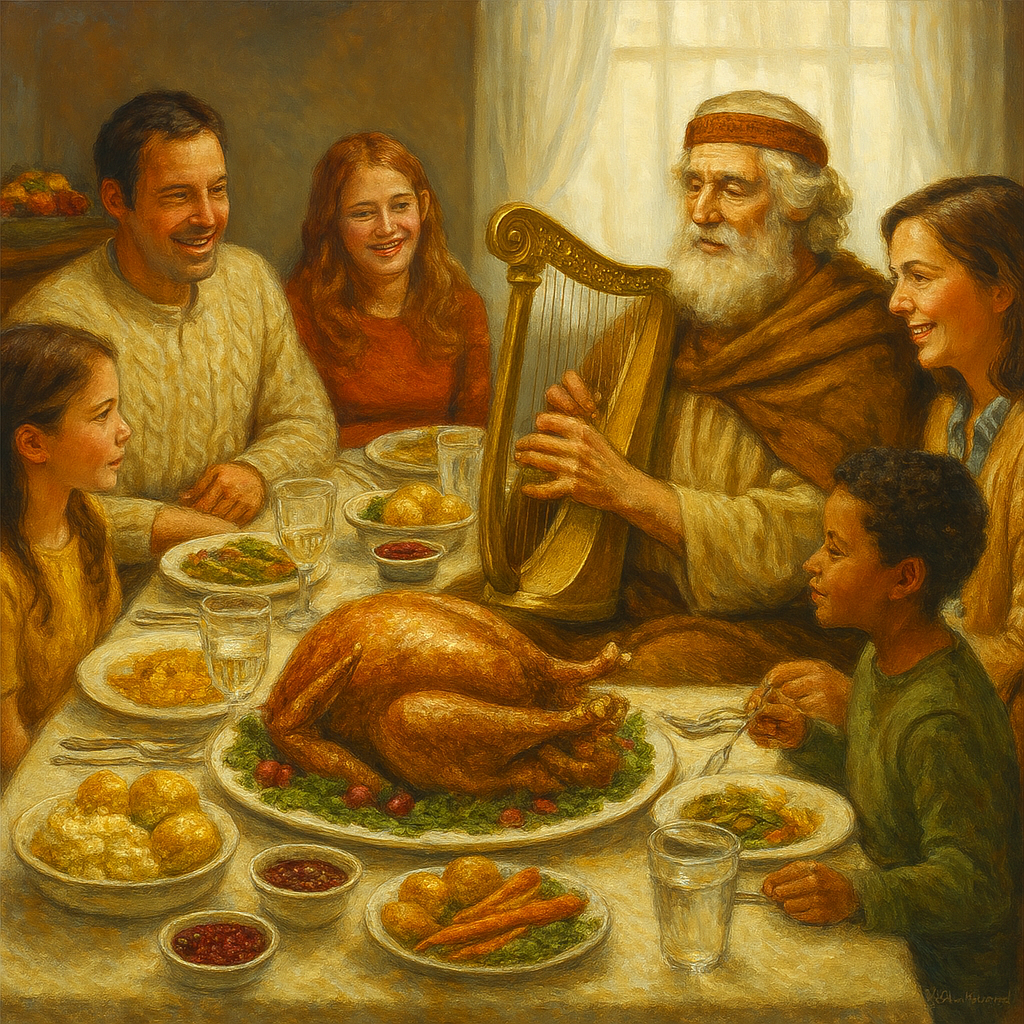
Image from Microsoft Bing’s AI Co-Pilot.
Happy Thanksgiving to all friends and readers of “Phronesis in Pieces” and OnWord.net.


 OnWord