
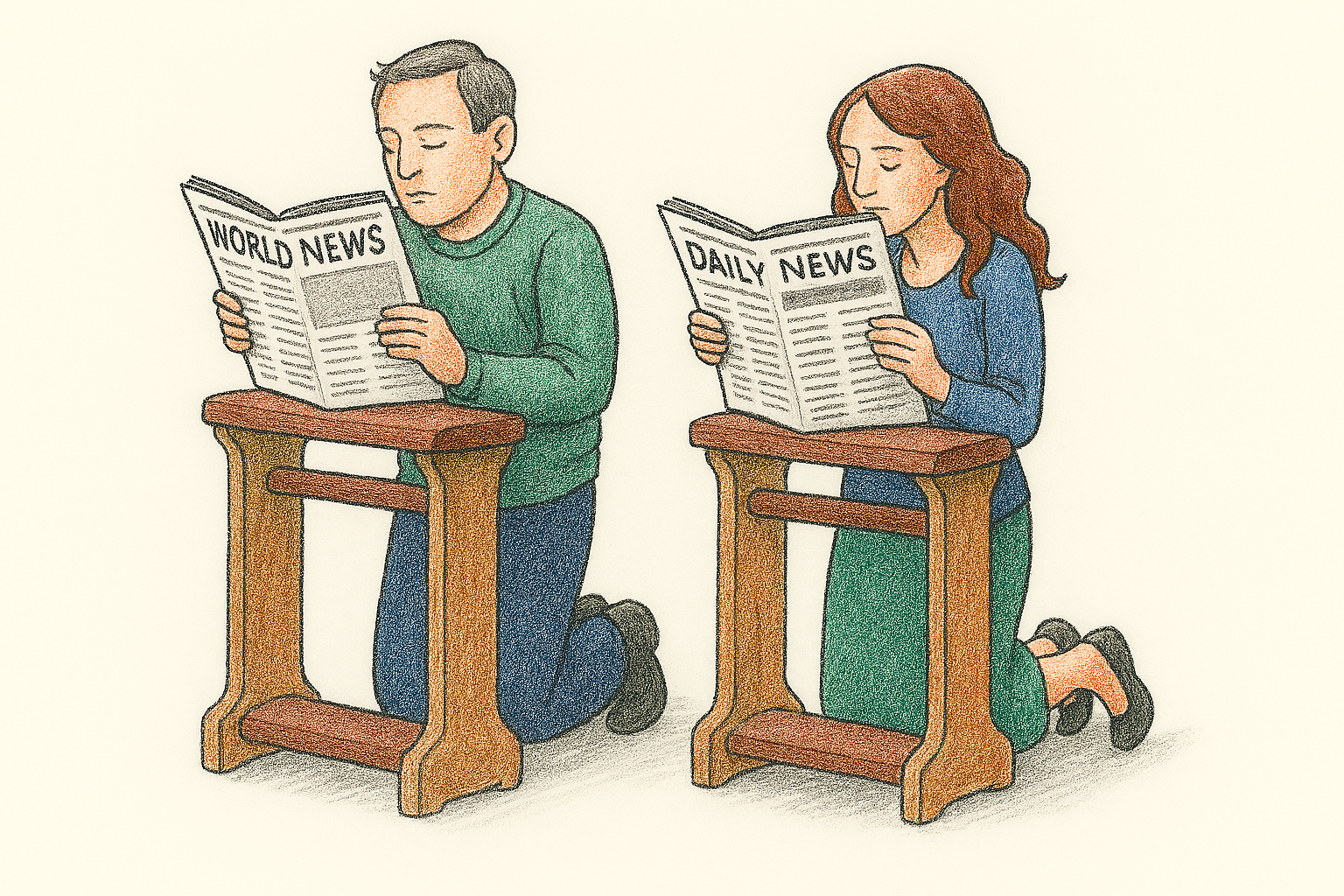
It sounds illiberal to suggest mentioning prayer in secular news coverage. After all, obituary writers frequently avoid discussing a deceased luminary’s faith practices, even his or her religion. When networks provided live coverage of the Sept. 21 memorial service for Charlie Kirk at a stadium in Arizona, they largely ignored the hours of praise and worship music before the political speeches began.
Such a separation of influence and inspiration is understandable—except when spirit is part of the story.
Coverage of People, Coverage of Prayer
On Oct. 14, USA Today posted a compelling “politics” article headlined “What is Simchat Torah? Hostage Release Transforms Jewish Holiday Forever Linked to Terror.” Jewish Americans were poised to resume their communities’ traditional celebration of “the joy of the Torah,” wrote reporter Deena Yellin.
However, any return to the holiday’s customary singing and dancing would entail “ambivalence” because of the “profound loss” suffered in the Israel-Gaza war of the past two years, she noted.
This holy day now has two meanings because the infamous Oct. 7 terrorist raid occurred on the date marked as Simchat Torah in 2023. Yellin quoted the rabbi of a New York City temple saying she would “recite the mi shebeirach, a prayer for the sick that seeks the healing of the soul and body,” to recall on Oct. 14 (the eve of Simchat Torah in 2025) that the released captives still face a long recovery period.
The newspaper’s online story included the hyperlink to the prayer.
An article in the Jewish Forward newspaper also linked to a prayer, and it added background: Although “the last 20 living hostages were returned to Israel [on Oct. 13] as part of a cease-fire deal,” many Jews still “wonder how to channel their prayers and practices toward whatever comes next. Twenty-four deceased hostages are believed to be in Gaza,” and “an enduring peace seems far away.”
The Oct. 14 Forward report went on to say, “Many Jews are relieved to be ending” certain hostage-period rituals —”even as they question whether it is right to do so….” And some changes in ritual remain, such as the additional recitation of “the Av HaRachamim [link included] memorial prayer, composed in the Middle Ages for those who perished in the Crusades.” The faithful held fast to their insistence on the deceased hostages’ return.
These newspapers referred directly to spiritual insights which gave a resonant voice to Jewish Americans’ latest encounters with the past, present, and future. The Oct. 13-15 period saw many things change, but other things did not. Patterns of prayer helped to draw readers more intimately into the bigger picture of these pivotal days.
The Charlie Kirk memorial service last month spotlighted the religious context that is often part of politics. Although the coverage excluded the segment of song, speakers who took the stage that day made many comments about the power of Christian belief and prayer in Kirk’s life. We learned that his guiding “life verse” was “Here I am, send me.” (Isaiah 6:8)
A week earlier, Erika Kirk had said on a podcast that her deceased husband’s favorite Bible verse was: “Husbands, love your wives, just as Christ loved the church and gave himself up for her.” (Ephesians 5:25) This was a poignant quotation in light of the Sept. 10 murder.
It would have been valuable to some audience members if journalists had linked to, or otherwise referenced, those quotes. One can understand their significance better given the context of surrounding verses, and the passages themselves add context to the activism that Turning Point USA will continue to promote.
Spirituality as Content and Context
Looking back, a variety of additional news stories from recent weeks could have been supplemented by inviting audiences deeper into humanity’s dialogue with God.
- On Oct. 23, King Charles III and Pope Leo XIV made history by praying together at the Vatican—an opportunity to learn more about the Church of England. Charles is the titular head of the worldwide Anglican Communion. He was accompanied in Rome by the church’s interim priestly head, Stephen Cottrell, the Archbishop of York. Cottrell is set to cede leadership to the first female Archbishop of Canterbury, who will face the rifts which have multiplied among Anglicans. Cottrell intensified one prayer-related rift in 2023 by saying the phrase “Our Father” may be patriarchal and “problematic.” The church already has two versions of the Lord’s Prayer, testifying to the traditional vs. modernist tightrope which many religions are now walking.
- On Oct. 15, The Guardian reported an unusual religious development in Brazil. “Catholicism is Reinventing Itself,” the secular British newspaper said, introducing readers to an influencer named Friar (or Frei) Gilson and the movement he is leading. Millions of Brazilians now rise daily at 4 am to watch this Carmelite priest’s livestreamed talks. Neither the Guardian article nor a previous piece in the Catholic news outlet Cruxprovided links to videos of the priest’s sermons. One recording, with captions in English, is found here; it shows us what’s on the mind of this clerical celebrity.
- On Sept. 30, newly titled War Secretary Pete Hegseth and President Trump convened generals and admirals of the U.S. miliary, outlining how they should flesh out the “warrior ethos” now touted by the Trump administration. At the controversial meeting, Hegseth, an Evangelical Christian, mentioned a prayer he found appropriate for these times—the “Commander’s Prayer.” It is now available as a Pentagon-produced video, apparently revealing the attributes desired by Hegseth. References to this video were AWOL in most news coverage, but you can watch it here.
- On Aug. 27, a shooter at Annunciation Parish in Minneapolis killed two schoolchildren and injured seventeen who were praying during a Mass to start their new year of studies. In the aftermath, parishioners turned to God and to each other for support in profound ways. What did the church community’s spiritual struggle look like? A video of the pastor’s homily, presented on the Sunday after the tragedy, apparently was not noticed in the media. But its availability on YouTube offers an entry point for empathy.
In this age of “hyper-novelty” and “liquid modernity,” current affairs move so quickly that journalists discard paragraphs which seem off-topic or fail to warrant clickbait.
That means the public is too often deprived of meaningful details, such as a deeper moral or spiritual dimension inherent in the coverage. The complexity of world-changing developments, some of which seem downright apocalyptic, is downplayed, and anxiety is increased. News consumers leapfrog over their natural impulse, indeed their duty, to learn more (and care more) about the hopes and fears through which facts energize souls.
Conscience is King
Pope Leo XIV, in an Oct. 9 address, told global news executive that today’s current events “call for particular discernment and responsibility” among them and their audiences. “The media has a crucial role in forming consciences and helping critical thinking.”
When verbal or visual narratives point us to online spiritual treasures—or reporters incorporate actual interviews and personal encounters with prayerful pilgrims—we gain confidence to pursue our own communication with God and our neighbors. Some of us are nudged into public discussions or social action, others respond with further research or quiet discernment. Either choice is better than skimming over important news and becoming cynical or indifferent spectators.
Journalists should always endeavor to open their lens wider, to give us “all the news that’s fit to print” so their stories leave us better grounded in reality. If the wider aperture reveals connections to faith, the media should neither proselytize nor pooh-pooh the religious angle. That angle is a valid part of the information smorgasbord at which thoughtful people can pick and choose.
Catholic evangelist Bishop Robert Barron, in a recent video, bemoaned some people’s knee-jerk condemnation of the phrase “thoughts and prayers” as a hypocritical substitute for action. Offering prayers in response to hard times has never been an empty gesture, he said. “We’re the first [generation] ever to hold this view.”
Throughout history, people have believed that God is a loving force in our lives. Refusing to call on God in our storm-tossed boats is both counterintuitive and risky. Our preference to “go it alone” without navigational aid results in wrong or wasted efforts. Adding prayer to our problem-solving, according to Barron, can make us instruments for God’s work, conform our intentions to a higher good, and plug us into a source of power.
Making Faith a Regular Feature
In light of these spiritual advantages, we conscientiously should revive habits and structures of communication which seek out “the rest of the story.”
Let’s admit that media’s environment of immediacy leaves little time or space for journalists to dwell upon intangibles when news is breaking.
Instead, here’s a plan. Organizations that want to tell stories more fully should designate certain feature-writers, columnists, and video producers as their mavens of meaning. Let this cadre react promptly to daily headlines, exploring how faith and reason will enlighten society’s responses as facts keep flowing.
Thank God for journalistic “old souls” who are hungry for truth and moral clarity, whose commentaries can rise to the status of heroic adventures—order vs. chaos, sacrifice vs. selfishness, substance vs. fakery from artificial intelligence.
Their “beat” shall be civilization, culture, civics, and practical virtue (Aristotle’s “phronesis”), seen through disciplines of the humanities and liberal arts. Their bias shall not be toward any one religion or ideology, but toward the common good of humanity. In a democracy, their goal shall be to help the citizenry flourish as dignified problem-solvers with rights and responsibilities.
Their reportorial tools of the trade shall include not only online access to repositories of knowledge from the past and present, but also a love for grass-roots wisdom among diverse people with all sorts of backgrounds and experiences. The “newsmakers” they pursue shall range from professors who write books to the marginalized who seek justice.
Our grand plan for media renewal will place some of these meaning-mavens in secular agencies with big budgets. But the religious press must step up, too. Let us pray that the young people we’re describing will take positions in diocesan and sectarian news outlets, as well as podcasts, blogs, and social media or websites. Let’s also pray that budgets and mission statements will allow them to be hired.
The public square of the future will need these “sherpas” who know the terrain of the soul. Think of them as human hyperlinks to specific traditions and traits which will facilitate valuable conversations, as well as communities and families committed to the really real.
From the Catholic perspective, renowned author G.K. Chesterton wrote that joining his religion “is not to leave off thinking, but to learn how to think.” With such competence, the “elevated journalism” we envision will shun “hot takes” and AI “slop” as anathema.
Behold, I Am Doing a ‘News’ Thing (Isaiah 43:19)
No one is saying that a heightened understanding of the spiritual in our stories will always give us more fruitful faith, or that all prayer-adjacent news deserves coverage and meditation, or that all newsmakers drawing attention to the spiritual plane will be sagacious saints. Ultimately, prudent media consumers will determine the success of the blueprint for “good news” which we have sketched above.
We must “pray without ceasing.” This Biblical mandate suggests we abide always at a transcendent level of critical thinking.
A realigned media, joined with the realigned tastes of news audiences, will help to build avenues of awareness where everything is connected to everything else. Big-picture communication frequently has a prayerful humility at its core.
As the firehose of portentous news immerses us, religious media and faithful professionals in the secular media will enable our short-attention society to “read between the lines.” Looking more closely at life, our fascination with sensational headlines will link up with the tangible context of everyday life. This often takes the form of prayers to be shared; they are found among people celebrating their identity on holy days, crowds seeking solace from sermons and blessings, and communities building camaraderie.
Content producers and consumers should keep our culture’s Judeo-Christian inspiration accessible on our screens, lest today’s secular chaos of change render us isolated and mute. As the great communicator, God will remind us that his influence and the human soul are always in the news. If we welcome a holy spirit into our information and formation, we will see it in every story worth telling.
Image by Bing Co-Pilot. We note that AI has reversed the kneelers’ orientation; the humans are on the ground.


 OnWord