
Here are highlights from Pope Leo’s Oct. 9 address in Rome to a conference of Minds International, a non-profit organization of news agency executives collaborating on new-media businesses. Minds International says it was founded in 2007 to support digital development in the media industry.
Excerpts, with some added emphases, follow:
- Today’s current events “call for particular discernment and responsibility, and it is clear that the media has a crucial role in forming consciences and helping critical thinking.”
- Along with a “period of crisis” in the news media, consumers of news “are also in crisis, often mistaking the false for the true, and the authentic for the artificial.”
- “Yet, no one today can say, ‘I did not know.’ That is why I want to encourage you … and recommend opportunities for collaboration.”
- “Information is a public good that we should all protect.” He urged “partnership between citizens and journalists in the service of ethical and civic responsibility.” A “virtuous circle” emerges when citizens value and support media which “demonstrate seriousness and true freedom.”
- We owe much to journalists who take the risks of covering “widespread and violent conflicts” and to countless people “who work to ensure that information is not manipulated for ends that are contrary to truth and human dignity.” Leo said of the correspondents, “We must not forget them!”
- He reaffirmed his earlier appeal for the release of journalists who have been “unjustly persecuted and imprisoned.” Their right to cover the news “must be protected.” … We must “defend and guarantee” people’s “free access to information.”
- He also reaffirmed Pope Francis from his address to participants in the Jubilee of Communication on January 25, 2025, and he added: “Communication must be freed from the misguided thinking that corrupts it, from unfair competition, and from the degrading practice of so-called clickbait.”
- The media need “principles” that allow both a company to sustain itself and the “protection of the right to accurate and balanced information.” The fast pace of news coverage requires “competence, courage, and a sense of ethics”—as an antidote to proliferation of “junk information.”
- “We are destined to live in a world where truth is no longer distinguishable from fiction.” Algorithms play a huge part in content, “but who controls them?” Artificial intelligence is changing “the way we receive information,” but “who directs it and for what purposes?”
- “We must be vigilant in order to ensure that technology does not replace human beings, and the information and algorithms that govern it today are not in the hands of a few.”
- The need for free and objective information recalls Hannah Arendt’s warning that: “the ideal subject of totalitarian rule is not the convinced Nazi or the convinced Communist, but people for whom the distinction between fact and fiction and the distinction between true and false no longer exist.” Arendt (1906-1975), a historian, philosopher, and political theorist, wrote this in The Origins of Totalitarianism.
- Leo told the association that “you can act as a barrier against those who, through the ancient art of lying, seek to create divisions in order to rule by dividing.” He continued, “You can also be a bulwark of civility against the quicksand of approximation and post-truth.”
- “The communications sector cannot and must not separate its work from the sharing of truth. Transparency of sources and ownership, accountability, quality, and objectivity are the keys to restoring the role of citizens as protagonists in the system, convincing them to demand information worthy of the name.”
- “I urge you, never sell out your authority!”
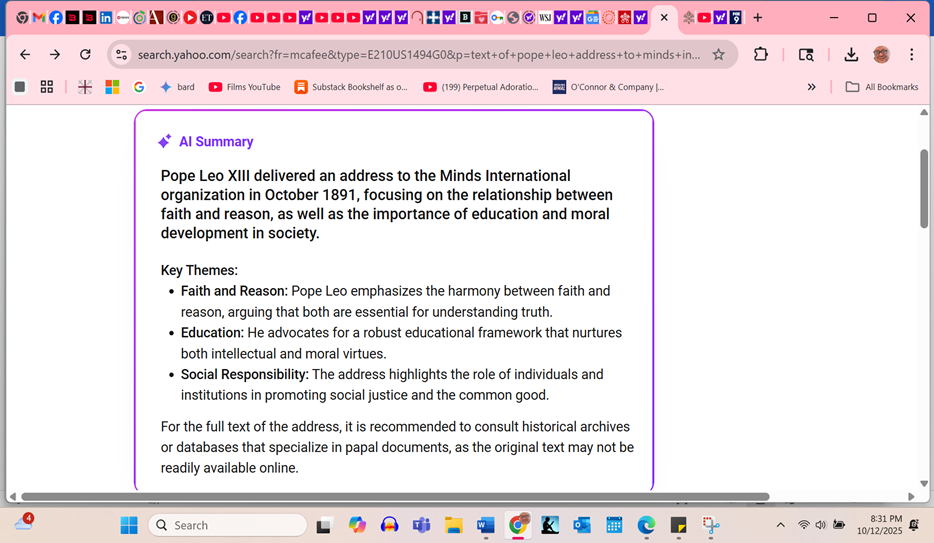
(Editor’s note: When I searched for information on the Minds International address by “Pope Leo,” the AI’s response served up a reminder of the need to pursue greater accuracy in the knowledge it provides. Google AI focused on Pope Leo XIII, not Pope Leo XIV, primarily describing the former Pope’s work, making additional errors, and leaving out the current pope’s concerns about challenges like AI. My AI guide said:
“Pope Leo XIII delivered an address to the Minds International organization in October 1891, focusing on the relationship between faith and reason, as well as the importance of education and moral development in society.”)


 OnWord